

PMS Bazaar recently organised a webinar titled “Listed vs PRE-IPO: Two Markets, One Goal — Finding Alpha,” which featured Mr. Radha Raman Agarwal, MD & CEO, Swyom Advisors Limited.
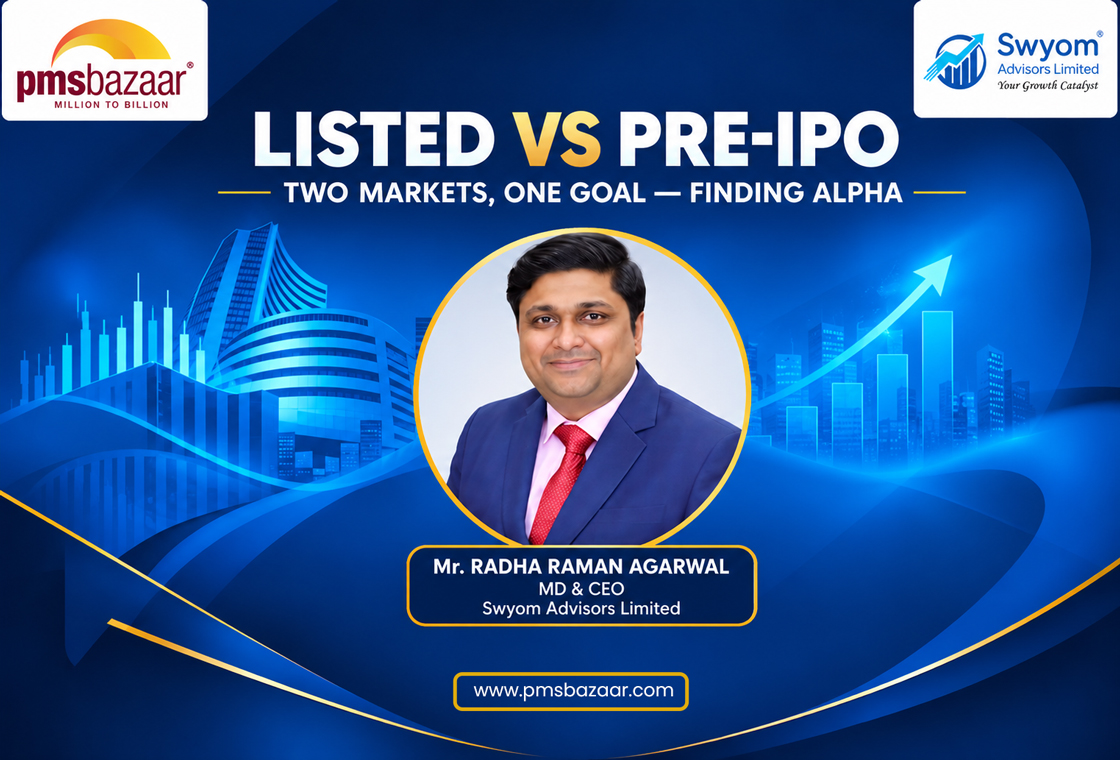
This blog covers the important points shared in this insightful webinar.
Key aspects covered in this webinar blog are
- The Evolving Equity Landscape and the Rise of Alternatives
- The Three-Pillar Strategy: Orchestrating Listed, Unlisted, and Corporate Actions
- Mitigating Risk Through Rigorous Due Diligence
- Listing as a Landmark, Not an Exit Strategy
- Defining the Pre-IPO Investment Horizon
- Interpreting Data Beyond the Surface in an AI Era
- Decoding Post-IPO Portfolio Dynamics
- The 70-30 Allocation Framework: Balancing Growth and Liquidity
- Risk Mitigation, Hedging, and Downside Protection
Summary: As the investment landscape undergoes rapid transformation, traditional models of asset allocation are facing a paradigm shift. Recently, during an exclusive investor webinar, fund manager Mr. Radha Raman Agarwal shared profound insights into how modern portfolios can transcend conventional boundaries to generate alpha. Addressing an audience eager to understand the nuances of wealth creation in a volatile economic climate, he outlined a comprehensive 360-degree strategy that synchronizes listed equities, pre-IPO opportunities, and corporate actions.
The Evolving Equity Landscape and the Rise of Alternatives
Opening the session with festive greetings for Navratri, Mr. Agarwal noted that the traditional investment model—equities for growth, fixed income for stability, and gold for diversification—no longer suffices in isolation. Today's investors operate in a volatile, uncertain, complex, and ambiguous (VUCA) world. To consistently outperform benchmarks like the Nifty 500, fund managers must look beyond historical data and standard public market transactions.
Alternative Investment Funds (AIFs) have witnessed stupendous growth in India, with total commitments soaring significantly and projections estimating the sector to reach massive milestones by 2030. This expansion reflects a growing investor appetite for sophisticated alternative products that offer higher risk-adjusted return potential.
The Three-Pillar Strategy: Orchestrating Listed, Unlisted, and Corporate Actions
To successfully navigate this changing landscape, Mr. Agarwal explained that his firm employs a harmonized, multi-pronged approach that functions like a well-coordinated orchestra:
- The Unlisted Space (Pre-IPO): Spotting companies early in their lifecycle is where substantial wealth is generated. However, investing in unlisted entities requires rigorous due diligence, as data availability is limited and regulatory oversight differs from public markets. Mr. Agarwal emphasized that high governance standards must outweigh short-term valuation temptations.
- Listed Equities: Once an unlisted company transitions through an Initial Public Offering (IPO), it enters the core public portfolio. An IPO is merely a landmark in a company's journey—providing capital, visibility, and a new set of institutional investors—rather than an end goal. Long-term wealth creation relies on sticking with fundamentally strong businesses through economic cycles.
- Corporate Actions: Strategic catalysts such as mergers, demergers, QIPs, preferential allotments, anchor allocations, and open offers play a critical role in unlocking hidden value. By restructuring inefficient business segments or combining complementary entities, significant structural efficiencies are realized.
Mitigating Risk Through Rigorous Due Diligence
Addressing the allure of pre-IPO investments, Mr. Agarwal cautioned that while unlisted assets offer attractive entry valuations relative to listed peers, they carry heightened risks. Individual investors face limitations in conducting deep enterprise due diligence. Therefore, a professional institutional framework—comprising chartered accountants, valuers, legal advisors, and sector experts—is vital to ensure that chosen companies are genuinely investment-grade and governed with integrity.
Furthermore, he stressed the importance of maintaining a balanced portfolio allocation between liquid listed holdings and illiquid unlisted commitments, ensuring that overall portfolio risk aligns with individual investor risk appetites.
Listing as a Landmark, Not an Exit Strategy
Opening the discussion, the moderator raised a fundamental query that haunts many pre-IPO investors: does an initial public offering (IPO) signal an immediate opportunity to cash out, or does it mark the threshold of a far greater growth trajectory?
Mr. Agarwal reiterated that an IPO serves as a structural milestone in a firm’s evolution rather than its ultimate destination. A listing certainly brings liquidity, capital, enhanced visibility, and a broader institutional shareholder base, but the decision to retain or divest a position is made strictly on the listing date based on underlying fundamentals. If a company maintains robust earning visibility, strong corporate governance, and expanding operational prospects, the fund chooses to remain invested for the long term. Conversely, if management shifts focus, strategic execution falters, or performance metrics diverge from expectations, an exit is executed. Divestment is never driven by short-term listing flips or lock-in expiration dates, but by rigorous ongoing evaluation of future return potential.
Defining the Pre-IPO Investment Horizon
Addressing an audience query regarding typical investment timeframes, Mr. Agarwal outlined the fund’s structural holding period for pre-listing assets. The vast majority of pre-IPO allocations operate within a 12 to 36-month timeline leading up to an exchange listing.
A smaller segment—approximately 10% to 15% of the unlisted portfolio—is structured around a slightly extended horizon of three to four years. These longer-term holdings allow the fund to capture fundamental value creation prior to executing an exit through either private equity transactions or a public market debut. This disciplined horizon balances the patience required for pre-IPO value realization with the liquidity requirements of institutional portfolios.
Interpreting Data Beyond the Surface in an AI Era
The conversation then turned to the shifting efficiency of private equity markets. With corporate data now widely accessible via search engines and generative AI tools, the moderator questioned whether the traditional pre-IPO information advantage has vanished.
Mr. Agarwal observed that while raw data availability and automated financial analytics have democratized basic information, raw metrics represent only 10% of the true investment picture. The remaining 90% of value creation resides behind the numbers—uncovered through direct management engagements, operational site visits, thorough channel checks, and institutional due diligence (DD). In private markets, surface-level financial statements can obscure underlying realities. Consequently, the real competitive edge no longer lies in obtaining data, but in interpreting subtle operational nuances and evaluating management integrity through a structured institutional approach.
Decoding Post-IPO Portfolio Dynamics
Clarifying a technical question regarding post-IPO fund management, Mr. Agarwal elaborated on how Alternative Investment Funds (AIFs) navigate the transition of holdings from private to public markets.
The strategy focuses on managing the entire corporate lifecycle rather than viewing private and public holdings as isolated buckets. Once an unlisted company completes its public listing, the fund manager faces a clear choice: retain the equity within the core public portfolio or liquidate the position in the open market.
By choosing to hold high-conviction companies post-listing, the fund continues to participate in the enterprise's long-term compounding journey, ensuring that initial early-stage research continues to deliver sustained alpha well into the company's public existence.
Continuing the deep dive into modern portfolio management, Mr. Agarwal shifted toward the practical mechanics of asset allocation, risk management, and the philosophy of "skin in the game." Addressing granular queries from participants, Mr. Agarwal detailed how his fund maintains liquidity while capturing upside across the entire corporate lifecycle.
The 70-30 Allocation Framework: Balancing Growth and Liquidity
A central topic of discussion among investors is how the fund manages allocation between listed and unlisted assets. Mr. Agarwal explained that the portfolio operates on a disciplined 70-30 asset allocation model, where up to 70% is allocated to listed equities and a maximum of 30% is dedicated to unlisted (pre-IPO) opportunities.
While legal frameworks permit a higher threshold, the fund maintains an internal cap of 30% for unlisted assets to ensure rigorous risk management and uncompromised liquidity. Because successful pre-IPO investments eventually transition into the public market following an IPO, this percentage naturally fluctuates (often hovering around 20% to 22%). This fluid dynamic allows the fund to continuously offer full liquidity to its clients while maintaining exposure to high-growth private opportunities. Furthermore, the selection of unlisted companies that enjoy active secondary trading within India's unlisted ecosystem ensures smooth marketability and robust capital access.
Shifting Investor Paradigms: From Short-Term Flipping to Compounding
Addressing whether IPO listing pops continue to drive investor behavior, Mr. Agarwal highlighted a distinct maturation in the Indian investor base. While retail participants historically sought quick listing gains (flipping), Alternative Investment Fund (AIF) investors increasingly embrace patient capital and long-term compounding.
Investors are recognizing that true multi-bagger returns are forged through patience rather than short-term trading. Wealth compounds exponentially when investors stick with fundamentally sound businesses through economic cycles. Mr. Agarwal emphasized that an exit strategy should never rely on calendar dates or lock-in expiration; rather, if a company's fundamental thesis or management execution falters—even resulting in a loss—an exit must be executed decisively to protect capital.
Sweet-Spot Investing: The Pre-IPO Growth Phase
Clarifying the fund's investment horizon, Mr. Agarwal reiterated that the strategy strictly avoids early-stage venture capital (VC) investing. Instead, the fund positions itself as a growth catalyst, targeting the "sweet spot" of 12 to 36 months (up to 3 years) prior to an anticipated IPO.
At this stage, companies are already profitable (PAT-positive), possess established operational moats, and require growth capital to scale rapidly before public market funds arrive. By stepping in when promoters' personal capital is fully utilized, the fund captures high-conviction growth while maintaining a 100% success ratio across its listed exits to date.
Risk Mitigation, Hedging, and Downside Protection
Responding to inquiries about the fund's long-short categorization and potential vulnerability to private valuation markdowns, Mr. Agarwal provided reassuring structural details:
- Listed Dominance: Approximately 80% of portfolio returns originate from the listed space, ensuring that private market markdowns carry minimal systemic impact.
- Rigorous Valuation Standards: Unlisted asset valuations are strictly monitored by SEBI-registered independent valuers, compliant with custodians and RTAs (like Nuvama and KFintech).
- Tactical Hedging: To navigate macroeconomic volatility (such as geopolitical tensions, tariff changes, or budget disruptions), the fund utilizes index options (buying puts) to maintain a 25% to 30% hedge on the portfolio, strictly prioritizing capital preservation.
Decoding Corporate Actions: Demergers and Strategic Catalysts
Moving into corporate actions, Mr. Agarwal explained how to separate headline noise from genuine value creation. Taking the example of conglomerates housing disparate businesses (such as chemicals, pharmaceuticals, and spirits) under one roof, he noted that composite valuations often suffer from multiple compression because investors prefer pure-play exposure.
When a strategic demerger occurs, individual management teams regain sharp focus, and the market can accurately value each independent entity. However, he cautioned that demergers are not universally value-accretive; investors must evaluate whether the restructuring is driven by growth ambitions, statutory compliance, or the separation of loss-making divisions. Similarly, corporate actions like preferential allotments and QIPs require a deep look into the end-use of funds and promoter participation.
Skin in the Game: Alignment of Interest
Concluding the session on a personal note, Mr. Agarwal addressed the significance of a fund manager's personal capital deployment. Noting that he stands as the single largest investor in his own fund—significantly exceeding statutory SEBI requirements—he emphasized that true alignment of interest transforms decision-making. When a fund manager's personal wealth rides alongside investor capital, the commitment to rigorous due diligence, long-term governance, and capital protection becomes absolute.
Mr. Agarwal covered all the topics mentioned above in-depth and answered questions from the audience toward the end of the session. For more such insights on this webinar, watch the recording of this insightful session through the appended link below.
Get access to rich data and analytics of PMS & AIF by subscribing to us. Join the 100000+ investors & experts: Subscribe NOW
Recent Blogs
Decoding Performing Credit with Vaibhav Porwal
“We commit ₹50 crore or more to each underlying fund as an institutional anchor, which gives us deal-level data room access that an individual investor might not have.”

SIFs Explained: Can Sundaram Select SIF Unlock Opportunities Beyond the Top 100 Stocks
PMS Bazaar recently organised a webinar titled “SIFs Explained: Can Sundaram Select SIF Unlock Opportunities Beyond the Top 100 Stocks Webinar,” which featured Mr. Madanagopal Ramu, Fund Manager, Equity, Sundaram Mutual.

India's Next Decade of Equities: The Changing Engines of Growth
As India's economy evolves and capital becomes more selective, investors may need to rethink where future market leaders emerge from.

Active PMS Strategies Navigate a Turbulent H1 FY27
Six months. Heightened geopolitical tensions. Persistent inflationary pressures.

Is Large-Cap Alpha Changing? What Does It Mean for Investors
PMS Bazaar recently organised a webinar titled “Is Large-Cap Alpha Changing? What Does It Mean for Investors,” which featured Mr. Naveen Chandramohan, Founder and Fund Manager, ITUS Capital. This blog covers the important points shared in this insightful webinar.

PMS Performance : 401 Equity PMS Beat the Nifty 50 TRI
September 2026 saw global markets grapple with persistent macroeconomic uncertainty, as rising U.S. bond yields, crude oil prices above $90 per barrel and escalating Middle East tensions kept investors on edge. Concerns over renewed inflationary pressures and tighter financial conditions continued to shape market sentiment. The reported 25-basis-point Federal Reserve rate hike, bringing rates to 3.75–4.00 per cent, added another dimension to the evolving global outlook.

When Market Direction Is Uncertain, Can Arbitrage Add Stability to Client's Portfolio?
PMS Bazaar recently organised a webinar titled “When Market Direction Is Uncertain, Can Arbitrage Add Stability to Client's Portfolio?” which featured Mr. Sandeep Tyagi, Founder & Chairman, Estee Advisors and Mr. Shubham Goyal, Director, Strategy, (Principal Officer and Fund Manager - I-Alpha), Estee Advisors Pvt. Limited. This blog covers the important points shared in this insightful webinar.

MF-PMS: Is This the Next Big Wealth Management Opportunity
PMS Bazaar recently organised a webinar titled “MF-PMS: Is This the Next Big Wealth Management Opportunity,” which featured Mr. Sandeep Jethwani, Co-Founder, Dezerv & Vice Chairman, APMI.