

Continuing our efforts to provide new financial insights, we hosted the first episode of an Exclusive AIF Knowledge Series a few days back. This new initiative from PMS Bazaar and Emkay Investment Managers 'Spotting Emerging Stars: The Emkay Way'. The insights were shared by Sachin Shah and Kashyap Javeri, fund managers at Emkay Investment Managers.

Emkay Emerging Stars Fund is a Category III Alternative Investment Fund (AIF) seeking to generate long-term capital appreciation for investors from a portfolio of equity and equity-related securities. Emkay has recently launched the fourth series of Emkay Emerging Stars. With the aim to make investors understand Emkay Investment Managers’ investment philosophy, stock picking rationale and the thinking that drive investments, Sachin and Kashyap spent over an hour discussing these subjects during the special webinar.
About guests, Hexagon approach
Sachin is a seasoned fund manager with over two decades of experience in the Indian equity markets. Kashyap Javeri is a fund manager with more than a decade of experience in company and sector research.
The Emkay investing philosophy follows a ‘Hexagon Approach’. They believe that to start with, avoiding mistakes is very important. This means avoiding unscrupulous promoters/managements, businesses getting irrelevant, highly leveraged companies and euphoric valuations.
"Mr. Warren Buffett says that rule number one is to not lose money. Rule number two is to not forget rule number one, which is where we talk about avoiding mistakes. So that is our crystal clear focus," says Sachin.
Next comes the long term investing approach i.e. buy to hold. This is practiced with a low churn of portfolio & remaining patient before and after investing. "We are very clear that we want to invest with a perspective to own the businesses for at least three to five years; the longer, the better.
Third in the Emkay Hexagon Approach comes the aspect of building a focused portfolio with allocation discipline to avoid concentration risk.
The fourth aspect is about doing your own homework. It encourages research-backed and process oriented investments. Next comes the focus on compounding, which Sachin believes is the name of the game as it enables creation of sustainable wealth. He says that the fun of investing in equities is all about the game of compounding. “As Albert Einstein famously said – compounding is the eighth wonder of the world," added Sachin.
Last but not the least is conviction. The focus here is absolute returns and high emphasis is placed on purchase price. "For us to own businesses for a longer period of time, it's very important that we build a lot of conviction and also that we have a lot of patience once we have done our own research and homework. These are very, very important things" says Sachin.
Divis, Laurus, VRL and Zomato
Emkay Investment Managers experts also shared their insights on some great companies.
Divis has been an investment for Emkay for over seven years. It has been a great compounder. Actually, a deeper study of Divis led to discovering value in Laurus. "About three years back Divis was a part of our large cap and multi cap portfolios. When we launched our first small cap fund, and were evaluating which investments we needed to make, Divis emerged as one of the better performing businesses. And this was in contrast to a lot of other pharma companies. So, when we looked at Divis more closely, we realised that the API businesses and the custom synthesis businesses were doing quite well. So we asked ourselves if we should look at a few more companies in similar space, and that's when we identified Laurus labs," shares Sachin.
The Mahindra Holidays stock was identified right at the IPO stage. At the time when Mahindra Holidays came up with their IPO, it was a very unconventional business model if one were to consider the hotel or the hospitality industry. A very conventional hospitality business model for a hotel involves a very large capex, followed by a wait for the inventory to be occupied. These conventional businesses would wait for higher occupancies and for a demand-supply mismatch to get higher Average Room Rate. The business also is exposed to high cyclicality. "But when Mahindra Holidays came up with an IPO, it was pretty evident that the business model is very different, since they didn’t have any capex on their books or likely a large part of their capex was getting funded by the customers. So it was a very new business model, and although we may not have invested in it, at that point of time in 2009, for multiple reasons, it always remained on our radar because it was an interesting business model which we felt was very good for the equity shareholders," the experts said.
Another example is VRL Logistics. Logistics as an industry is highly fragmented, which is where VRL as a company has created a business model, that is technology-savvy and very disciplined in terms of delivery to the customers.
Talking about Zomato, Sachin said that it has disrupted the way food is delivered and the way people eat. "I think it's an amazing disruption. They identified a big problem that a lot of people faced, and then they came back with a great solution. So, this is another business which will stay on our radar," he noted.
E-Qual framework
Emkay prides itself on its proprietary model E-Qual, a first-of-its-kind evaluation framework in the country for quantifying and thereby objectively evaluating the governance aspect of management quality.
Under the E-Qual module, companies are scored on aspects like management’s integrity and capability, wealth distribution, investor communication, and liquidity so that companies with accountability issues, ethical violations, conflict of interest and other corporate governance issues are systematically excluded from the portfolios.
The robust E-Qual module brings in purchase price discipline so that fund managers buy with a margin of safety and avoid timing the market. "In the last two years, this module has helped us avoid more than 100 companies that have eventually blown-up, due to management and governance issues," the experts revealed.
Questions and answers
A query was put forth on ageing management and management bench strength in portfolio companies and how Emkay viewed this factor.
"After management delivers, in the next few meetings we focus a lot on how transition will happen. We often see that the key promoter age range is 45 to 65 years. So, we are always trying to find out how professional or institutionalised the management is. But there are certain businesses that will be entrepreneur-driven and we would like to ride their growth but at the same time keep our eyes wide open on the transition," Sachin remarked.
Responding to a question on the differences between an AIF and a PMS, the Emkay experts shed light on how in case of AIF, the sponsor has to have substantial skin in the game and the entire construct of an AIF is like that of private equity, with a specific tenure and mandate.
One of the queries was directed towards the misses of Emkay Investment Managers. Discussing them openly, Sachin talked about a time when the portfolio manager had invested in a business that made generators for captive power plants. The company could not deliver due to external and internal factors. Entry valuation was also not right. The fund managers realized that the business did not have tailwind and the capex cycle had not revived in India in the last few years. Though the company went to focus on export markets, the stock price was beaten down badly and eventually Emkay exited the business. Kashyap Javeri talked about Inox Leisure and how Covid-19 made the business difficult to operate leading to Emkay exiting it 12-14 months ago. "More than an internal issue, it was an exogenous factor - Covid, which hit our investment case for Inox Leisure," Kashyap said.
If you missed the opportunity to listen to the Emkay experts directly, you can relive the entire session through the appended link below:
For more information, please contact info@pmsbazaar.com
Recent Blogs
PMS Performance : 401 Equity PMS Beat the Nifty 50 TRI
September 2026 saw global markets grapple with persistent macroeconomic uncertainty, as rising U.S. bond yields, crude oil prices above $90 per barrel and escalating Middle East tensions kept investors on edge. Concerns over renewed inflationary pressures and tighter financial conditions continued to shape market sentiment. The reported 25-basis-point Federal Reserve rate hike, bringing rates to 3.75–4.00 per cent, added another dimension to the evolving global outlook.
When Market Direction Is Uncertain, Can Arbitrage Add Stability to Client's Portfolio?
PMS Bazaar recently organised a webinar titled “When Market Direction Is Uncertain, Can Arbitrage Add Stability to Client's Portfolio?” which featured Mr. Sandeep Tyagi, Founder & Chairman, Estee Advisors and Mr. Shubham Goyal, Director, Strategy, (Principal Officer and Fund Manager - I-Alpha), Estee Advisors Pvt. Limited. This blog covers the important points shared in this insightful webinar.
MF-PMS: Is This the Next Big Wealth Management Opportunity
PMS Bazaar recently organised a webinar titled “MF-PMS: Is This the Next Big Wealth Management Opportunity,” which featured Mr. Sandeep Jethwani, Co-Founder, Dezerv & Vice Chairman, APMI.
PMS Performance: Over 94% of Tracked Strategies Beat Nifty 50 TRI
Global markets remained under pressure in August 2026 as geopolitical tensions, rising bond yields and elevated crude oil prices kept investors cautious.

The Next Alpha Cycle: How Should Investors Position ‘Alternatives’ in Their Portfolios?
PMS Bazaar recently organized a webinar titled “The Next Alpha Cycle: How Should Investors Position ‘Alternatives’ in Their Portfolios,” which featured Mr. Akhil Chaturvedi, ED & CBO, Motilal Oswal AMC. This blog covers the important points shared in this insightful webinar.
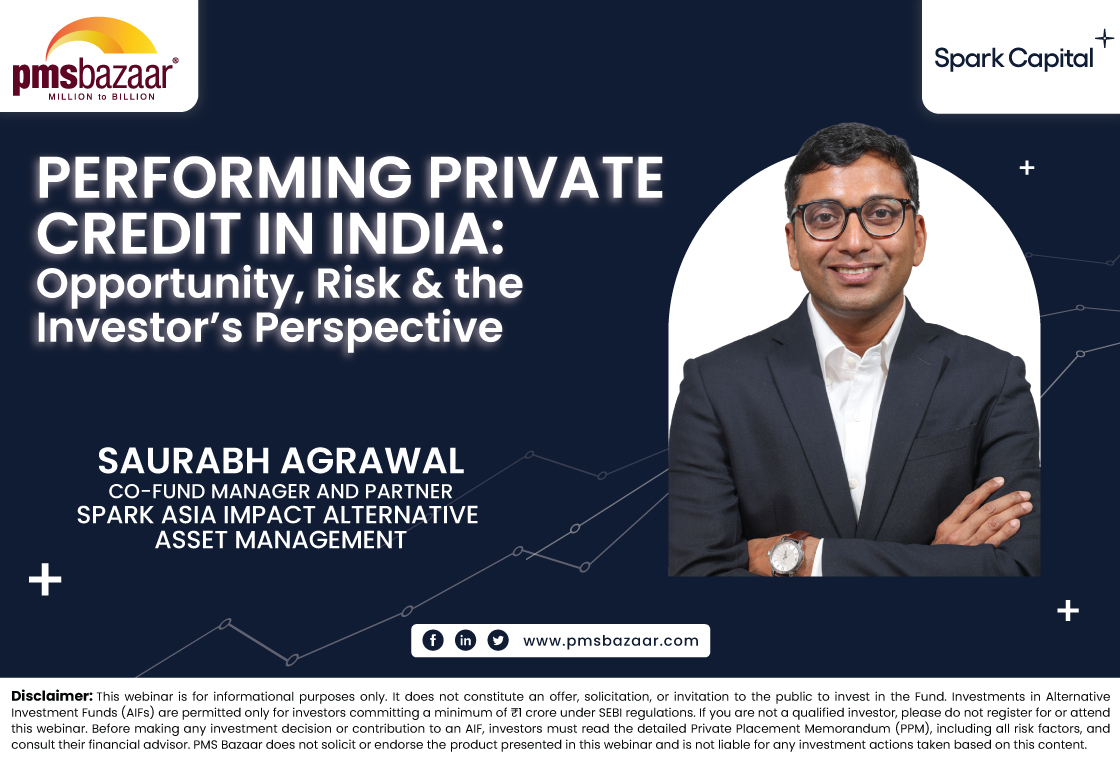
Performing Private Credit in India: Opportunity, Risk & the Investor’s Perspective
PMS Bazaar recently organised a webinar titled “Performing Private Credit in India: Opportunity, Risk & the Investor’s Perspective,” which featured Mr Saurabh Agrawal, Co-Fund Manager and Partner, Spark Asia Impact Alternative Asset Management.
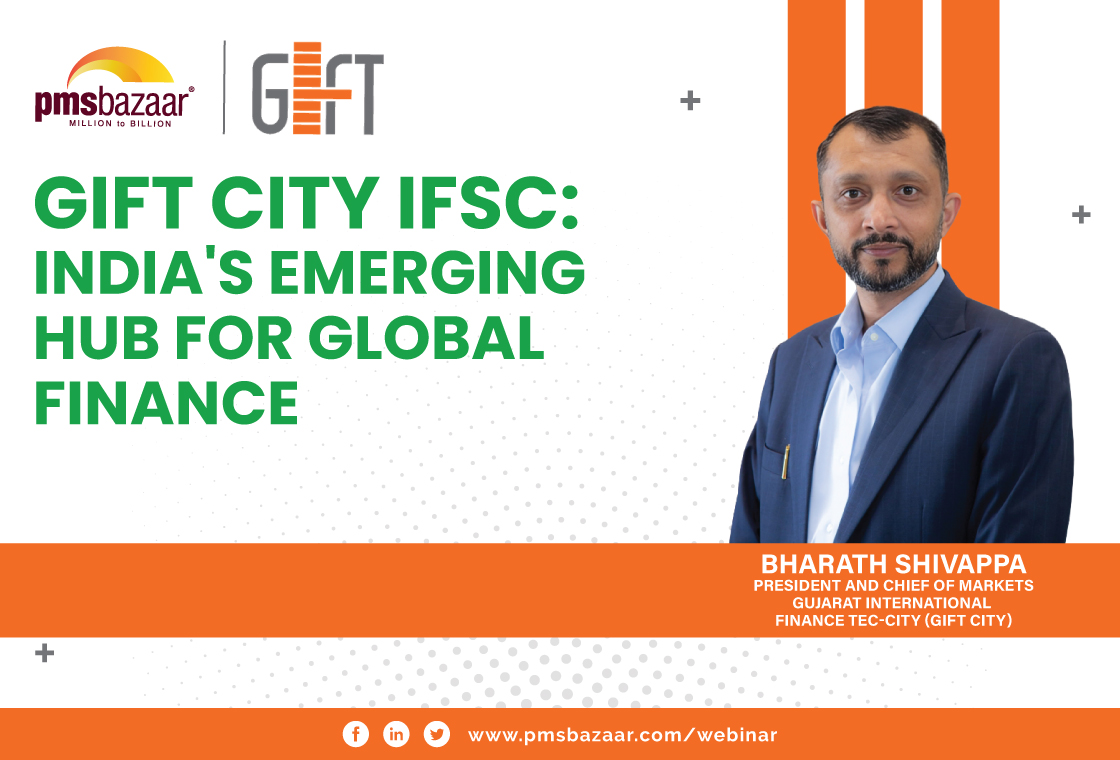
GIFT City IFSC: India's Emerging Hub for Global Finance
PMS Bazaar recently organized a webinar titled “GIFT City IFSC: India's Emerging Hub for Global Finance,” which featured Mr. Bharath Shivappa, President & Chief of Markets, Gujarat International FinanceTec-City. This blog covers the important points shared in this insightful webinar.
PMS Performance: Who Outperformed in July 2026?
July 2026 was another month marked by uncertainty, with market performance shaped by evolving global cues and shifting investor sentiment. Despite the uncertain environment, equity PMS strategies continued to present opportunities, with several managers delivering returns ahead of the broader market benchmarks.