

23 Dec 2025
Transcript
Demystifying Quant Investing with Rishabh Nahar
Aravind Ravindran: Hello and welcome, everyone, to yet another episode of the fund manager interview with PMS Bazar. I am your host, Aravind Ravindran, and today we are privileged to have with us Mr. Rishabh Nahar, Partner and Fund Manager at Qode Advisors. Rishabh holds over 9 years of experience in equity and quantitative research with a focus on building data-driven models to decode market behavior. A self-taught coder with a background in finance, he combines analytical thinking with a deep interest in investment history and strategy. Welcome, Rishabh. It's wonderful to have you with us today.
Rishabh Nahar: Thank you, Aravind. Thank you for having me. You know, happy to meet again; we did this in the past. Yeah, very excited to move forward.
Aravind Ravindran: Yes. To start with, could you introduce yourself to our audience, Rishabh? We would love to hear about your journey from how you started in finance to founding Qode Advisors and your evolution into managing capital for HNI, ultra-HNI, and institutional investors.
Rishabh Nahar: Absolutely. I’ll give a quick background. I started my journey in finance back in 2014 after I got done with college. I started off as a research analyst at a firm called Griha Wealth Advisors. I worked for about one and a half to two years as a research analyst and went through about 50 to 75 different businesses. I was doing pure play equity research, just the traditional way. So, that was the starting and sort of the foundational years for me.
Post that, post-2016, after I left Griha, I sort of wanted to do something by myself. That's when I started Qode; I have three more partners with me. We started back in 2016. The idea was to manage money for ourselves. We weren't looking at growing AUM or targets or any of those things. The thought process was simple: we had a little bit of our own capital, and we wanted to grow that over the years. So, 2016 is when we began. The idea was, let's see how we can get a big CAGR number; that was the thought process.
Just like most journeys for most investors, I started off with speculation and trading, and that's how I got my hands dirty. But along the way, I stumbled upon quant finance. I figured I can't be in front of the screen all day, can't be hooked to the markets. The idea is that you want to think in terms of first principles. So I stumbled upon quant finance. I was reading about two people from the industry. One is Jim Simons; he's pretty well known in the industry of quant. He has a track record of doing about 50-60% per annum for the last 20-25 years. The other was Ed Thorp; he was the guy who wrote this book called Beat the Dealer and he had devised a system to actually beat the casino in the game of blackjack. He went on to sort of becoming a quant investor and had a 25-30 year track record of doing about 25% per annum.
So the idea was that I was seeing these guys, and they've created a system out of investing. They've turned the entire art into a science, and that's how I was inspired; that's how I got into quant finance. We learned how to code, and we started building systems ourselves. Here we are today in 2025, we are managing anywhere between 500 to 600 crore rupees across different strategies, but everything is purely quantitative. I have three more partners with me; we all look at different departments, but our core focus area is research. That's how the entire company has been built. We're a team of 30 people today, and a large part of the team is built around doing research. That's how we've grown wealth for ourselves and for most of our investors too.
Aravind Ravindran: Thank you for sharing that, Rishabh. It's always inspiring to hear how passion and purpose come together to shape a professional journey. Looking back on your career, could you share some of the pivotal moments, key learning experiences, or challenges that have significantly shaped your approach to portfolio management?
Rishabh Nahar: I think the most pivotal years were when I was in Griha. So that was the starting, right? I think that's the foundation for most people. When you just start out, when you're really young, 22-23, and if you can really grind it out in those years, that sort of helps you shape your thinking. Also, in those years, you come across a lot of people who've actually already made it in the industry, guys who have had multibaggers as a part of the portfolio, so you sort of try to emulate them, look at what they've done and what's done right out there. So I think the first two years were very formative for me.
And even after I left Griha, that's when I started quant finance. The thing with quant finance is that there isn't a lot of information available in India, right? It was relatively new back in 2016; today there are few firms, but not as many. So when we started off, the references are more from US markets and guys who've done it out there, rather than people who are doing it in India. So I think we were at a very early stage out there.
2016 to '18, I think we must have run hundreds of different simulations and backtests, looked at gigabytes of data. I come from a commerce background, right? So I've just done a B.COM. I don't have a coding background, but those two years I learned how to code. Today I code in four different languages. Those two years were really good because it was just me and my partners; we didn't have a team. We were just sitting in a room. We had rented a small apartment. We used to sit in a room, come in at 8:00, be there till 12:00 at night, and all we were doing was just research. So I think those two years helped us create our first principles, our foundation for growth.
I think anyone who's wanting to start this out, I think you just have to get your hands dirty. So, back in the day, we were looking at gigabytes of data, trying to come up with different models, figuring how the market works. I think the biggest challenge was that most models would look good on paper, but the model would not really make money when you would go live. It was very silly of us because it's pretty simple, right? You just need to think in terms of first principles. Ideally, a stock will run up if there's going to be any earnings growth, and you don't need to predict anything other than earnings. So then we realized that okay, fine, all you need to focus on is which businesses are going to show earnings growth and what are the factors that can contribute to earnings. So yeah, that is just, I think, the formative years. The first four years were the right foundation. I think anyone who wants to start, the first three-four years of their career, if you get a good mentor and if you can get your hands dirty early on, that's just great.
Aravind Ravindran: That's fascinating, Rishabh. The way you highlighted the experiential aspect of investing gives our audience a real sense of how discipline develops over time. Now, stepping back to look at the broader picture, I'd love to get your thoughts on the current landscape of quantitative investing globally. Over the past decade, this space has evolved rapidly. So could you share your perspective on how quant strategies have transformed and what differentiates the leading global players in this space today?
Rishabh Nahar: Great. So, Aravind, when you think of quant finance, right, I think most people, especially the ones who are not from the industry, would sort of think that quant is like a black box and it's going to throw out some stock, and you'll get some recommendation, and the stock will move up. Essentially, that's not what quant is. I think quant is a set of rules that you put down, based on which you make decisions, whether you want to buy a stock or sell a stock, or any other financial instrument for that matter. So I think it's pretty simple; it's not that complicated. Quant is just a very fancy word for a set of rules. It needs to be broken down, and people need to understand that it's not what it appears to be. Essentially, there are humans behind a quant model; there are guys like me and the team who are actually thinking about what kind of stocks do I want in my portfolio, for which, what kind of rules do I want to set to get that stock in my portfolio.
Looking at it globally, I think there's a wide spectrum of quant. But if you were to strip down everything to basic, like what is the most silly quant model that exists even in India, I think the Nifty50. If you look at the Nifty50, it's a group of 50 stocks that are sort of determined by the size of the business, right? So based on free-float market cap, the top 50 businesses are selected and that's held for, once in six months is when the rebalance happens. Something as silly as that has done 12% per annum. That was my thought process, and even the team, we thought something as silly as a Nifty50, which is a very basic quant model without any fundamental filters, if that has done 12%, then if you can get a little complicated and try to figure out the factors which are actually fundamental in nature and help us predict the business, we could do a lot better than what the Nifty does.
In the US, I think passive investing and quant investing is pretty big out there. The Vanguard ETF essentially is like a quant model. There's this data, I don't know how true it is, but 85% of fund managers in the US are unable to outperform the index, and the index is essentially a quant model. So I think we are shifting towards quant finance. What's important is that people get educated about what it exactly is. A lot of times, we get investors who would not understand what quant is, and they're sort of intrigued by it, and they think quant is AI. I think there's a big mix-up out there. AI is a sort of a tool; I don't think it is the goal. It is a tool that helps us do better research, helps us build better models, but ultimately, the thinking is done by us and the team, and you need to have that understanding of finance.
So globally, if you look at the top-tier firms, there are guys who do quant trading and there are guys who do quant investing. Quant trading is very different from quant investing. Trading is like, there is high frequency, low frequency out there. You're only trying to predict price movement; there is no fundamental premise of owning a business. Where Qode comes into the picture, essentially we are using quant to actually pick fundamentally good businesses. That is the thought process, so we're not trying to just predict stock prices; we're trying to actually pick the right business.
Globally, I think that's the division between quant trading and quant investing. There are more quant trading firms out there than quant investing firms. But I think the future lies in quant investing. Ultimately, if you hold on to good businesses, you're going to do really well. So that's the break-up.
Aravind Ravindran: Absolutely, that's a great overview, Rishabh. We know within quant investing itself there are multiple approaches, from factor investing and statistical arbitrage to machine learning models and many more. So which of these strategies do you find most compelling in the current market environment, and what makes them stand out in your view?
Rishabh Nahar: So, when I'm thinking of quant investing, I don't think I'm ignoring any sort of data, whether it is statistical arbitrage, or fundamental multi-factor models, or even single factor models. What I'm looking at is that I want to be an owner of a business, and what can help me predict earnings? Ultimately, you want to know, if you're sitting today, you want to know what the earnings are going to be 5 years out, 7 years out, or 10 years out.
So, at least within Qode, what we're doing is we're looking at different factors to figure out what contributes. I think one single factor doesn't help you really come to a conclusion. To give you an example, one of the models within our strategies is called the Qode Growth Fund, and it's a portfolio of 30 businesses around the small and midcap space. Now, the kind of businesses that we are looking at are businesses that are showing great earnings momentum, businesses that have high return on capital employed, have very good working capital ratios. Something that's different from most models is that we're also looking at the age of the promoter. So we're seeing that promoters from the age group of say 40 to 60 end up doing a lot better than promoters in a higher age group or a lower age group. Logically it should make sense, and also there should be some pattern to the entire data frame.
So what we're trying to do with our quant models is we want to fish in the right area. I'm not looking at hitting the ball out of the park. I'm not trying to see whether I'll get a 20-bagger, 30-bagger, 40-bagger. I think that's the luck part of investing. The only thing that you can control is your entry, right? You can't control what's going to happen to the stock after that. So, using quant models, what we want to do is fish in the right areas so that whatever we end up picking, at least we can do well using that.
Aravind Ravindran: Yeah, that's a very insightful take, especially how you connected practical application with evolving market dynamics. Now I want to ask you, managing multiple responsibilities in your career can be demanding. So how do you maintain balance between work and personal life, and what habits or routines have helped you stay focused, disciplined, and grounded?
Rishabh Nahar: I think that's pretty valid, right? As you grow as a fund manager, focus generally... the time I used to spend on research back in 2016 to '18 is a lot more than what I would be spending today. So back in the day, I would spend probably 14 to 16 hours a day just doing research, and I think that's in my DNA. But as we scaled, more responsibilities came within the organization. As we had more investors, I had to do calls with investors, and the team grew, so people management.
What we've done over the years is, I think time management is extremely important. I generally break up my day into sections. The first six hours of the day is essentially only research-focused. I think whatever you do, research should not take a back seat. The rest of the day, post 3:00, maybe 3 to 6:00, is when I do the other activities, which is speaking to investors and looking after the employees, investors, and operations, etc.
The advantage of having partners within the organization is that we can divide our roles and responsibilities pretty well. My other partner takes care of operations end-to-end, so I don't need to worry about that. I have someone who takes care of compliance, so I don't need to be worried about that. So I think one thing that I've learned is that you need to be working with very good people, and the pie is very big; it can get a lot bigger if you have the right people on your team.
For me, my team is extremely important. It's probably the most important part of my life, and making sure that they are happy and making sure that the entire engine is running pretty well, that's what I look after. So there are two things I do right: one is research, and the second part is making sure that we have the right people on the bus, because we keep changing trajectory and we keep coming out with new research and new ideas, but you need to have the correct people who you want to spend your time with. Because if you think about it, you're going to spend about 12 hours a day, or maybe 10 to 12 hours a day, at work, and you need to make sure that you're working with the right people.
In terms of the rest of the day, I'm married, I have a daughter, and I end up spending a lot of time post 6:00, and even in the morning. I'm an early riser; I wake up at 5:30 a.m. So the morning, 5:30 to 8-8:30, I'm pretty free. So I get a lot of time to work out and spend time with my daughter.
I think the beauty about being in business and in investing is that you have a very long runway; you could do this for the rest of your life. Unlike being a sportsman where your career is only maybe 8 to 10 years—that's the peak—and after that you don't have an option, so you have to be in a hurry then. But the great thing about being in investing is that the longer you live, the better your track record.
Aravind Ravindran: Wonderful. It's always refreshing to hear how leaders like you find the equilibrium between professional intensity and personal wellbeing. Now, coming to your interesting proposition at Qode Advisors, how would you describe your core investment philosophy, and how has it evolved since you began managing client capital? Could you also elaborate on how the integration of quantitative research, fundamental analysis, and disciplined risk management works in practice across your portfolios?
Rishabh Nahar: Great. Yeah. So, Aravind, today what we're doing is... when we started out, we started as a pure quant fund, and we were very restrictive back then. But we realize that there are obviously restrictions with quant finance also. So we do have a small element of subjectivity; we try to restrict that. The idea with quant essentially is we want to remove the role of luck out of investing.
So, say I have a 30-stock portfolio, and over the last six-seven years, I did like a 25-30% per annum. In that period, I need to know what has contributed to the return. If one stock has done a 20-bagger or 30-bagger and it contributes to 70-80% of the return, I won't be really happy. The idea is that you want to find a repeatable exercise. So I want to see, can I do this for the next 5, 10, 15 years? Is my model good enough? So when I'm thinking about quant finance, I'm thinking about first principles, I'm thinking about fishing in the right areas, and my models are always evolving.
There is a bottom-up approach wherein you're trying to find the right businesses from bottom up, and then there's a top-down approach wherein we're looking at the entire environment. If you see Warren Buffett's life cycle, he's been in an environment where interest rates have more or less been dropping. I think you want to be in a dropping interest rate environment. He's been in an environment where we're in the era of fiat currency, where there's a lot of money printing happening, so the price of assets, whether it's equity, gold, real estate, has only gone up in the last 20, 30, 40, 50 years because constant money printing is happening. So you want to judge the environment that you're in.
We've divided into two buckets: one is the macro research, and then one is stock-level research. On macro research, you want to understand what kind of environment you are in. So, are you in a... right now, the next five years, we think that there's a global reset happening and the US is going to go through a very tough time. So we are doing research around the macro trend and how that will affect equity markets.
For example, when 2020 hit, we were very sure that asset prices over the next four years will go up. From 2020 to 2024, we saw Nifty doing a 20% or 25% CAGR, and the reason for that is not that India did well, but one of the reasons, the majority of the reason, is that there was a lot of liquidity being injected into the system. $4 trillion was the Fed balance sheet size in March 2020, and by December it reached about eight or eight-and-a-half trillion dollars. They almost printed what they printed in the last 25 years, in 6 months. That effect trickled into the system, and across the world, all assets did well.
I think you shouldn't be restricted in terms of only looking at businesses alone, but you need to know what environment you are in and what's going to happen. I think the next five years is going to be really tricky because the expectation is that a lot of money printing is going to happen, and if that happens, then asset prices will go up. The US is going to go through a complete reset; we are already seeing that with movement in gold; people don't want to hold the dollar. I think what we're going to see in the next five years, none of us have seen in our lifetime. So that's the kind of research we're doing: two ends. One is the bottom-up approach, where you know what are the right businesses to select in a period like this, and the second is the top-down: what kind of environment are we going to see in the next 5 years?
Aravind Ravindran: That's a very clear articulation, Rishabh, and it's impressive how your process blends analytical precision with real-world insight to manage risk and deliver returns. Speaking of results, Qode All Weather has significantly outperformed the Nifty50 since inception. If you were to attribute this performance, what do you think have been the key factors, whether it's strategy design, risk management, or market positioning, that have driven such consistent outcomes?
Rishabh Nahar: So, if I break down Qode All Weather, the thought process is very simple: you want to perform in a market which could be volatile or which could be flat. You want to have outperformance regardless of the market environment. We knew this very well last year when we launched the strategy that the market's going to be really challenging over the next five years. So even though we expect India to do really well, there could be volatility, and this is what we saw this entire year.
If I break down the portfolio, 60% of the portfolio is equities and 40% is gold. What gold essentially does to the portfolio is it cuts through the drawdown, reduces the volatility, and is a very good hedge to the entire equity portfolio. All Weather, from November since inception, we've done, I think, 24 or 25% as we speak, and the market in the same time has done about 10 or 12%. Nifty has done about a 10-11%; BSE 500 has done an 8-9% in that same period.
So I think the outperformance has been great because of two things. One, gold became a part of the portfolio. Second, the equity portfolio was sort of protected using hedges on the entire portfolio; we use put options to hedge the portfolio. These two elements contributed to the entire outperformance. If you look at gold as a whole, if you break down your portfolio and say 50% is Nifty and 50% is gold, you would see that you get a very good risk-adjusted return.
At Qode, what we're looking at is not only returns; we're also looking at risk-adjusted returns. You could very well make 25-30% by holding a micro-cap or a small-cap portfolio over a five-six year period, but you're going to go through a lot of volatility, so you have to have the stomach to endure something like that. Not every investor is built for that, or has the liberty to run a portfolio like this. So that's why Qode All Weather was designed: we want to do well, we want exposure to equity markets, but we want to have very low drawdowns.
Aravind Ravindran: Yes, that really underscores how consistency and structure can outperform even in volatile markets. Now, both your All Weather and Tactical Fund portfolios have a notable allocation to gold, which has rallied so strongly over the past year. So how do you view gold from here? Do you expect meaningful upside potential in the near term, or is a period of consolidation or correction more likely for gold?
Rishabh Nahar: Thanks for the question, Aravind. I think it's valid. Gold has done extremely well over the last one year. But when I'm looking at gold, I'm not looking at predicting where gold is going to move in the short term. I think if you ask me for a five-year view, I think gold is going to move up. The reason being that if you break down gold returns, it's pretty much, gold long-term has done 11% or 10% per annum, sort of divided between 6-7% inflation and 2-3% is the currency depreciation. So as long as that continues, gold will continue to see that 10-12% gain over a long-term period.
In the next one year, anything can happen. It could be anyone's call because gold price movement is determined by demand and supply by central banks, and that could be anybody's guess. When we were looking at gold within our own portfolio last year, when we started the All Weather portfolio, 40% was allocated to gold, so All Weather ended up doing extremely well. As we saw, in the last one-and-a-half weeks, gold has seen almost a 10 or 12% drawdown. From ₹1,35,000, gold came down to ₹1,21,000. But our All Weather portfolio only saw about a 1.5-2% drawdown. The reason being that it complements itself very well with equities; equities ended up doing very well. So we did not give up a large part of the gains that we made over the last one year. So I think that beautifully, within Tactical and the All Weather both, it works pretty well. So when I'm looking at gold, I'm looking at it more like a hedge to the portfolio rather than a wealth creation mechanism.
Aravind Ravindran: It's interesting how gold continues to play a key role as both a return generator and a hedge across portfolios. Now I have a special one. The Qode Tactical Fund has delivered a higher Sharpe ratio, lower beta, and a significantly lower maximum drawdown compared to its benchmark. Could you walk us through the investment management process behind this fund and explain how these outcomes are achieved?
Rishabh Nahar: Yeah, I think that's a valid question. Generally, when you're looking at long-only portfolios, Sharpe ratios are bad because drawdowns are very large. But I think it's not only the returns that matter; it's also the risk-adjusted returns. How much risk are you taking to actually achieve the return? Especially when you're managing an investor's money, I think it's your conviction that's most important, and the investor's journey should not be really bumpy. If you're going to see a 40-50% drawdown, he might lose his confidence and withdraw the funds, even though it's a time when you need to double down as an investor. If you think of the psychology, when an investor is handing over the funds to you, they know only so much about the fund, so it just comes down to trust and process.
What we've done with the Tactical Fund essentially is that every time we use gold as an entry mechanism. So when you start out making an investment, if markets are at extreme highs, then 40% of the portfolio will be gold. And as markets start going into drawdowns—if Nifty falls 5%, 10%, 15%, 20% for that matter—gold gets taken off the portfolio. We don't look at gold as a wealth creation mechanism; we purely look at it as an entry mechanism into starting the portfolio.
That's what we did last November; 40% of the portfolio in the Tactical Fund was gold. By March, when Nifty was in a 16% drawdown, the gold allocation came down to only about five or 10% of the portfolio, and we went to 90% equities. So you're buying more equities when markets are in a drawdown, and the gold sort of helps you act as a hedge. In the same period, the midcap index was down maybe 15 or 20%, but we remained flat because gold made all that money for us, and I had enough money to buy more equities. So I sold the gold from my portfolio. That's something that we've devised using a quant mechanism, and we're trying to sort of not exactly time the market, but if you want a good CAGR, then I think entry makes a lot of difference. You can't enter at market tops and expect to make 25%.
Aravind Ravindran: That really highlights how strong process orientation and disciplined execution can make all the difference in risk-adjusted performance. Finally, Rishabh, looking ahead, what's your outlook on the growth and adoption of quant-based PMS products in India over the next few years? Are there any niche or specialist investment products you anticipate launching or see gaining traction as investors become more sophisticated?
Rishabh Nahar: I think more and more, as we get deeper into this, quant funds will end up doing extremely well. The only reason why I'm so confident about this is because quant removes the entire emotion out of investing. Whether Rishabh exists or doesn't exist, or if Rishabh's having a bad day, I don't think the process is changing. None of those things are happening. If I'm not in office, or if there are a lot of emotions flowing through, the market is really volatile, we already have set down rules and processes, and we end up sticking by those rules.
If you look at someone like Buffett, essentially he doesn't need a quant fund because he's so mentally disciplined; he has rules; he can sit on 40% cash for extended periods of time and not look bad. But most active managers might find it hard to do something like that. And again, giving the example of Nifty, the Nifty is such a simple quant fund and yet doing 12%. So if we can do something more sophisticated, we could easily beat the Nifty.
Going ahead, I think a lot of adoption of quant is going to come into the picture. Second, also, there's a lot of data available. Back 15-20 years ago, data was not easily available; our markets were fairly young back then. I think now we've seen different cycles; we've seen 2008, we've seen 2020, so there's a lot of data available for managers to do testing. I think the adoption will be a lot bigger. In terms of performance, quant will end up doing extremely well. So I think there's a very bright future for quant going ahead.
Aravind Ravindran: That's a very forward-looking perspective, and it's exciting to see how asset managers like Qode are pioneering a new generation of data-driven, high-discipline investing in India. Rishabh, next we will move to a quick rapid-fire round, and for each question, you can just pick the one that resonates with your views.
Rishabh Nahar: All right.
Aravind Ravindran: Which factor do you prioritize most in your quant models? Momentum or low volatility?
Rishabh Nahar: I think momentum.
Aravind Ravindran: Okay. Which challenge is more critical for quant strategies? Model overfitting or market regime shifts?
Rishabh Nahar: I think market regime shifts.
Aravind Ravindran: Fine. Which emerging trend in quant investing excites you most? AI/machine learning or alternative data?
Rishabh Nahar: Alternative data.
Aravind Ravindran: Preferred asset class in the current environment: equities or gold?
Rishabh Nahar: Equities.
Aravind Ravindran: Oh, that's an unexpected one.
Aravind Ravindran: That brings us to the end of today's session, Rishabh. Thank you so much for joining us and for sharing such insightful perspectives on quant investing and portfolio management. It's been an absolute pleasure having you with us.
Rishabh Nahar: Thanks a lot. I think it was great, a great conversation. Thanks for having me.
Aravind Ravindran: And to all our viewers, thank you for tuning in. We hope you enjoyed this engaging discussion and gained valuable insights into the evolving world of quant investing. Stay connected with PMS Bazar for more such thought-provoking conversations with industry leaders. Until next time, take care and goodbye.
Top Viewed Interviews
18 Sep 2024

How to find multi-baggers with Small & Mid cap valuations?
Mr.Arpit Shah
Co-Founder, Investment Director & Fund Manager
Care Portfolio Managers Pvt Ltd
This interview with the Co-Founder & Investment Director of Care PMS, Arpit Shah, focuses on the company’s investment philosophy, particularly their approach to identifying multi-bagger stocks in the small and mid-cap space by considering factors like valuation, management quality, and potential growth triggers.
08 Jan 2026
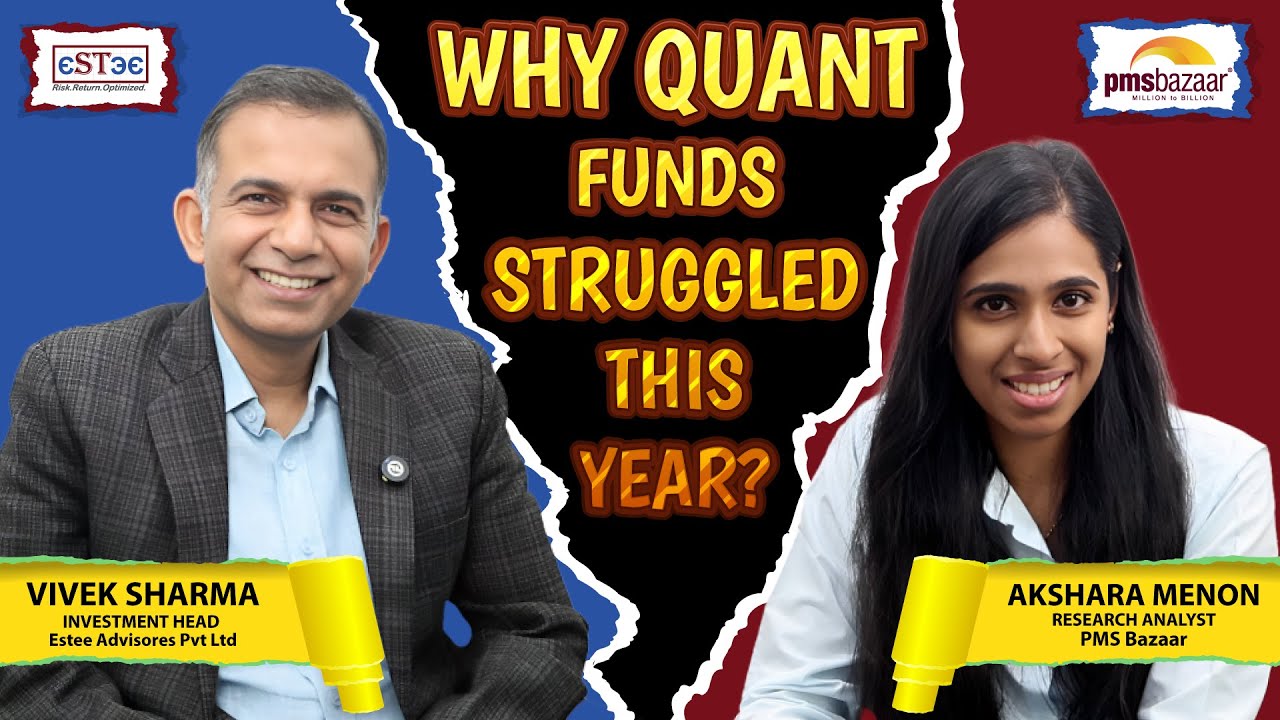
Why Quant funds underperformed in 2025?
Mr. Vivek Sharma
VP and Head of Investments at Estee Advisors
Estee Advisors Pvt Ltd
This interview with Vivek Sharma, VP & Head of Investments at Estee Advisors, discusses the evolution of quant investing and why quant funds underperformed in 2025. He shares views on factor cycles, risk management, AI, and the importance of disciplined, process-driven investing.