

PMS Bazaar recently organized a webinar titled “Aurum Multiplier Portfolio - Where Small and Mid-Cap Alpha Meets Large-Cap Stability,” which featured Mr. Sandeep Daga, MD& CIO, Nine Rivers Capital and Mr. Kunal Sabnis, Portfolio Manager, Nine Rivers Capital. This blog covers the important points shared in this insightful webinar.
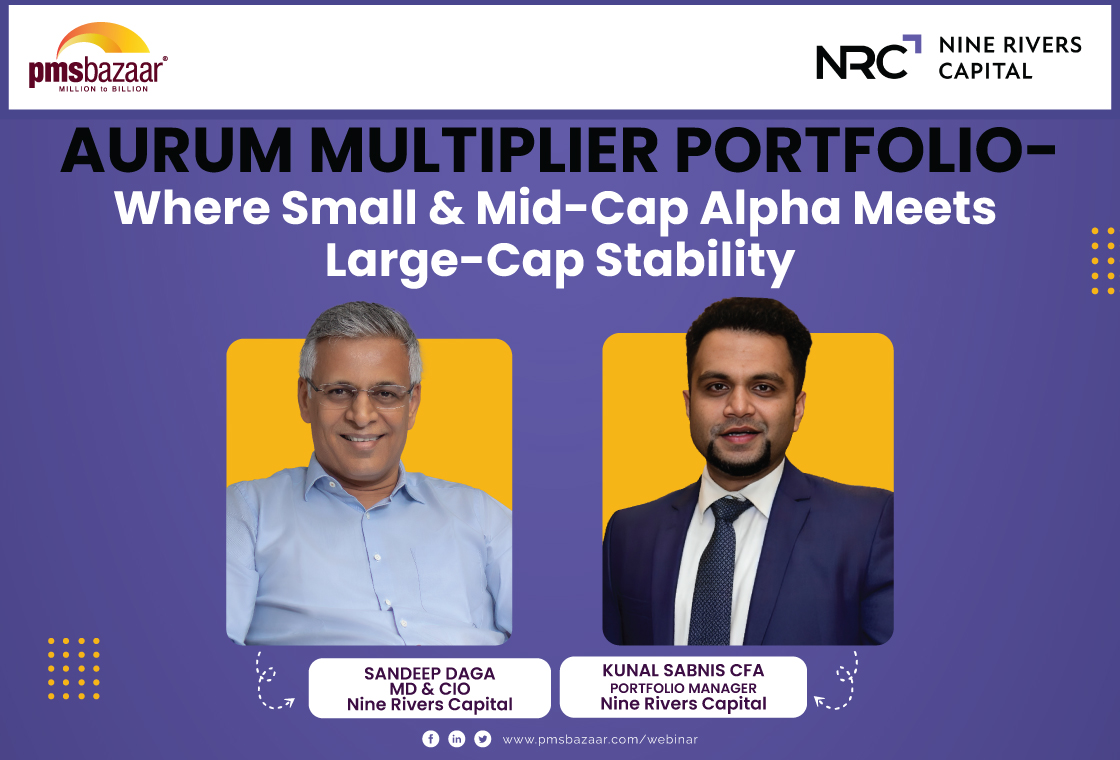
The webinar blog covers insights from Mr. Daga and Mr. Sabnis, which includes how they leverage a Flexi-Cap strategy, rooted in private equity principles, to generate long-term wealth. It explains their research-driven approach, combining “Alpha Generators” and “Portfolio Anchors” for balanced returns. Using a cricket team analogy, they highlight portfolio diversification across market caps. The piece also shares success stories like Mrs. Bectors Foods and SJS Enterprises and outlines sectoral opportunities for 2026–27.
Key aspects covered in this webinar blog are
- A legacy rooted in private equity principles
- The "cricket team" philosophy of portfolio building
- Strategy: alpha generators and portfolio anchors
- A rigorous four-bucket research process
- Success stories: theory into practice
- Case study: the Mrs. Bectors Foods journey
- Aesthetic growth: the SJS Enterprises story
- The 2026-2027 outlook: sectoral convictions
Summary: In a detailed session, Mr. Sandeep Daga and Mr. Kunal Sabnis highlighted their firm’s Flexi-Cap strategy, rooted in private equity principles, blending rigorous ground-level research with market-cap flexibility. Using a cricket team analogy, they explained combining Momentum, Large-Cap, Compounding, and Discovery stocks for optimal risk-adjusted returns. Their approach focuses on “Alpha Generators” and “Portfolio Anchors,” identified through a four-bucket research process. Success stories include Mrs. Bectors Foods and SJS Enterprises. For 2026–27, they see opportunities in BFSI, paints, and power transmission, emphasizing disciplined, adaptable investing.
In an insightful session, Mr. Sandeep Daga and Mr. Kunal Sabnis shared the core philosophy behind their investment firm’s success and why a Flexi-Cap strategy is becoming the cornerstone of modern equity portfolios. Drawing from a legacy of private equity (PE) investing, the speakers detailed how they apply a "business-first" lens to public markets to generate consistent alpha. The discussion was designed to provide investors with serious food for thought regarding long-term wealth creation and the nuances of market-cap flexibility.
A Legacy Rooted in Private Equity Principles
Mr. Sandeep Daga opened the discussion by tracing the firm’s roots back over thirteen years. With fourteen years of experience in active growth in private equity before transitioning into public markets, Daga explained that the firm’s "genesis" is built on thinking like a private equity investor even when dealing with listed securities. This involves a fundamental shift from traditional retail thinking; the team chooses to challenge conventional wisdom regarding both the quality and the valuation of a business.
He noted that the firm does not merely rely on digital screens or secondary data. Instead, they validate every aspect of an investment thesis on the ground through extensive interaction with a company’s entire ecosystem, including competitors, suppliers, and distributors. Today, their offerings have expanded from a flagship small-cap PMS, which has a thirteen-year track record of serious alpha generation, to include an SME-focused fund and a pre-IPO fund. However, the current focal point is their Flexi-Cap strategy, which leverages their private equity approach across the entire market spectrum.
The "Cricket Team" Philosophy of Portfolio Building
Mr. Kunal Sabnis used a highly relatable analogy to explain why a Flexi-Cap approach is essential for a balanced portfolio. He compared building a winning investment portfolio to assembling a world-class cricket team. He argued that a team comprised of eleven "Sehwags" (aggressive but volatile) might score 700 runs or get bowled out for 70. Conversely, a team of eleven "Dravids" (stable but slow) might not provide the scoring rate required to win in a dynamic 50-over game.
He pointed to the 2011 World Cup-winning Indian team as the perfect example of a Flexi-Cap portfolio. That team succeeded because it combined diverse skill sets into a single unit:
- The Momentum Stocks (The Sehwags): Players who provide explosive growth when the conditions are right.
- The Large-Caps (The Sachins): The steady anchors around which the entire innings revolves.
- The Compounding Stocks (The Gambhirs): Consistent performers who deliver results at reasonable valuations.
- The Discovery Stocks (The Virats): Young, undiscovered talents that start as small-caps and eventually grow into massive, well-discovered large-caps.
Sabnis explained that a Flexi-Cap strategy mimics this winning combination. It provides the best risk-adjusted returns by blending these different "players" to navigate various market tracks and economic cycles, rather than being restricted by rigid market-cap mandates.
Strategy: Alpha Generators and Portfolio Anchors
Sabnis detailed the two-pronged approach the firm takes within its Flexi-Cap strategy to outperform the BSE 500 benchmark. He noted that the BSE 500 is the ideal benchmark because its volatility is often lower than the Sensex, while its returns sit comfortably between large-cap and small-cap indices. The strategy is divided into two distinct buckets:
1. Alpha Generators
These are quality companies that are temporarily out of favor due to demand slowdowns, input cost pressures, or regulatory shifts. The firm enters these positions at what Sabnis calls an "earnings inflection point." These companies have already proven their moats and established a niche, but they are currently disliked by the broader market. When the earnings cycle turns, investors benefit from both earnings compounding and a valuation re-rating.
2. Portfolio Anchors
These are well-discovered, high-growth companies that are growing faster than their peers and consistently grabbing market share. While these companies are not necessarily "cheap" in a traditional sense, their valuations are sensible and sustainable for long-term compounding. They provide a steady-state flavor to the portfolio, ensuring that volatility remains manageable even when the "Alpha Generators" are in their gestation period.
A Rigorous Four-Bucket Research Process
The speakers emphasized that their high-conviction, concentrated portfolios—typically containing only 20 stocks in the Flexi-Cap strategy—require intense oversight. This conviction is built through a four-bucket research process:
- Governance: Assessing promoter integrity, capital allocation history, and the prudence of accounting policies.
- Leadership: Evaluating the management’s appetite to scale and whether there is a strong "second rung" of leadership.
- Business Model: Identifying "moats" and preferring oligopolistic market structures over commoditized businesses.
- Financials: Prioritizing low or no leverage, superior cash flow generation, and high Return on Capital (ROC).
Sabnis highlighted that they particularly look for the "delta change." Finding a company with a 12% ROC that has the potential to reach 22% over a three-year cycle is where the maximum wealth is created.
Success Stories: Theory into Practice
To illustrate their approach, Sabnis shared three key examples of how they applied this logic to real-world investments:
- Shriram Finance: This was a non-consensus pick in June 2023. While the market saw it as a cyclical entity, the firm recognized that a strategic merger had diversified the book and removed its deep cyclicality. This led to a significant re-rating from 1.2x book value to over 3x.
- Polycab: The firm entered this "Portfolio Anchor" during a market overreaction to a competitor's expansion news. By recognizing the massive industry tailwinds for cables and wires, they bought a quality franchise at an 18% discount on a single day.
- Eicher Motors: After brokerages turned negative due to new competition, the firm’s ground-level research showed that management was successfully gunning for volume growth. By monitoring "green shoots" during the 2024 season, they built high conviction before the stock reached new heights.
Case Study: The Mrs. Bectors Foods Journey
Mr. Kunal Sabnis highlighted Mrs. Bectors Foods as a definitive example of their research-driven approach. Following its 2021 IPO, the stock halved from its peak—a trend the speakers noted affects nearly 80-90% of new listings, reinforcing the firm’s policy of avoiding IPOs initially.
When the price dropped below its IPO level in March 2022, Daga and Sabnis spent an entire day in Chandigarh with the top management. They identified a unique hybrid business model: a 60% branded retail piece (Cremica biscuits and English Oven breads) and a powerhouse B2B segment supplying buns to QSR giants like McDonald’s, Burger King, and KFC.
The firm entered when the stock was trading at 24 times PE, significantly lower than Britannia’s 45 times. The thesis relied on the company outperforming Britannia's volume growth by 8-10 percentage points. This thesis played out for eight consecutive quarters, resulting in a six-bagger return. Sabnis noted that with two large new plants coming on stream, the company is now entering its next leg of growth.
Aesthetic Growth: The SJS Enterprises Story
Another notable success mentioned was SJS Enterprises, an auto ancillary focused on aesthetic products for bikes, televisions, and consumer goods. Sabnis emphasized its high margins and robust cash flow generation. The company’s strategy of acquiring, integrating, and turning around smaller firms without taking on debt aligned perfectly with their core investment tenets. Bought at 23 times PE, SJS exemplifies the firm’s commitment to "extremely attractive valuations" as the primary determinant of outsized returns.
The 2026-2027 Outlook: Sectoral Convictions
Looking ahead, the speakers identified several "fallen angel" sectors where they remain highly bullish:
1. The BFSI Recovery
Sabnis pointed out that asset quality is at a 15-year best across Indian banks and NBFCs. As the RBI maintains a dovish stance, credit costs are at a historic low. He expects select large private banks and affordable housing finance companies to outperform as private capital expenditure (CapEx) finally takes the heavy lifting from government spending.
2. The "Fallen Angel" of Paints
A non-consensus contrarian call was made on the paints and payments sectors. In paints, despite recent flat growth and the entry of Birla Opus (which grabbed 8% market share), the firm believes the 75% "repainting demand" remains a structural driver. With competitive intensity nearing a peak and margins set to recover, the next two years look promising.
3. Power Transmission: The "Pick and Shovel" Strategy
While many investors focus on renewable generation (solar/wind), Sabnis prefers the "pick and shovel" strategy of power transmission. With a projected ₹9 lakh crore CapEx over the next decade, the firm is heavily positioned in transformers, switchgears, and cables.
Addressing the recent market pessimism, Mr. Sandeep Daga argued that sentiments are currently lagging behind fundamentals. He cited recent policy shifts—including the UK Free Trade Agreement (FTA), mineral policies, and semiconductor investments—as massive structural tailwinds that the market is currently underestimating.
Daga noted that despite mid and small-cap biases, the portfolio beta remains less than one. This is achieved through a deliberate blend of "Alpha Generators" (out-of-favor companies at earnings inflection) and "Steady State" anchors.
When asked about maintaining discipline, the speakers explained that "Flexi-Cap" stands for adaptability. Rather than being "cast in iron" with fixed weightages, the strategy uses "intuitive intelligence" to shift weight between large, mid, and small-caps based on where the growth cycle is most attractive.
Ultimately, the speakers concluded that while global events like the "Yen Carry Trade" or US trade deals capture disproportionate mindshare, the true edge lies in mapping the inherent earnings growth of individual companies. With a consolidated 20-stock portfolio and a focus on long-term compounders, they anticipate 2026 and 2027 to be standout years for disciplined investors.
Mr. Daga and Mr. Sabnis covered all the topics mentioned above in-depth and answered questions from the audience toward the end of the session. For more such insights on this webinar, watch the recording of this insightful session through the appended link below.
Get access to rich data and analytics of PMS & AIF by subscribing to us. Join the 90000+ investors & experts: Subscribe NOW
Recent Blogs
PMS Performance : 401 Equity PMS Beat the Nifty 50 TRI
September 2026 saw global markets grapple with persistent macroeconomic uncertainty, as rising U.S. bond yields, crude oil prices above $90 per barrel and escalating Middle East tensions kept investors on edge. Concerns over renewed inflationary pressures and tighter financial conditions continued to shape market sentiment. The reported 25-basis-point Federal Reserve rate hike, bringing rates to 3.75–4.00 per cent, added another dimension to the evolving global outlook.

When Market Direction Is Uncertain, Can Arbitrage Add Stability to Client's Portfolio?
PMS Bazaar recently organised a webinar titled “When Market Direction Is Uncertain, Can Arbitrage Add Stability to Client's Portfolio?” which featured Mr. Sandeep Tyagi, Founder & Chairman, Estee Advisors and Mr. Shubham Goyal, Director, Strategy, (Principal Officer and Fund Manager - I-Alpha), Estee Advisors Pvt. Limited. This blog covers the important points shared in this insightful webinar.
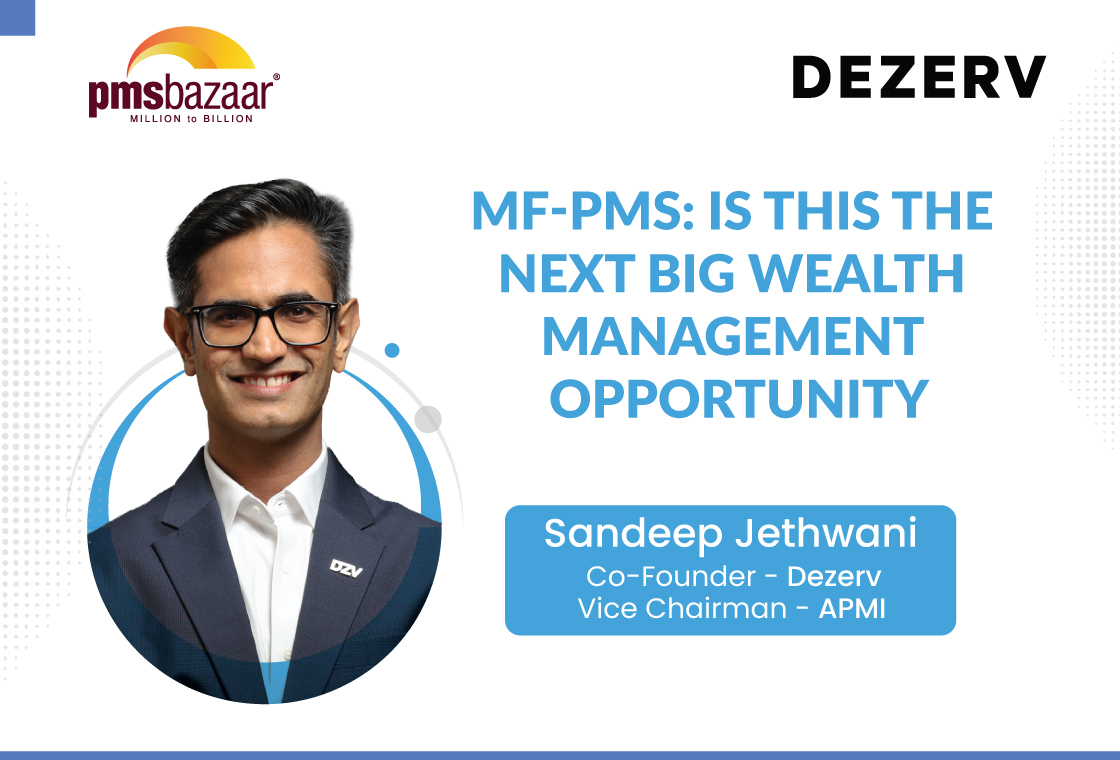
MF-PMS: Is This the Next Big Wealth Management Opportunity
PMS Bazaar recently organised a webinar titled “MF-PMS: Is This the Next Big Wealth Management Opportunity,” which featured Mr. Sandeep Jethwani, Co-Founder, Dezerv & Vice Chairman, APMI.

PMS Performance: Over 94% of Tracked Strategies Beat Nifty 50 TRI
Global markets remained under pressure in August 2026 as geopolitical tensions, rising bond yields and elevated crude oil prices kept investors cautious.

The Next Alpha Cycle: How Should Investors Position ‘Alternatives’ in Their Portfolios?
PMS Bazaar recently organized a webinar titled “The Next Alpha Cycle: How Should Investors Position ‘Alternatives’ in Their Portfolios,” which featured Mr. Akhil Chaturvedi, ED & CBO, Motilal Oswal AMC. This blog covers the important points shared in this insightful webinar.
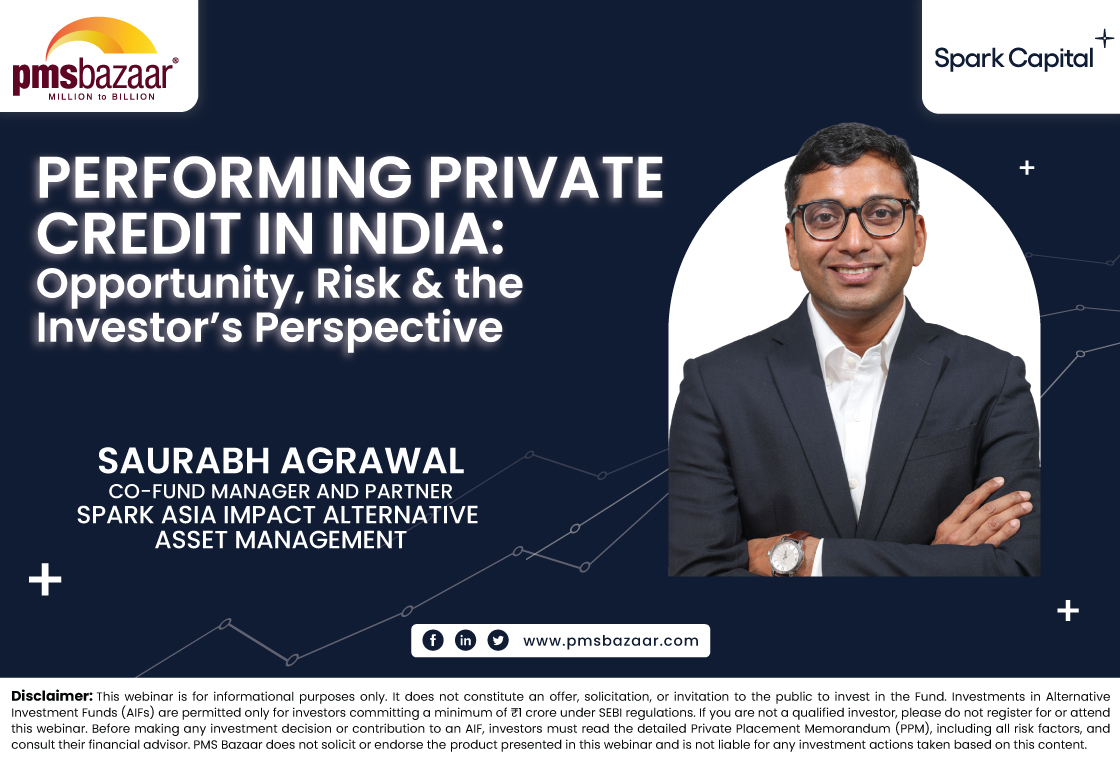
Performing Private Credit in India: Opportunity, Risk & the Investor’s Perspective
PMS Bazaar recently organised a webinar titled “Performing Private Credit in India: Opportunity, Risk & the Investor’s Perspective,” which featured Mr Saurabh Agrawal, Co-Fund Manager and Partner, Spark Asia Impact Alternative Asset Management.
GIFT City IFSC: India's Emerging Hub for Global Finance
PMS Bazaar recently organized a webinar titled “GIFT City IFSC: India's Emerging Hub for Global Finance,” which featured Mr. Bharath Shivappa, President & Chief of Markets, Gujarat International FinanceTec-City. This blog covers the important points shared in this insightful webinar.
PMS Performance: Who Outperformed in July 2026?
July 2026 was another month marked by uncertainty, with market performance shaped by evolving global cues and shifting investor sentiment. Despite the uncertain environment, equity PMS strategies continued to present opportunities, with several managers delivering returns ahead of the broader market benchmarks.