

PMS Bazaar recently organized a webinar titled “Investment Frameworks: A Practitioner’s Guide,” which featured Mr. Sumit Agrawal, Senior Vice President, Nuvama Asset Management Limited. This blog covers the important points shared in this insightful webinar.
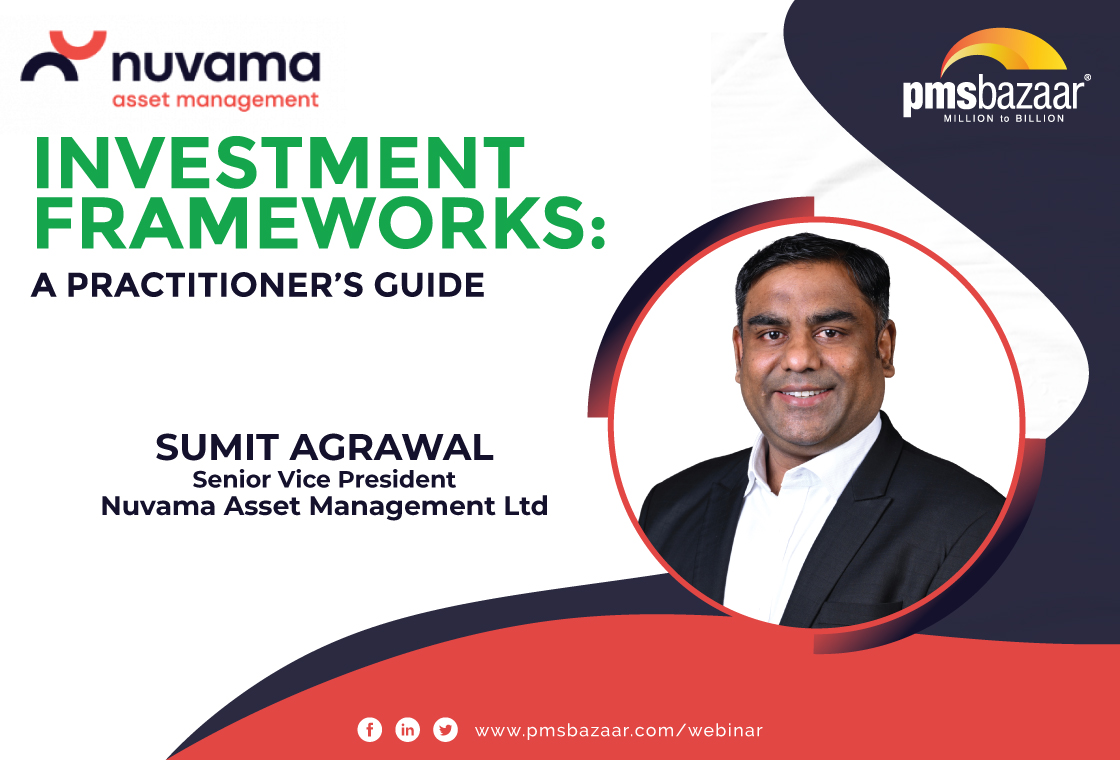
The webinar blog covers insights from Mr. Agrawal, which includes how investors can build resilient investment frameworks during volatile markets. It highlights the importance of simplicity, disciplined processes, and proper allocation alongside stock selection. Using the BMV framework and a growth-moat matrix, it shows how to evaluate businesses across market cycles, manage risk during corrections, and make probability-based decisions for long-term wealth creation.
Key aspects covered in this webinar blog are
- Introduction to resilient investment frameworks
- The underrated power of simplicity
- The investor’s paradox: selection vs. allocation
- The BMV framework: business, management, valuation
- The growth-moat matrix: categorising opportunities
- Market returns and long-term growth
- Generating alpha through active share
- Selecting fund managers during tough times
- Portfolio construction and core-and-satellite approach
- Handling corrections and deploying capital gradually
Summary: Mr. Sumit Agrawal started by addressing a timely and critical topic: building resilient investment frameworks. He noted that the chosen theme of ‘Investment Frameworks and Practitioner’s Guide’ was particularly relevant in the current market context. The prevailing correction, he observed, was forcing both successful investors and novices alike to re-evaluate their understanding of what investing truly entails and what actions they should take.
Mr. Agrawal commenced by emphasising that a robust investment framework is something applied across entire market cycles, not just during bull or bear phases. He described these frameworks as essential guardrails or fundamental philosophy, which might be unique to each individual but often share common threads. He pointed out that most successful investors globally align with 70-80% of a similar thought process.
The most defining tenet of his own framework, he revealed, was the belief that simplicity is often underrated, yet it is the most powerful trait. He argued that all frameworks must, at their core, be simple. Overly complex systems risk becoming difficult to navigate, especially when multiple variables change, thereby losing their effectiveness.
The Investor’s Paradox: Selection vs. Allocation
Mr. Agrawal began by illustrating a typical investor’s paradox. He recalled his early days as an analyst, where a disproportionate amount of time was devoted to analysing stocks and sectors—through deep company research, management meetings, channel checks, and competitor analysis. Further time would be spent on financial modelling and projections.
He then posed a more challenging question: after identifying, say, ten stocks to buy, how does one decide how much to buy? Would an investor add more to these positions later, and when should they exit—whether after making a profit or a loss? He noted that most individuals spend little time developing systematic frameworks for these critical decisions.
A novice approach, like equal-weighting a portfolio, was mentioned but dismissed as not entirely rational. Mr. Agrawal stressed that there must be a scientific approach to allocation. He shared an anecdote from his experience managing a focused fund, where he would ask audiences how many had identified multi-bagger stocks. However, when he followed up by asking how much wealth that stock actually helped create, far fewer hands remained raised. The common reply was, “We identified the stock… but we bought very little.”
This, he stated, was the crux of the problem: intelligent investing is as much about allocation as it is about selection.
The BMV Framework: Business, Management, Valuation
The core framework Mr. Agrawal has followed for years is the BMV model: Business, Management, and Valuation. He explained that when evaluating any company or sector, these are the three fundamental pillars.
- Business: The enterprise must be scalable, with the potential to grow 5x or 10x from its current base, and address a large market opportunity. Crucially, it must generate a return over a cycle that is higher than its cost of capital (e.g., ROCE or ROIC). There is little point, he advised, in owning a fast-growing business that fails to generate even a fixed-income-like return on equity.
- Management: The quality of the team running the business is paramount. The best way to judge management, according to Mr. Agrawal, is to observe their behaviour during difficult times—such as the COVID-19 pandemic—when business models are disrupted. Additional yardsticks include their conduct towards minority shareholders, corporate governance standards, dividend policies, and capital allocation decisions.
- Valuation: This is the critical anchor of the framework. Even a fantastic business run by excellent management is not a good investment if bought at an excessively expensive price. He cautioned against confusing valuation with a single point-in-time estimate, like a one-year forward P/E. Valuation must be considered with a full-cycle view, factoring in the company’s growth trajectory over multiple years.
Mr. Agrawal emphasised that the true art lies not just in analysing each pillar in isolation, but in understanding how they interact. For instance, a good business with average management at a high valuation presents a very different proposition than a feeble business with excellent management at an attractive price. Navigating these interactions, he said, is how practitioners generate alpha.
The Growth-Moat Matrix: Categorising Opportunities
The next step, after filtering companies through the BMV lens, involves evaluating them on a two-dimensional matrix: Rate of Growth and Quality of Moat (measured by metrics like ROCE).
This creates four distinct quadrants:
- Stars (High Growth, Strong Moat): These are the ideal businesses everyone wants to own—growing fast while generating high returns on capital. The challenge is that they are often well-discovered and richly priced. The key to success here is to identify them early, before the broader market does. Historical examples include leading paint companies or private sector banks in their high-growth phases, which were once available at reasonable valuations.
- High Growth, Weak Moat: Companies here are growing rapidly but not generating good ROCE. Markets may reward them temporarily, but valuations may not sustain over a full cycle unless the moat strengthens. He cited new-age platform companies, which initially had high growth without profits but are now evolving towards profitability and better capital returns.
- Cash Cows (Low Growth, Strong Moat): These are stable businesses that generate high cash flows and strong returns but have low growth rates. They provide an anchor to a portfolio and are generally less volatile but offer limited potential for valuation expansion (PE re-rating).
- Value Traps (Low Growth, Weak Moat): Businesses in this quadrant often trade at very cheap valuations, usually for a reason. They are typically to be avoided. However, if an investor considers them, it must be with a sharp, bottom-up focus on whether the company can transition to a better quadrant.
Mr. Agrawal concluded his prepared remarks by reiterating that a good framework enables consistent decision-making through a process, not a pursuit of perfection. The goal, he said, is to work in probabilities.
During the subsequent question-and-answer session, several key insights emerged:
- On Market Returns: He explained that long-term market returns are a function of earnings growth. While India’s long-term story remains robust, investors should focus on buying individual companies growing faster than the market at reasonable valuations.
- On Generating Alpha: Alpha is directly correlated with ‘active share’—how different a portfolio is from its benchmark. Constructing a concentrated portfolio of 25-35 stocks with high active share, based on bottom-up stock picking, can still deliver alpha.
- On Selecting Fund Managers: For those allocating to fund managers, he advised looking beyond performance in good times. The critical test is how a manager behaves and communicates during tough times, including their humility in acknowledging mistakes.
- On Portfolio Construction: He endorsed a core-and-satellite approach if followed consistently, with automatic rebalancing to maintain discipline. Position sizing, he suggested, should be proportionate to the investor’s level of conviction in each idea.
- On Handling Corrections: When a stock falls significantly but the thesis remains intact, he advised revisiting the BMV framework. If only the valuation pillar has become more attractive, it may be a buying opportunity, but deployment should be gradual and layered. He categorised corrections into three types: sentiment-driven, valuation-driven, and fundamental. The current environment, he suggested, appears to be a mix of sentiment and healthy valuation correction, with fundamentals still looking sound.
Mr. Agrawal covered all the topics mentioned above in-depth and answered questions from the audience toward the end of the session. For more such insights on this webinar, watch the recording of this insightful session through the appended link below.
Get access to rich data and analytics of PMS & AIF by subscribing to us. Join the 90000+ investors & experts: Subscribe NOW
Recent Blogs
PMS Performance : 401 Equity PMS Beat the Nifty 50 TRI
September 2026 saw global markets grapple with persistent macroeconomic uncertainty, as rising U.S. bond yields, crude oil prices above $90 per barrel and escalating Middle East tensions kept investors on edge. Concerns over renewed inflationary pressures and tighter financial conditions continued to shape market sentiment. The reported 25-basis-point Federal Reserve rate hike, bringing rates to 3.75–4.00 per cent, added another dimension to the evolving global outlook.

When Market Direction Is Uncertain, Can Arbitrage Add Stability to Client's Portfolio?
PMS Bazaar recently organised a webinar titled “When Market Direction Is Uncertain, Can Arbitrage Add Stability to Client's Portfolio?” which featured Mr. Sandeep Tyagi, Founder & Chairman, Estee Advisors and Mr. Shubham Goyal, Director, Strategy, (Principal Officer and Fund Manager - I-Alpha), Estee Advisors Pvt. Limited. This blog covers the important points shared in this insightful webinar.

MF-PMS: Is This the Next Big Wealth Management Opportunity
PMS Bazaar recently organised a webinar titled “MF-PMS: Is This the Next Big Wealth Management Opportunity,” which featured Mr. Sandeep Jethwani, Co-Founder, Dezerv & Vice Chairman, APMI.

PMS Performance: Over 94% of Tracked Strategies Beat Nifty 50 TRI
Global markets remained under pressure in August 2026 as geopolitical tensions, rising bond yields and elevated crude oil prices kept investors cautious.

The Next Alpha Cycle: How Should Investors Position ‘Alternatives’ in Their Portfolios?
PMS Bazaar recently organized a webinar titled “The Next Alpha Cycle: How Should Investors Position ‘Alternatives’ in Their Portfolios,” which featured Mr. Akhil Chaturvedi, ED & CBO, Motilal Oswal AMC. This blog covers the important points shared in this insightful webinar.

Performing Private Credit in India: Opportunity, Risk & the Investor’s Perspective
PMS Bazaar recently organised a webinar titled “Performing Private Credit in India: Opportunity, Risk & the Investor’s Perspective,” which featured Mr Saurabh Agrawal, Co-Fund Manager and Partner, Spark Asia Impact Alternative Asset Management.

GIFT City IFSC: India's Emerging Hub for Global Finance
PMS Bazaar recently organized a webinar titled “GIFT City IFSC: India's Emerging Hub for Global Finance,” which featured Mr. Bharath Shivappa, President & Chief of Markets, Gujarat International FinanceTec-City. This blog covers the important points shared in this insightful webinar.

PMS Performance: Who Outperformed in July 2026?
July 2026 was another month marked by uncertainty, with market performance shaped by evolving global cues and shifting investor sentiment. Despite the uncertain environment, equity PMS strategies continued to present opportunities, with several managers delivering returns ahead of the broader market benchmarks.