

PMS Bazaar recently organized a webinar titled “Spot the Trouble: Red Flags in Equity Investment Analysis,” which featured Mr. Arpit Shah, Co-Founder & Director, Care Portfolio Managers. This blog covers the important points shared in this insightful webinar.
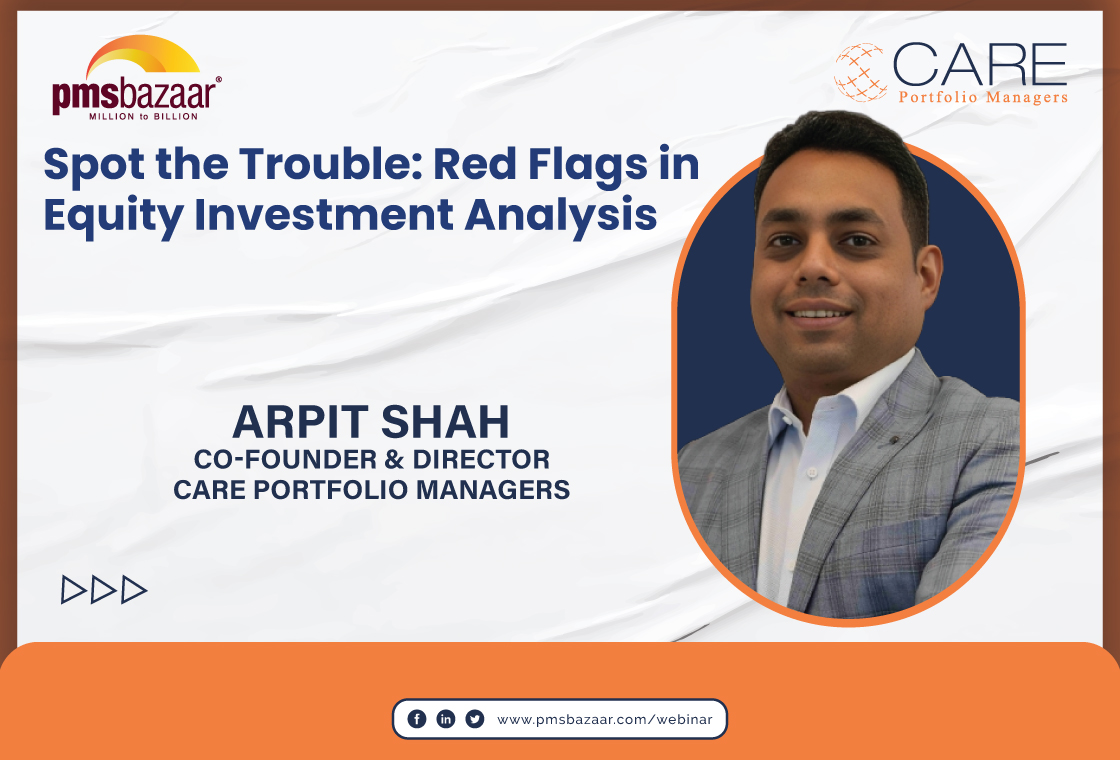
The webinar blog covers insights from Mr. Shah, which includes his insights into identifying red flags in companies during strong market phases. It explains why disciplined investing, understanding management behaviour, and analysing governance issues are crucial. Through real company examples, it highlights risks such as promoter selling, unrealistic guidance, related party transactions, and misuse of debt. The article encourages investors to review portfolios wisely and rely on informed judgement over market optimism.
Key aspects covered in this webinar blog are
- Market optimism and the need for discipline
- Importance of understanding what you own
- Example of red flags ignored in a railway company
- Can AI replace fund managers?
- Portfolio-level discipline and sector allocation
- When red flags can still be investable
- Management inconsistency as a major warning sign
- Related party transactions and governance risks
- Borrowing patterns and misuse of funds
- Conclusion and key investor takeaways
Summary: Mr. Arpit Shah discussed the recent strong market run and highlighted how optimism often hides red flags. He stressed disciplined investing, understanding businesses, and avoiding overexposure to sectors or single stocks. Shah explained that while AI can analyse data, it cannot replace human judgement in evaluating management quality and industry nuances. Using examples from railway, auto ancillary, EMS, dairy, and tea companies, he illustrated how promoter behaviour, unrealistic guidance, poor governance, and misuse of debt can signal trouble. He concluded by urging timely portfolio review and informed decision-making.
Mr. Arpit Shah started the session by providing insights into the equity markets, describing the last three to five years as an extraordinary period. He observed that the strong rally, abundance of liquidity, and a surge of new investors have led to an environment where optimism has often overshadowed caution.
In these buoyant phases, Mr. Shah explained, it is natural for fundamental red flags to be overlooked. Rising prices can misleadingly make weak businesses appear strong, and market momentum often conceals underlying inconsistencies. He stressed that for long-term investors, this is precisely when discipline matters the most. His goal was to recenter discipline, offering clarity rather than fear, to help investors understand opportunities more deeply.
Referencing Peter Lynch, Mr. Shah emphasized the need for investors to know both what they are owning and why they are owning it. He questioned the audience why red flags are pertinent now, noting that despite markets being at a lifetime high, many retail investors’ portfolios have yet to see a corresponding uptick. He suggested that if investors suspected they had missed red flags, his guidance would help them check company fundamentals, identify warnings, and churn their portfolio if necessary.
Mr. Shah illustrated a common trap: a railway company where promoters decreased their holding substantially, yet the public shareholder count increased ninefold, despite no recent share price growth. He cautioned that ignoring red flags in such cases can lead to investors getting trapped.
The Intersection of Research, AI, and Human Artistry
Responding to a question on whether AI could automate and potentially replace the work of a fund manager by interpreting fundamentals and red flags, Mr. Shah firmly disagreed. He argued that while basic numerical analysis might be automated, the deeper interpretation of financial data is highly subjective and cannot be fully standardized.
He stressed that every industry and company requires a different lens; for instance, a textile company cannot be measured using the same parameters as a dairy company. Unique, subjective events—like a specific plant shutdown—impact companies differently and cannot be captured by a generalized automated system. Mr. Shah concluded that research is a blend of art and science, noting that AI might handle the science (the numbers), but the art—the keen interest, judgment, and ability to define what is truly important—will remain with human analysts. He even shared his experience where his firm invested in companies with qualified auditor reports (a red flag) but whose stock still yielded significant 4x or 5x returns due to the analyst's subjective conviction.
Checking for Red Flags at the Portfolio Level
Moving beyond stock-specific red flags, Mr. Shah shared his firm's (KRBMS) approach to portfolio-level discipline, particularly within their growth-plus-value strategy. He emphasized the importance of maintaining a balanced portfolio to mitigate systemic risks.
Key red flags an investor should look out for at the portfolio level include:
- Tilted Allocation: The portfolio should not be overly tilted towards only growth companies or only turnaround companies.
- Liquidity Risk: Exposure to companies with poor liquidity might prevent an investor from exiting quickly when cash is needed.
- Sector Concentration: To mitigate red flags, the firm implements a specific framework: no more than 20% exposure to a particular industry (even if they like the industry) and no more than 12% in any single company.
Drawdown and Participating in the Next Bull Run
Mr. Shah asserted that corrections and drawdowns are inevitable in the market. The crucial factor, he explained, is how an investor positions themselves to participate in the next bull run. Observing that the small-cap and broader markets have been underperforming for the last year, he advised that today is the time to churn the portfolio to companies with greater merit.
He warned against clinging to a stock purely based on the hope that its price will return to a previous high (e.g., waiting for ₹40 to cross ₹100 again) when that capital could be better deployed in companies likely to appreciate in the next cycle. He recommended that investors maintain a four-to-five-year time frame for investments, acknowledging that this period will inevitably include both a correction phase and a bull run. He cautioned that none of us can time the market, not even Warren Buffett.
Differentiating Risky vs. Investable Red Flags
Mr. Shah addressed the difficult question of how to differentiate a company with a red flag that is still worth investing in. The answer lies in deep-dive due diligence and management interaction.
He provided the example of an auto ancillary company with two significant red flags: promoters were reducing their stake and all revenue growth was coming through acquisitions, not organic business expansion.
- Promoter Selling: After meeting the management, Mr. Shah's team learned the exit was logical: one promoter had died, a second generation did not want to continue, and a private equity investor who had helped build the company needed to exit after 7-8 years.
- Acquisition-Led Growth: The investigation revealed the acquisitions were of companies with niche, proprietary technology (e.g., buying the Indian arm of a bankrupt German firm). The acquisitions were strategic, allowing the company to immediately push the new technology through its existing sales channels.
These subjective factors converted initially strong red flags into logical, acceptable business decisions. His firm invested in the stock, which grew from ₹400-500 to ₹1800, proving that not all red flags signify fraud; they simply necessitate a deeper level of investigation. He emphasized that the investor should always ensure that the underlying assets are good and the buying price is reasonably valued.
Management Commentary: A Red Flag to Watch
Mr. Shah pointed to the risks associated with inconsistent management guidelines. He presented a case study of an Electronics Manufacturing Services (EMS) company that gave its first-quarter profit after tax (PAT) guidance 45 days into the 90-day quarter. This late timing already reduced the uncertainty and should have yielded a more accurate forecast.
The company initially guided for a ₹400 crore PAT, attributing the positive outlook to anticipating an early monsoon. However, in the subsequent quarter's call, the management revised the guidance sharply downwards by 33% to ₹300 crore, citing the same reason: the early arrival of the monsoon.
Mr. Shah explained that this inconsistency is a major red flag, emphasizing that management should be honest and transparent with their guidance, especially when two-thirds of the revenue period has already passed. This revised guidance led to a sharp fall in the stock price, and, coincidentally, the management also reduced their holding. Mr. Shah cautioned investors: don't jump based only on guidelines; wait for the company to deliver on its anticipation before buying.
Personal Interest vs. Company Interest: Related Party Transactions
Another critical red flag is the presence of related party transactions that suggest a conflict between personal interest and company interest. Mr. Shah provided the example of a textile company with a total debt of ₹125 crore, where ₹27 crore was borrowed from the promoters themselves at an interest rate of 14.5%.
He noted that the company had access to cheaper institutional funding and other borrowings at sub-6% to 8% interest. Why, then, would the promoters lend funds to their own company at a rate significantly higher than the market rate? . He asserted that this behavior questions the management's integrity. While not necessarily fraud on paper, such practices indicate a management that is prioritizing extracting higher interest income over minimizing the company’s borrowing cost. He advised investors to avoid companies where management integrity is questionable, as there are thousands of other investment opportunities available.
Understanding Business Dynamics: Peer Analysis
Mr. Shah stressed that understanding business dynamics is far more important than mere numerical analysis. He used the dairy industry as an example, noting that it involves highly perishable goods with a shelf life of only about 7 days.
In one dairy company, analysts found abnormally high inventory and receivable days compared to industry peers—a clear red flag in a perishable business. The management vaguely attributed this to a higher weightage of value-added products. This red flag materialized when the company was forced to write off over ₹500 crore worth of inventory, leading to a sharp stock price fall, a delayed annual announcement, and the resignation of the Chief Financial Officer (CFO). Mr. Shah concluded that a peer analysis reveals a company's deviation from industry fundamentals, serving as an early warning signal.
Misuse of Borrowing
Finally, Mr. Shah highlighted the misuse of borrowing by comparing an engineering company with a tea plantation company, both of which significantly increased their borrowing.
- The engineering company increased borrowing from ₹180 crore to ₹680 crore, but this was matched by a parallel increase in fixed assets (e.g., machinery, property), which is logical for a business that needs to expand capacity.
- The tea plantation company increased its borrowing from ₹900 crore to ₹1,900 crore, but instead of using the funds for its core agricultural business, it lent the money to its struggling group companies (like a juice business). The company provided corporate guarantees to help the group. This ultimately led to provisions and the company becoming bankrupt.
Mr. Shah concluded that borrowing itself is not a red flag, but the application of those funds must be logically consistent with the company's industry and business nature.
Mr. Arpit Shah covered all the topics mentioned above in-depth and answered questions from the audience toward the end of the session. For more such insights on this webinar, watch the recording of this insightful session through the appended link below.
Get access to rich data and analytics of PMS & AIF by subscribing to us. Join the 75000+ investors & experts: Subscribe NOW
Recent Blogs
PMS Performance : 401 Equity PMS Beat the Nifty 50 TRI
September 2026 saw global markets grapple with persistent macroeconomic uncertainty, as rising U.S. bond yields, crude oil prices above $90 per barrel and escalating Middle East tensions kept investors on edge. Concerns over renewed inflationary pressures and tighter financial conditions continued to shape market sentiment. The reported 25-basis-point Federal Reserve rate hike, bringing rates to 3.75–4.00 per cent, added another dimension to the evolving global outlook.
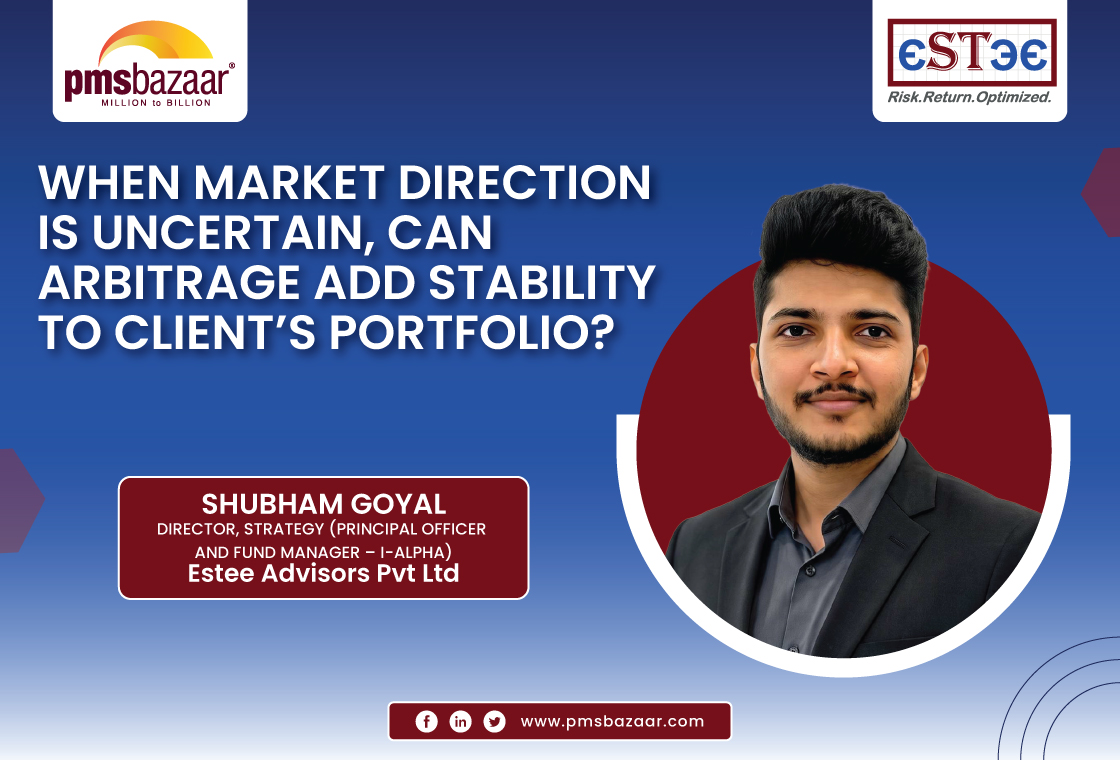
When Market Direction Is Uncertain, Can Arbitrage Add Stability to Client's Portfolio?
PMS Bazaar recently organised a webinar titled “When Market Direction Is Uncertain, Can Arbitrage Add Stability to Client's Portfolio?” which featured Mr. Sandeep Tyagi, Founder & Chairman, Estee Advisors and Mr. Shubham Goyal, Director, Strategy, (Principal Officer and Fund Manager - I-Alpha), Estee Advisors Pvt. Limited. This blog covers the important points shared in this insightful webinar.
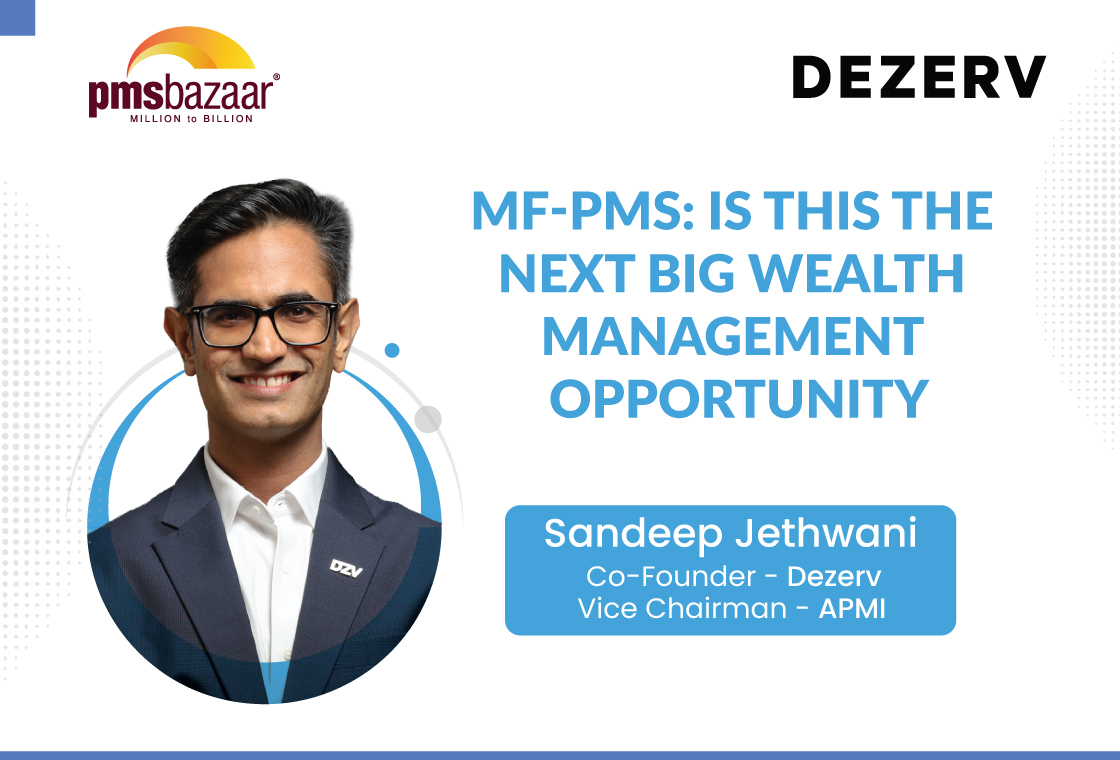
MF-PMS: Is This the Next Big Wealth Management Opportunity
PMS Bazaar recently organised a webinar titled “MF-PMS: Is This the Next Big Wealth Management Opportunity,” which featured Mr. Sandeep Jethwani, Co-Founder, Dezerv & Vice Chairman, APMI.

PMS Performance: Over 94% of Tracked Strategies Beat Nifty 50 TRI
Global markets remained under pressure in August 2026 as geopolitical tensions, rising bond yields and elevated crude oil prices kept investors cautious.

The Next Alpha Cycle: How Should Investors Position ‘Alternatives’ in Their Portfolios?
PMS Bazaar recently organized a webinar titled “The Next Alpha Cycle: How Should Investors Position ‘Alternatives’ in Their Portfolios,” which featured Mr. Akhil Chaturvedi, ED & CBO, Motilal Oswal AMC. This blog covers the important points shared in this insightful webinar.
Performing Private Credit in India: Opportunity, Risk & the Investor’s Perspective
PMS Bazaar recently organised a webinar titled “Performing Private Credit in India: Opportunity, Risk & the Investor’s Perspective,” which featured Mr Saurabh Agrawal, Co-Fund Manager and Partner, Spark Asia Impact Alternative Asset Management.
GIFT City IFSC: India's Emerging Hub for Global Finance
PMS Bazaar recently organized a webinar titled “GIFT City IFSC: India's Emerging Hub for Global Finance,” which featured Mr. Bharath Shivappa, President & Chief of Markets, Gujarat International FinanceTec-City. This blog covers the important points shared in this insightful webinar.
PMS Performance: Who Outperformed in July 2026?
July 2026 was another month marked by uncertainty, with market performance shaped by evolving global cues and shifting investor sentiment. Despite the uncertain environment, equity PMS strategies continued to present opportunities, with several managers delivering returns ahead of the broader market benchmarks.