

23 Sep 2026
Transcript
Ms. Akshara Menon: Welcome back to the fund manager interview series with PMS Bazaar. This is your host Akshara Menon . Today we have a special guest in our studio, Mr. Vijay Baradia from Wallfort PMS. Welcome to the show, sir.
Mr. Vijay Baradia: Thank you. Thank you so much.
Ms. Akshara Menon: When I was researching about you, I understood that you are going to Harvard for your executive studies. With so many years of experience in this industry, what really made you choose this path?
Mr. Vijay Baradia: There is a very interesting story behind this, Akshara. My daughter just turned 18, and last year in September she came and told me that she wants to do her undergrad from the US. That is when we started applying for her, and in that process I said, I started working very early when I was 17 and I just did my B.Com after that. So I thought, let us go with her and that will be a great experience, and why not pursue. I believe learning has no finish line. It is a continuous process which you have to keep following. Markets are evolving, so is everything around us. So we also have to keep evolving. When she came to me and said that she wants to study there, she applied and she was applying to one of the universities in Boston. So I also said, let me also come — father and daughter can go together and study together. So I also applied and I got in, and my daughter did not get the university she was wanting to go to, but she got into a better university. She is now on the west coast. She is going to USC.
Ms. Akshara Menon: Mhm.
Mr. Vijay Baradia: And I am going to Harvard. I am going to spend a few weeks at Harvard and then I am going to spend two weeks with my daughter every year for the next three years.
Ms. Akshara Menon: So how do you feel about this return to college life?
Mr. Vijay Baradia: As I said, learning has no finish line. I believe Harvard is going to be a great experience. I have heard a lot about the course. I have read about the program. There are only entrepreneurs from across the world who come there who want to scale their business. We all know that the top 10 companies in the world who have scaled very large are all from the US. So I just want to go there and meet people from across geographies, across countries, how they have built their businesses, what challenges they faced, and learn from that.
Ms. Akshara Menon: Now you spoke about your daughter, your family, within three decades in this industry. So what were the lessons? Generally the family is in the same industry, even dining table conversations would be on the same path. So what were the investment decisions or what were the lessons that you learned during the years of experience here?
Mr. Vijay Baradia: Yes, you are right. Dining table conversations too — every family outing usually with my brothers. We live in a joint family, a large joint family of 30 to 35 people.
My older brother Ashok Bharadia started in 1987 as a sub-broker. Then we became brokers in 1994. I joined in 1997. But I was always fascinated when my brothers used to go to the ring during that Harshad Mehta time and all the conversations about how you bought shares and sold shares and that journey at home. Many lessons, right from my grandfather to my father, were all about integrity. Whatever you do, you have to do it with complete integrity. That is the only way to prosper for yourself as well as people associated with you. So integrity was a very large lesson which Dadaji always spoke about, and which I think the next generations followed, and that is how we have reached where we have reached today in the last 30 years.
Good businesses again with good founders. The way you want to have integrity, you want the founders also to resemble that. As far as you are able to resonate with the similar qualities which you are thinking about and brought up with, if you are able to find those traits in the founder also — where he is very hardworking — my father is 82 today and he still goes to office from morning 11 to evening 8. So he is still working more than me.
That is what we also want to continue. Seeing the discipline which the grandfather and fathers everybody had, we want to just continue with that. A lot of those things I have been able to implement in my life in bits and parts, and that has led to where I am today. Yes, the family conversations were very important and they always lured me into the stock market.
Ms. Akshara Menon: From your answer I could get two things. One is the integrity part, which is very important. The other one is that you don't need to search for inspiration outside. It is always inside, inside your family. And at 82 years still working, which means you are also inspiring people like us out here. Thank you for that.
Mr. Vijay Baradia: Thank you.
Ms. Akshara Menon: When you say about integrity here, it is very important. For a fund manager, it is not about betting on India's growth story but rather on the business, a good business. So what should a fund manager look into to find a good business?
Mr. Vijay Baradia: Very nice question. As I said, my grandfather was 99 when he passed away. Inspiration from him, inspiration from my father, inspiration from my brothers who have worked relentlessly to get us where we are. So in the founder again, you look for similar traits. I mean his integrity, his behavior while he was nothing and while he becomes something. That behavior should not change. His hard work has to be there. To the company he is in, to his shareholders, to his employees — how he behaves with them. We spend a lot of time with the founders before we invest in any company. The research starts much earlier where we evaluate the company for almost 6 to 9 months before we can invest. We do all the possible channel checks, peer comparison, industry experts and everything we can do to know about the founder, because eventually we are betting on the founder and his capability to execute rather than anything else. The business has to be good. First we look at the industry which is going to do well and then we go and look at the founders who will be able to consistently deliver in terms of numbers. If the capability is there and integrity is there, then I think the journey becomes much easier.
Ms. Akshara Menon: So which means the combination of top-down and bottom-up approach.
Mr. Vijay Baradia: Yes.
Ms. Akshara Menon: Great answer, sir. This actually gives me curiosity now. You have spoken about betting on founders which will enable the stock or the company to enter your portfolio. Then what decides your exit?
Mr. Vijay Baradia: Valuation — beyond a point certain valuations do not resonate. Eventually earnings have to catch up. I will give you a better answer. There are three reasons we sell. The first reason is if there is any corporate governance issue, which usually we take a lot of care about before entering, but as I said things are evolving and changing on a daily basis. That is one sell button. Then the other is if there is a disruption in a particular industry, then it is a sell. I will give you an example: when EVs were announced, Amara Raja and Exide, which hold almost 90% market share in the battery market, did not do anything for 5 to 6 years. There was no return, so they became a sunset industry. If we feel there is a disruption where the company cannot immediately adapt and change and there will be time value loss of money, then we sell. Or if we find a better opportunity where a particular stock has run up quite a bit or the valuations today are less attractive compared to something new we found where we can make more money in the stipulated time, then we will exit. So these are the three reasons we would sell.
Ms. Akshara Menon: You have spoken so much about this exit part. Let us put it in very layman terms for an investor out here. Today when an investor is going to enter, what expectation should he have? Because the investors who entered before 2020, the returns that they made — an investor who is entering now, can he make the same returns? That is one question. And second, what kind of expectations should he have from the equity markets of India?
Mr. Vijay Baradia: Very nice question. We are living in two worlds. We have lived in two worlds. One is pre-Covid, one is post-Covid. Post-Covid, people's expectations right from returns — what we have seen over the last 5 years in the stock market — have been dramatically different from the past few decades. I think whosoever invests today firstly has to — investing in the small and micro cap industry itself is a challenge. The first thing is, the way we do our due diligence in terms of which companies, which businesses we want to invest — the investor should do his due diligence in terms of the fund manager he wants to invest with. There are more than a thousand fund managers, and he has to do his due diligence on how comfortable or certain he is that there is nothing wrong going to happen with his money. That is the first thing he has to assess. And then obviously today risk-free return in the bank is not more than 6 to 7% on your FD and the tax is almost 35 to 40%. Whereas in equity, if you are able to make 18 to 20%, which is essentially doubling your money every four years, that is a good return to have. So the expectation should be around that, and not the way last few years our return also has been phenomenal, but past experience cannot be the benchmark for the future. I think a reasonable expectation is to have 18 to 20% kind of returns.
He also has to time his horizon. Especially if he has no money to invest for 3 to 5 years, then this space is again not for him. And I think if he cannot digest volatility, that is another thing, because in small and micro cap, anything happens in US or Iran or Taiwan, India — it hits the small and micro cap companies. So having these basic things — return expectation has to be muted, high volatility has to be digested, and a 3 to 5 year horizon has to be there — then I think these are the few things he should look at before investing in this space.
Ms. Akshara Menon: After September 2024, small caps have not delivered what they actually should. So is it a good time for small and micro caps?
Mr. Vijay Baradia: I will reiterate my answer on that. If you have a 3 to 5 year horizon, any time is a good time to invest in the market. I believe India in the next 10, 15, 20 years is going to keep growing. The 140 crore people all aspiring to grow. Out of that, only 6000 & 7,000 companies have reached the stock exchange. Out of that, we just have to find 15 to 20 companies, or good promoters, good businesses, which are going to deliver superior returns in the next few years. So again, your time horizon should be the point you are concentrating on and not the timing. It is about time in the market and not timing.
Ms. Akshara Menon: Patience is more important than industry.Let us talk about your strategy. Your diversified fund has given over 40% in the last 3 months and also 25% annualized returns. What made you deliver this big alpha?
Mr. Vijay Baradia: Thank you so much for that question. I believe it is not the outcome, it is the process. We focus more on the process, consistently applying the 4P strategy to all the stock ideas. We look for monitoring the earnings and not the stock price. We continuously monitor the earnings. We do our risk management in terms of continuously meeting the management every 6 months and understanding from him what the next step he is taking in the right direction or otherwise is, and thinking in years, not in quarters. We think from day one. Whatever we have done 3 months back has not delivered these returns, but we have thought 2 years in advance and that is now bearing the fruits of what you are seeing. We think long-term while entering a stock, as I mentioned, a 3 to 5 year horizon. It is not only for the clients, for us also. We also think from a 3-year perspective whether we will be able to hold the stock and whether this stock will be able to deliver certain numbers which we have researched.
Ms. Akshara Menon: Let me talk about this investment sentiment here. Investor sentiment is more like a fund is doing good. I mean, it is having a consistent alpha — he doesn't talk about it much. But the moment the market has its downside and his portfolio is deteriorating, it is coming to red, and what happens is that immediately he asks a lot of questions and then he comes with a lot of calls, so many conversations happen after that. So how do you see the investor sentiment before and now?
Mr. Vijay Baradia: You are absolutely right, and that is human nature. As far as things are falling in place, everybody feels they have picked the right fund manager. But as soon as things start going south, they question what he has done and what he has not done properly. That is when the circle of competence comes in. We don't do anything outside our circle of competence. What we don't understand, what we are not able to project the future for — in terms of reasonable earning growth — we don't invest in those companies. So when you understand something and invest in something, you are able to explain that also very easily. All these questions do come. We have investor calls regularly as and when the markets have been down to handhold our investors and tell them what we are doing and what has gone wrong or what has gone right. If we were gods, everything would be right, but that is not the way it is. We also will make mistakes, but we keep learning from our mistakes. We accept our mistakes and we move on. We consistently work on what we are doing. We are 24 by 7 working, because when you manage your own money the responsibility is far less, but when you are managing outside money your responsibility goes 10x. I think knowing what you are doing helps us explain even during the period when the market is not supporting our thesis.
Ms. Akshara Menon: Now let us talk about your new AIF, about the investment journey and all. What has inspired you to start that?
Mr. Vijay Baradia: Yes, this is a new journey we started. It is the same architects, same team, same philosophy, but another product. In this product I think we are able to provide the unlisted part also, which is another interesting thing which we have done over the past 3 years. In 2024, as you mentioned, the markets were very richly valued and it was difficult to find opportunities where we were comfortable with the valuation. So we started looking at unlisted opportunities, where we evaluated almost 108 to 109 companies, out of which we found four or five companies where the founders were excellent and the growth path, the industry, was very good. Everything according to our understanding was there. So we invested via our family office and also made our PMS clients co-invest. But now to get that in a proper structure, we thought AIF will be the right route where we are able to do listed as well as unlisted. In the AIF we are going to have more than 70 to 75% listed with a similar mindset, and 20 to 25% will be unlisted to generate a little more alpha, because in unlisted I think we are able to get the kind of quantity we want at a valuation we are looking for. That is the main reason for that.
There are certain clients who are not allowed to own stocks in certain — maybe certain lawyers, certain life insurance managers, or certain people. For them, AIF — they are holding units. So it is okay. And our existing clients had certain things about every year tax filing which they didn't want to do. So again, AIF where you get units, you enter, you sell after 5 years, whatever you get is tax-free, as in the AIF pays the tax and the money in your hand is tax-free. So these are a few reasons why we are starting the AIF, but it is absolutely the same team, same philosophy, everything same, just a little bit of unlisted flavor.
Ms. Akshara Menon: You spoke about the investment philosophy part as well. Now let us talk about risk management. You have said on LinkedIn that risk doesn't come only from markets alone. It also comes from what you are not knowing to do. Can you explain that, sir?
Mr. Vijay Baradia: As Warren Buffett has always said, do something which you understand. You should understand your circle of competence. Every person cannot understand every industry and every business deep down. Certain businesses you understand, you are able to project or envisage the future in those stocks in terms of earnings, and you are able to monitor all the variables in that. Knowing basically is very important in what business you are investing, because it is a game of probabilities. Eventually you are just thinking in probabilities — what will work out, what will not — even the founder, even the fund manager. If you don't know the business and if you don't know all the nitty-gritties of the business, all the moving parts of the business, then in tough times you will not be able to understand whether the fall in the stock price is because of an internal problem where the business is going bad or the industry is going bad, or whether it is an external problem like a war happened which took down prices of many stocks for no reason. If you know the business, you will be able to judge whether it is an internal problem or an external problem. The risk comes when people think today everybody has painted small and micro cap or the theme as risky.
Ms. Akshara Menon: Yes.
Mr. Vijay Baradia: I don't see anything as risky. Risky is when you don't know where you are investing. If you know the business, you know the promoter, you do your study, you understand the business, you project your financials well for the next 3 to 5 years, and then you are fine going into something. I will give you another example. There is a hole in front of you and you will automatically go from the side, but if you don't know, you will fall into it. It is the same. I think risk comes from not knowing what you are doing. If you know what you are doing, then it is not risk. It is again, as I said, probabilities.
Ms. Akshara Menon: Great. I think risk is never risk unless you know what you are doing.
Mr. Vijay Baradia: Yes.
Ms. Akshara Menon: That is a great thing. It is unfair to not take this question about SEBI's consultation paper on the PMS. What is your take on it, sir?
Mr. Vijay Baradia: I think it is a great move. We have always been complaining about how PMS and AIF have been given less priority compared to a mutual fund, and that is the reason we have seen the mutual fund AUM grow beyond size. Opening the gates for more entrepreneurs to come and do it — they have spoken about reducing the capital from 5 crores to 2 crores, the minimum funds allowed from 50 lakhs to 25 lakhs. I think these are great steps and this will open up the industry even more. There will be more managers as the industry grows. Everybody in it grows, I believe. Opening up the market is a great move and I think SEBI should keep taking more steps in this manner. They have also spoken about allowing unlisted in the PMS, which is again a very good step, because anybody who is doing something — if it is allowed for a mutual fund, allowed for an AIF, why not for a PMS? Eventually all the fund managers are doing the same thing. Companies, be it unlisted, be it listed, be it anywhere, all companies are run by founders. If you are able to invest in those via any structure, everybody should be given a similar stage or platform to start.
Ms. Akshara Menon: With that, you have come to the end of this podcast. I think it was a really wonderful conversation with you. It is more about the investment philosophy, about Wallfort, and more about you. You have also inspired people like us that age is just a number — you can learn or understand things at any time that you want. Thank you so much.
Mr. Vijay Baradia: Thank you. Thank you so much, Akshara, and thank you PMS Bazaar. I think PMS Bazaar is a great platform where they don't have a conflicting business to the fund management thing. We as a firm also did not have any distributors, and PMS Bazaar was one of the first distributors we started with one and a half years back. I think you all are doing great work and continue doing the same.
Ms. Akshara Menon: Thank you.
Mr. Vijay Baradia: Thank you so much.
Top Viewed Interviews
18 Sep 2024

How to find multi-baggers with Small & Mid cap valuations?
Mr.Arpit Shah
Co-Founder, Investment Director & Fund Manager
Care Portfolio Managers Pvt Ltd
This interview with the Co-Founder & Investment Director of Care PMS, Arpit Shah, focuses on the company’s investment philosophy, particularly their approach to identifying multi-bagger stocks in the small and mid-cap space by considering factors like valuation, management quality, and potential growth triggers.
08 Jan 2026
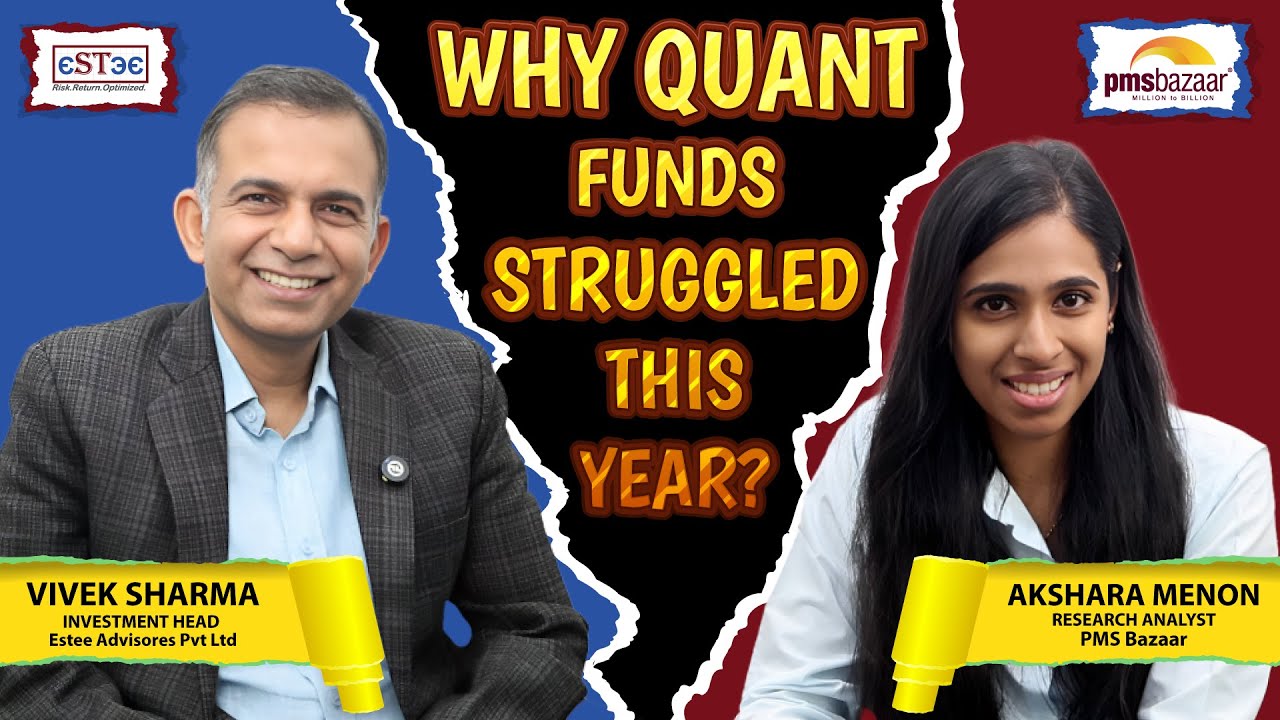
Why Quant funds underperformed in 2025?
Mr. Vivek Sharma
VP and Head of Investments at Estee Advisors
Estee Advisors Pvt Ltd
This interview with Vivek Sharma, VP & Head of Investments at Estee Advisors, discusses the evolution of quant investing and why quant funds underperformed in 2025. He shares views on factor cycles, risk management, AI, and the importance of disciplined, process-driven investing.