


Nearly 3/4th beat Nifty 50 TRI, while average equity PMS return stayed positive at 0.9 per cent amid volatility

After a shaky start to 2026, February offered a modest respite for equity PMS strategies, even as the broader market remained volatile and the headline benchmark stayed under pressure. Among 451 equity PMS strategies tracked out of a PMS Bazaar universe of over 500 PMS strategies, the average one-month return stood at 0.9 per cent in February 2026. Returns, however, were widely dispersed, with the best-performing strategy gaining 11.21 per cent and the weakest declining 8.31 per cent, underlining the sharp divergence in portfolio outcomes during the month.
A majority of equity PMSes managed to stay in positive territory. As many as 288 strategies, or 62.3 per cent, delivered gains, while 163 strategies, or 37.7 per cent, ended in the red. Importantly, PMS performance compared favourably with benchmark indices. While the Nifty 50 TRI slipped 0.51 per cent during the month and the S&P BSE 500 TRI rose 0.45 per cent, 336 equity PMSes, or 74.5 per cent, beat the Nifty 50 TRI and 254 strategies, or 56.3 per cent, outperformed the S&P BSE 500 TRI.
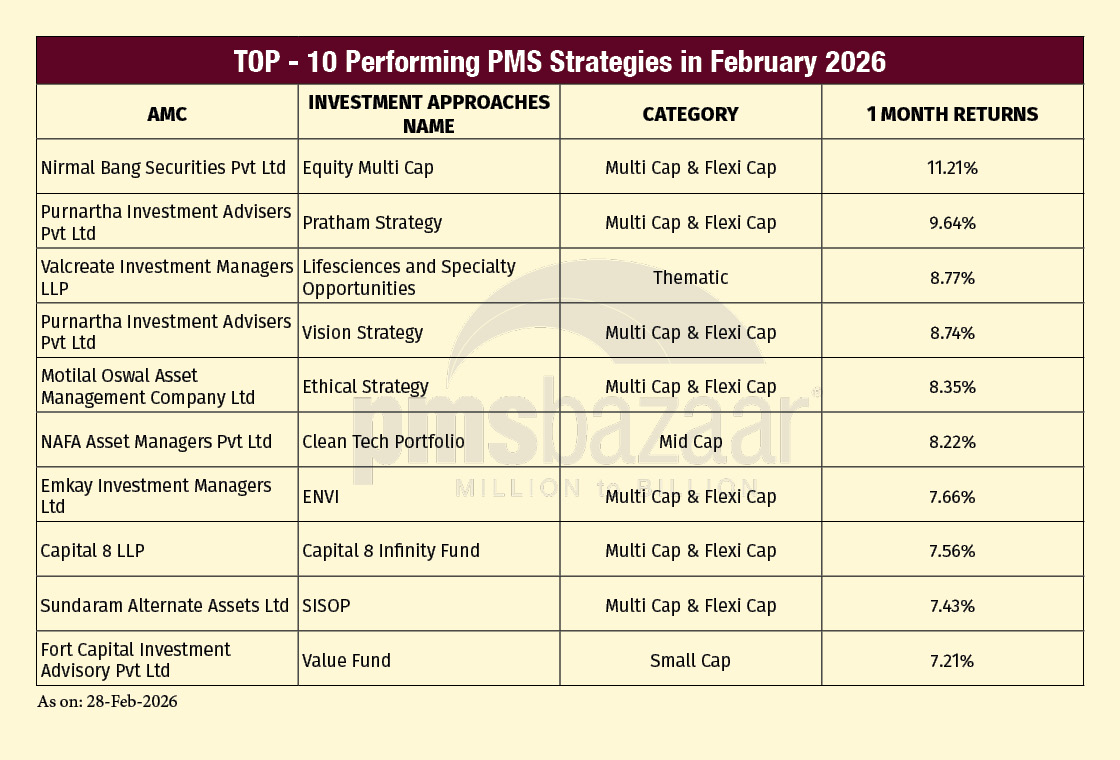
The month also saw a healthy spread of standout performers. The top 10 equity PMSes delivered returns ranging from 7.21 per cent to 11.21 per cent, led by Nirmal Bang Securities’ Equity Multi Cap, followed by Purnartha’s Pratham Strategy, Valcreate’s Lifesciences and Specialty Opportunities, and Purnartha’s Vision Strategy. Their outperformance came despite a market that corrected for a third straight month and saw sharp sectoral swings beneath the surface.
Let us take a deeper look at how PMS performance evolved in February-2026.
Top-10 performing PMSes of the month
February’s top-performing PMS list suggests that alpha did not come from one narrow market pocket. The leadership was fairly diverse, spanning multi-cap, thematic, mid-cap and small-cap strategies, which points to stock selection and portfolio construction mattering more than a simple style call in a volatile month.
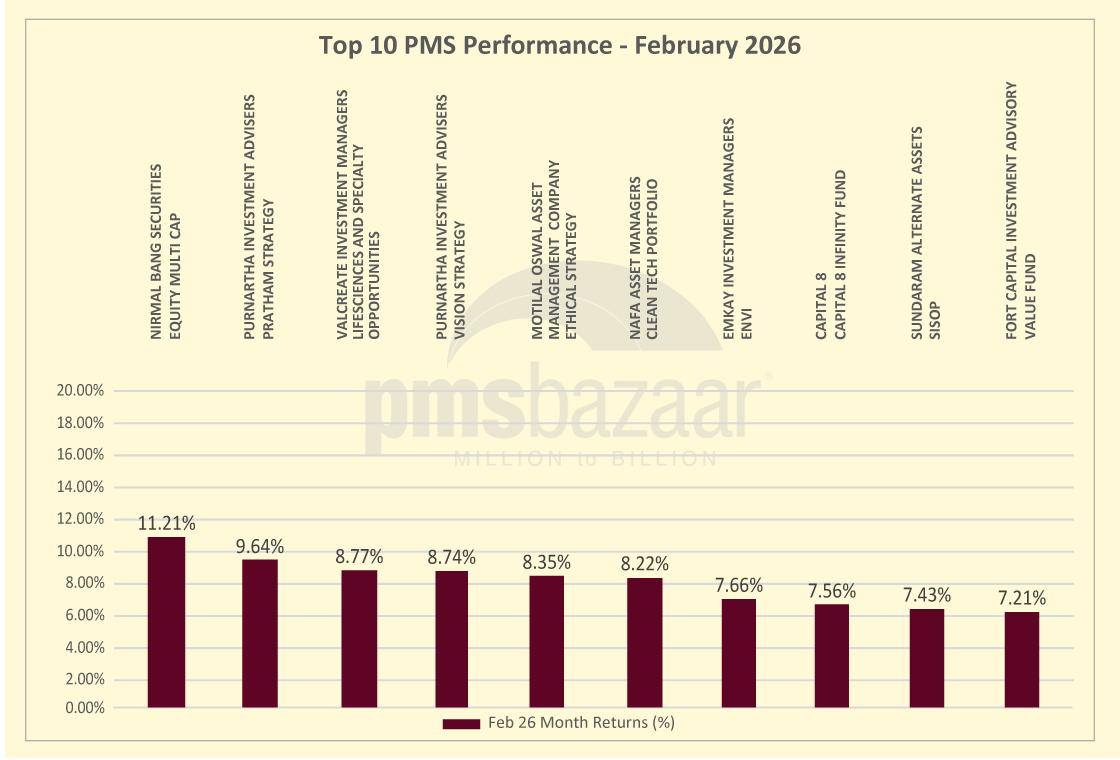
Nirmal Bang Securities’ Equity Multi Cap topped the chart with an 11.21 per cent return, opening a clear gap over the rest of the field. Purnartha Investment Advisers featured twice in the top four, with Pratham Strategy at 9.64 per cent and Vision Strategy at 8.74 per cent, indicating consistency within its investment framework. Valcreate Investment Managers’ Lifesciences and Specialty Opportunities, at 8.77 per cent, also stood out, showing that thematic strategies could still generate strong upside when sector positioning is right.
The broader composition of the top 10 is equally telling. Multi-cap and flexi-cap approaches dominated the list, but investors also saw strong contributions from more focused offerings such as NAFA Asset Managers’ Clean Tech Portfolio, Sundaram Alternate Assets’ SISOP and Fort Capital’s Value Fund. Motilal Oswal AMC’s Ethical Strategy and Emkay Investment Managers’ ENVI further reinforced that differentiated mandates were able to navigate a choppy market effectively.
For investors, the key takeaway is that February rewarded selective risk-taking rather than passive market exposure. Even in a month marked by volatility and a third straight benchmark correction, well-positioned PMS strategies were able to capture sectoral opportunities and deliver meaningful outperformance.
Category overview: How Februrary-2026 panned out
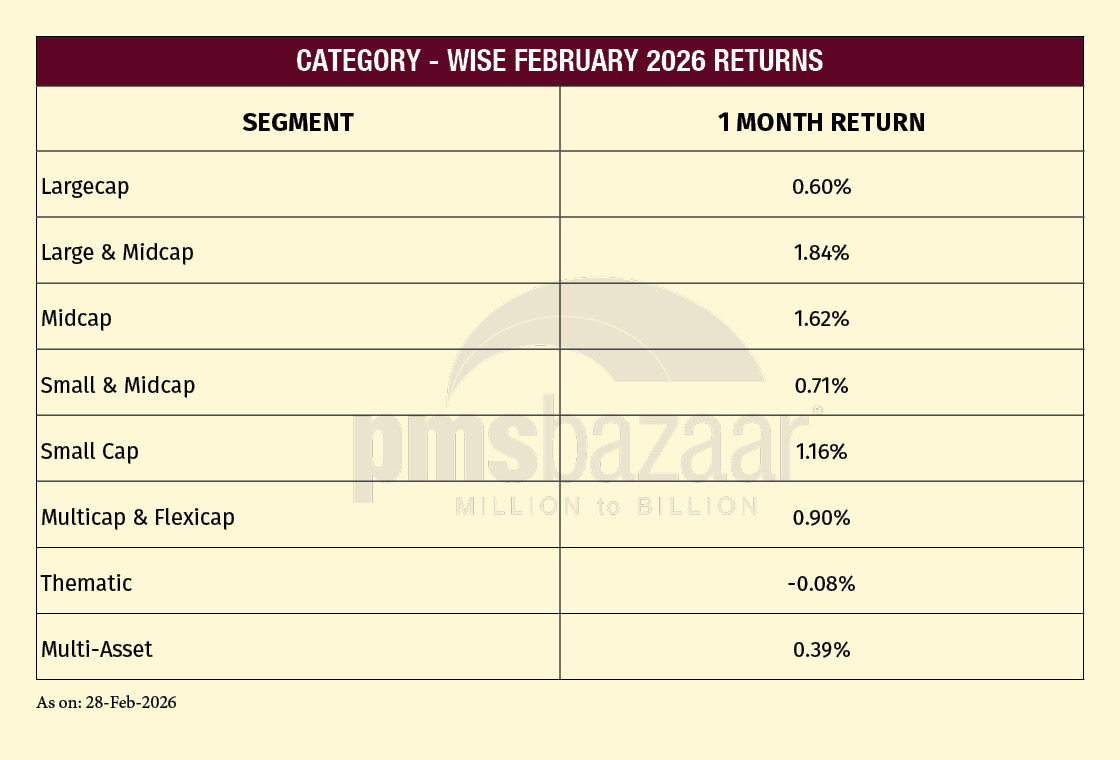
Category-level performance in February 2026 shows that PMS returns were strongest in the broader market buckets rather than in the most benchmark-hugging or narrow thematic segments. Large & Midcap strategies led the pack with an average one-month return of 1.84 per cent, followed by Midcap at 1.62 per cent and Small Cap at 1.16 per cent. That pecking order is notable because it suggests managers were able to extract more alpha from the wider market even as headline indices remained under pressure.
Multicap & Flexicap strategies, the largest and most diversified PMS category, delivered an average return of 0.90 per cent, broadly in line with the overall equity PMS average. Largecap strategies trailed at 0.60 per cent, indicating that the more index-aligned end of the market offered relatively less room for outperformance during the month. Small & Midcap strategies, at 0.71 per cent, sat between these two ends.
The biggest laggard was the thematic category, which on average slipped 0.08 per cent. In a month marked by sharp sectoral rotations, that underperformance suggests concentrated bets were less forgiving unless managers were positioned in the right pockets. Multi-Asset strategies delivered a muted but positive 0.39 per cent, reflecting their relatively defensive construction.
The broader message is that February rewarded breadth, flexibility and stock selection. Strategies with room to move across market-cap buckets appeared better placed to navigate volatility than narrowly defined mandates.
Large & Midcap PMSes top category rankings in February-2026
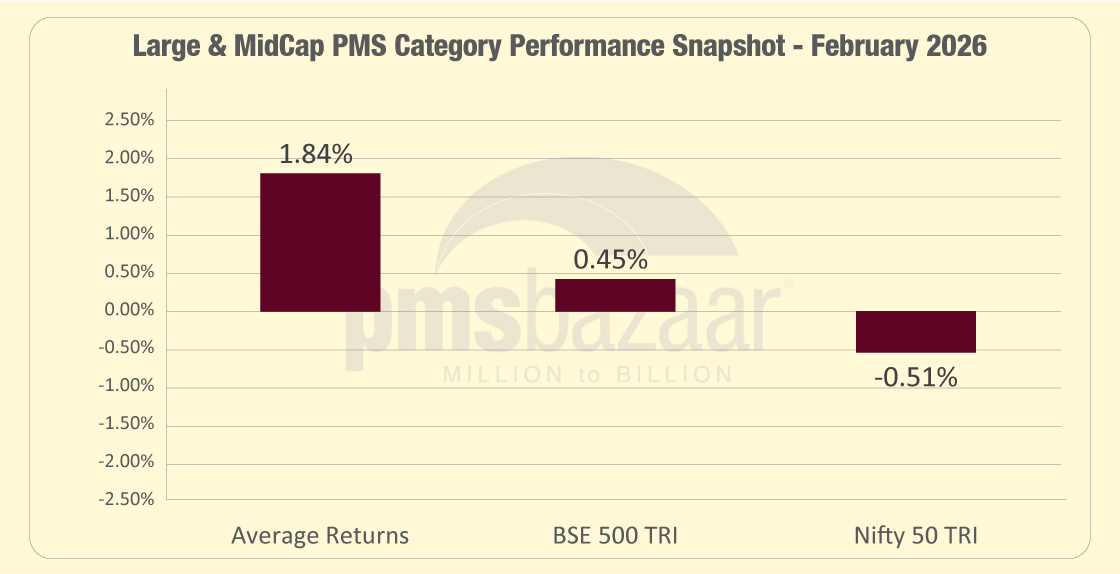
Large & Midcap PMSes were the best-performing category in February 2026, with 24 schemes delivering an average return of 1.84 per cent. That comfortably exceeded both the S&P BSE 500 TRI’s 0.45 per cent rise and the Nifty 50 TRI’s 0.51 per cent decline. Breadth of outperformance was strong: 18 schemes beat the BSE 500 TRI, while 23 outperformed the Nifty 50 TRI. That suggests this category benefited from having enough large-cap stability while still retaining exposure to the relatively stronger mid-cap segment.
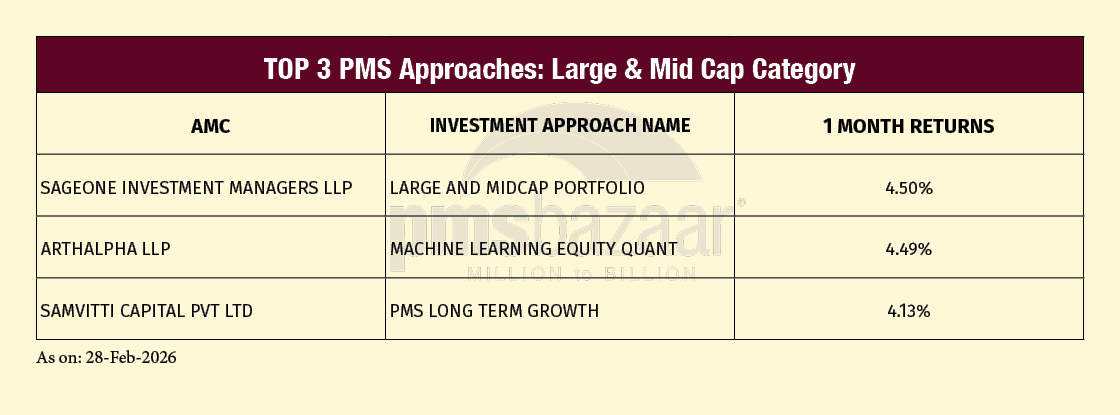
The top performers also point to a fairly broad-based leadership within the category. SageOne Investment Managers’ Large and Midcap Portfolio led with 4.50 per cent, closely followed by ArthAlpha’s Machine Learning Equity Quant at 4.49 per cent and Samvitti Capital’s PMS Long Term Growth at 4.13 per cent. Green Lantern Capital’s Alpha Fund and Cosmea’s All Weather Portfolio also delivered strong gains. The takeaway is that February rewarded managers who could balance resilience with selective participation in broader-market opportunities.
Mid-cap PMSes stay ahead despite volatile market backdrop
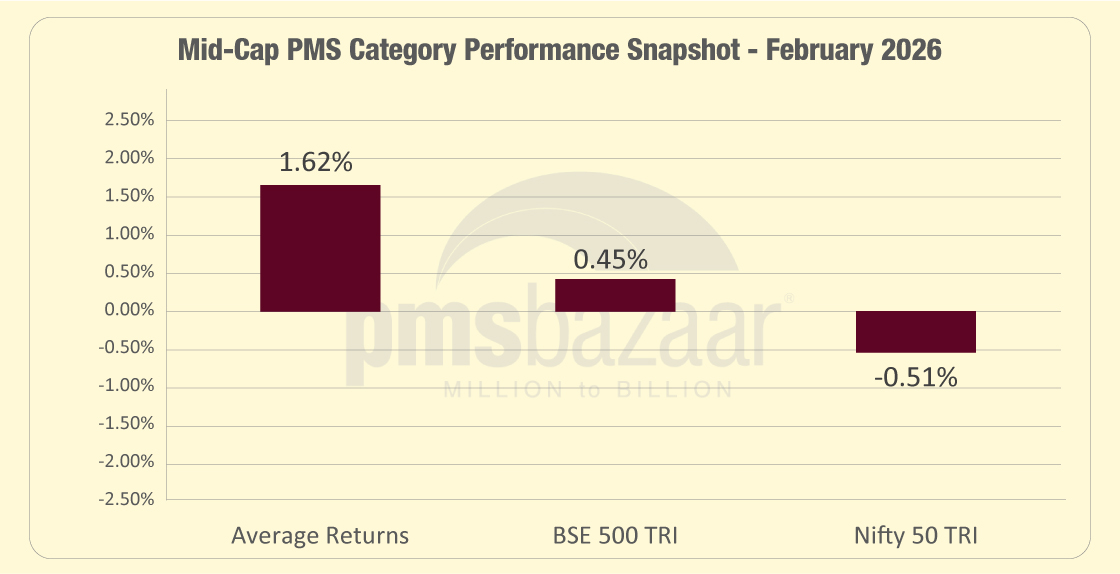
Mid-cap PMSes were among the stronger categories in February 2026, with 22 schemes delivering an average return of 1.62 per cent. That was comfortably ahead of the S&P BSE 500 TRI’s 0.45 per cent gain and far better than the Nifty 50 TRI’s 0.51 per cent decline. Outperformance breadth was healthy, with 14 schemes beating the BSE 500 TRI and 17 outperforming the Nifty 50 TRI. The category’s showing fits with the broader market trend in February, when mid-cap indices outperformed the frontline benchmark despite continued volatility.
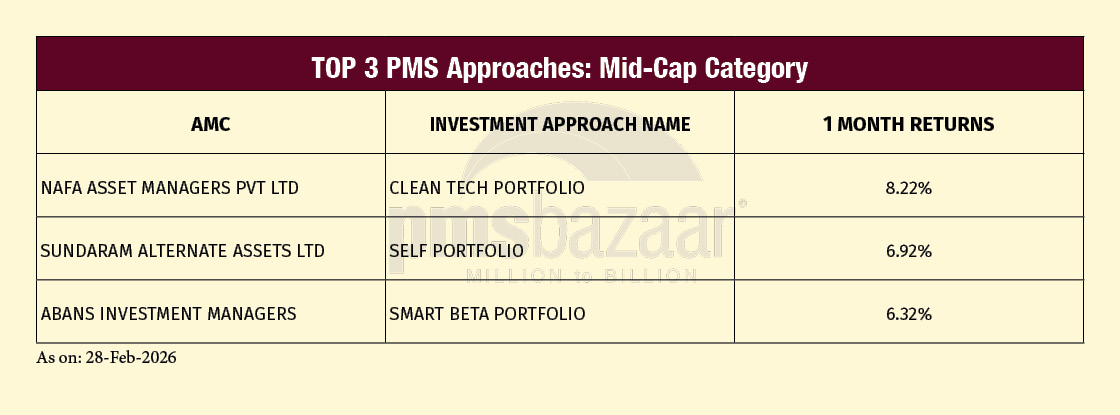
The return dispersion within the category, however, was quite sharp. NAFA Asset Managers’ Clean Tech Portfolio led by a wide margin with an 8.22 per cent gain, followed by Sundaram Alternate Assets’ SELF Portfolio at 6.92 per cent and Abans Investment Managers’ Smart Beta Portfolio at 6.32 per cent. That gap between the top performers and the rest suggests that sector positioning and portfolio concentration played a meaningful role. Beyond the top three, returns moderated, with Nuvama’s Equities eXpansion Target, Omniscience Capital’s Omni Barons and Eureka’s Signature Approach delivering more measured gains. Overall, the category appears to have benefited from selective participation in stronger market pockets rather than a uniform mid-cap rally.
Small-cap PMSes deliver selective outperformance
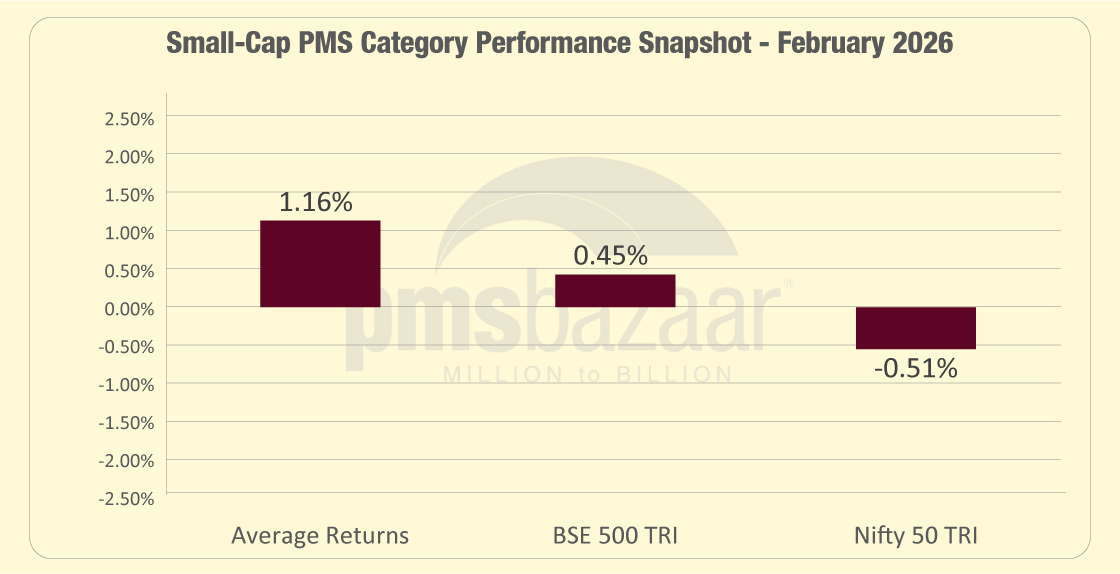
Small-cap PMSes remained in positive territory in February 2026, though the category trailed large & midcap and mid-cap peers on average. Across 27 schemes, the average return stood at 1.16 per cent, still comfortably ahead of the S&P BSE 500 TRI’s 0.45 per cent gain and the Nifty 50 TRI’s 0.51 per cent decline. Outperformance breadth was respectable, with 17 schemes beating the BSE 500 TRI and 20 outperforming the Nifty 50 TRI. That suggests the category continued to benefit from stock-specific opportunities, even if returns were less broad-based than in some other segments.
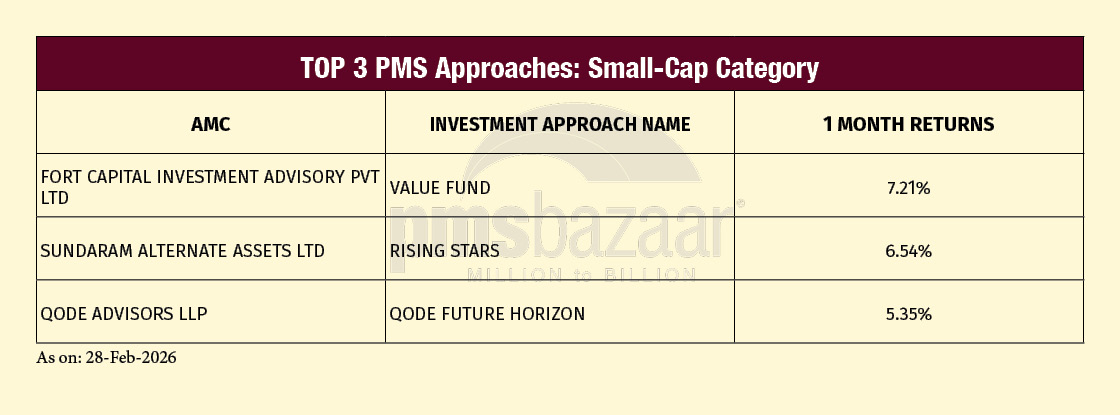
The top performers show that alpha in small-caps remained available, but was far from uniform. Fort Capital Investment Advisory’s Value Fund led the category with a 7.21 per cent return, followed by Sundaram Alternate Assets’ Rising Stars at 6.54 per cent and Qode Advisors’ Future Horizon at 5.35 per cent. Qode Growth Fund and NMR Growth Strategy also posted strong gains. The spread between the leaders and the rest indicates that manager selection mattered significantly in this segment. In a market still dealing with volatility and uneven sectoral moves, small-cap PMSes appear to have rewarded disciplined stock picking rather than broad exposure to the segment.
Multi & flexicap PMSes show wide dispersion
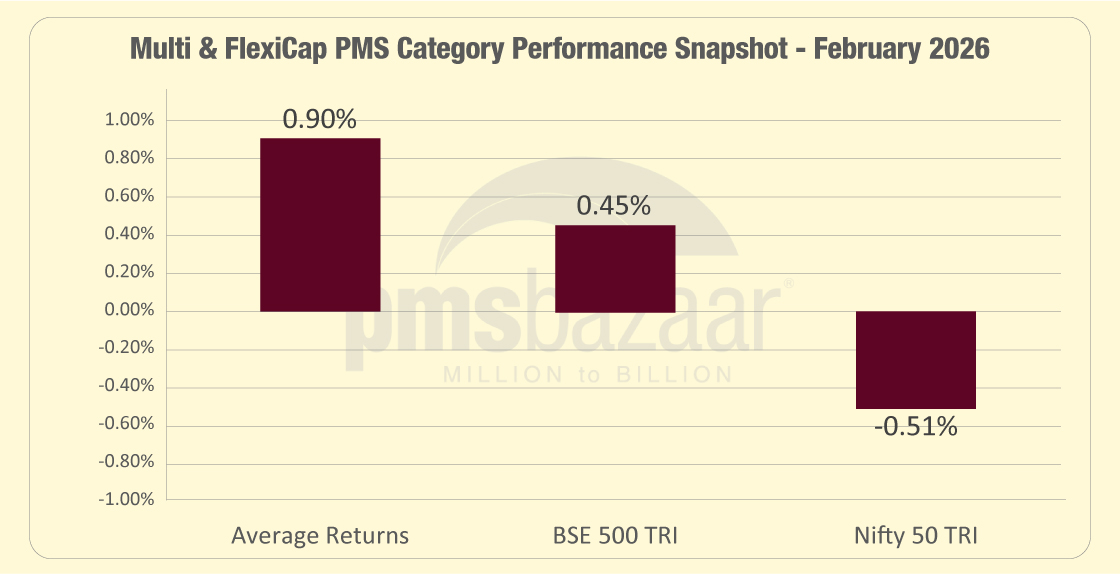
With 260 schemes, multi & flexicap remains by far the largest PMS category, making its performance a useful barometer of how actively managed equity portfolios navigated a volatile market. The category delivered an average return of 0.90 per cent, ahead of both the S&P BSE 500 TRI’s 0.45 per cent gain and the Nifty 50 TRI’s 0.51 per cent decline. In breadth terms too, the category held up well: 140 schemes beat the BSE 500 TRI, while 192 outperformed the Nifty 50 TRI.
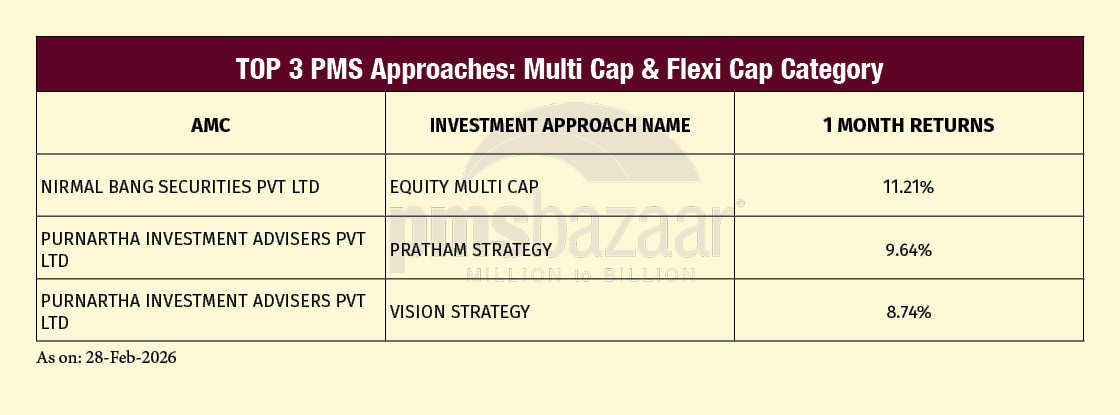
But the more striking feature was the return dispersion. The gap between the category average and the best-performing strategies was unusually wide, showing that manager selection mattered far more than category exposure alone. Nirmal Bang Securities’ Equity Multi Cap led with 11.21 per cent, followed by Purnartha’s Pratham Strategy at 9.64 per cent and Vision Strategy at 8.74 per cent. Motilal Oswal AMC’s Ethical Strategy and Emkay’s ENVI also posted strong gains, while Capital 8 Infinity Fund, Sundaram’s SISOP and Axis Securities Kaizen rounded out a strong top tier.
For investors, this category’s February performance reinforces two points. First, flexibility across market-cap segments did help managers navigate uneven market conditions. Second, simply being in a diversified category was not enough; outcomes depended heavily on portfolio positioning, conviction and stock selection.
Mid & small-cap PMSes deliver measured outperformance
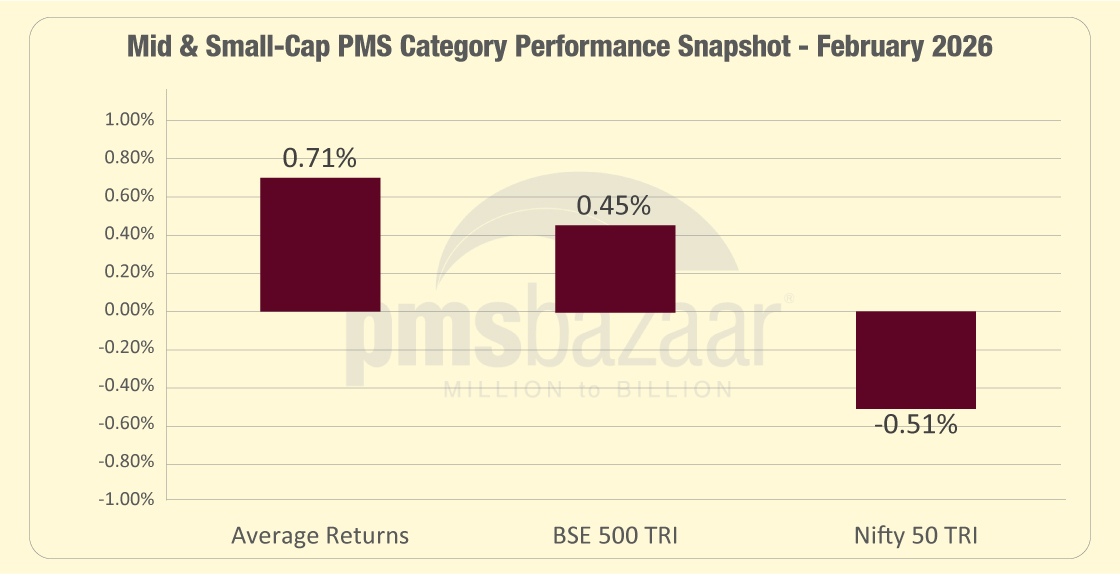
Mid & small-cap PMSes posted a more moderate showing in February 2026 compared with some other broad-market categories, but still managed to stay ahead of benchmark returns on average. Across 58 schemes, the category delivered an average one-month return of 0.71 per cent, above the S&P BSE 500 TRI’s 0.45 per cent gain and well ahead of the Nifty 50 TRI’s 0.51 per cent decline. In breadth terms, 33 schemes outperformed the BSE 500 TRI, while 46 beat the Nifty 50 TRI, indicating that a reasonable share of managers were still able to add value in a volatile month.
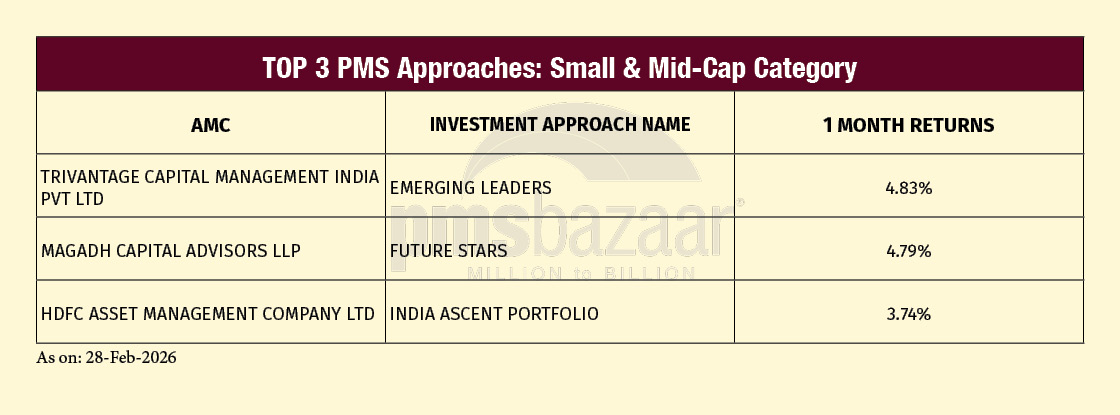
The top end of the category showed healthier upside than the average suggests. Trivantage Capital Management’s Emerging Leaders led with a 4.83 per cent gain, closely followed by Magadh Capital Advisors’ Future Stars at 4.79 per cent. HDFC AMC’s India Ascent Portfolio and Accuracap’s Picopower also turned in strong returns, while Geojit’s Advantage Portfolio and Wallfort’s Avenue Fund featured among the better performers.
The broader reading is that this category participated in the month’s opportunities, but in a more measured way than pure mid-cap or small-cap strategies. That makes sense in a market where leadership was uneven. The blend of mid- and small-cap exposure offered room for alpha, but outcomes still depended heavily on stock selection and positioning rather than a broad-based rally.
Large-cap PMSes stay positive, but alpha remains selective
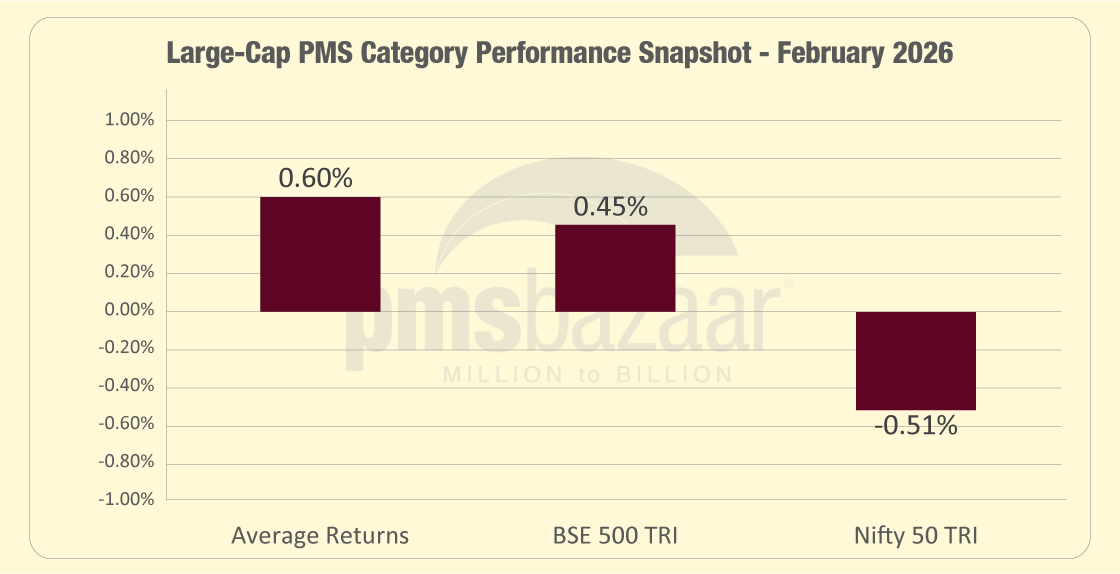
Large-cap PMSes delivered modest but positive returns in February 2026, reflecting the relatively defensive nature of the category in a month marked by continued volatility. Across 33 schemes, the average one-month return stood at 0.60 per cent. That was only slightly ahead of the S&P BSE 500 TRI’s 0.45 per cent gain, but comfortably better than the Nifty 50 TRI’s 0.51 per cent decline. Outperformance breadth was steady rather than exceptional, with 19 schemes beating the BSE 500 TRI and 21 outperforming the Nifty 50 TRI.
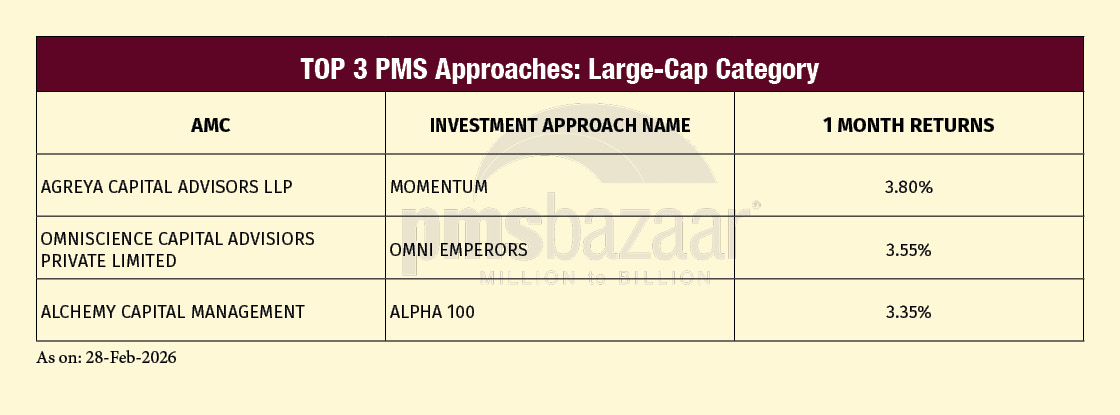
The category’s top performers show that even within large-caps, active positioning still made a difference. Agreya Capital Advisors’ Momentum strategy led with a 3.80 per cent return, followed by Omniscience Capital’s Omni Emperors at 3.55 per cent and Alchemy Capital’s Alpha 100 at 3.35 per cent. JM Financial’s Growth and Value and Marcellus Investment Managers’ Consistent Compounders also featured among the top performers, alongside ICICI Prudential AMC’s Large Cap Strategy.
The broader takeaway is that large-cap PMSes did what investors generally expect in a difficult month: preserve stability and still generate some excess return. But the category did not see the same degree of upside as broader-market segments. February appears to have favoured more flexible and mid-market-oriented portfolios, while large-cap strategies provided steadier, more contained participation.
Multi-asset PMSes trade off upside for smoother participation
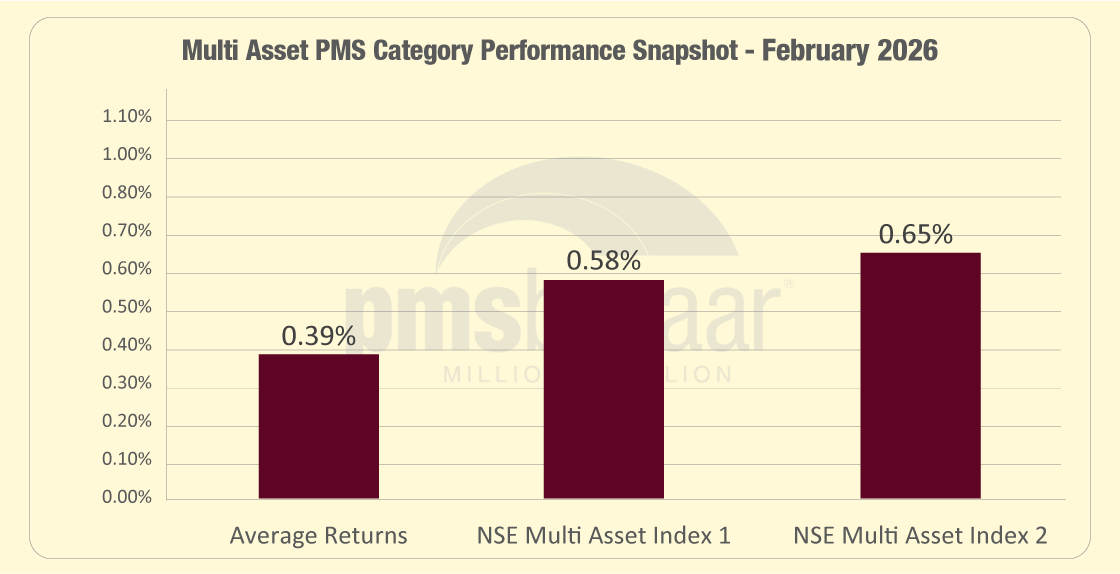
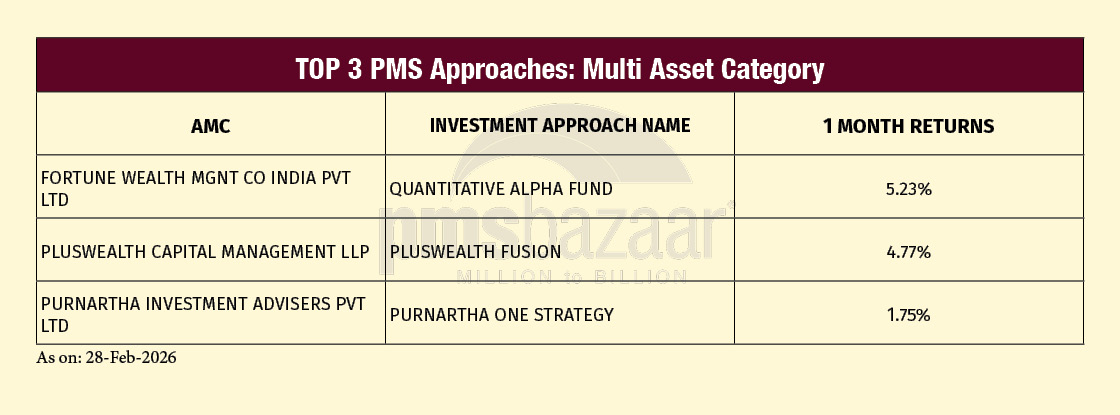
Multi-asset PMSes delivered the most muted average return among the positive-return categories in February 2026, reflecting their more balanced and diversified construction in a volatile market. Across 35 schemes, the category posted an average one-month return of 0.39 per cent, which fell short of both NSE Multi Asset Index 1 at 0.58 per cent and NSE Multi Asset Index 2 at 0.65 per cent. Even so, the breadth of outperformance was not weak: 18 schemes beat NSE Multi Asset Index 1, while 16 outperformed NSE Multi Asset Index 2. That suggests results within the category were quite dispersed despite a soft average.
The top performers show that select managers were still able to generate meaningful upside. Fortune Wealth Management’s Quantitative Alpha Fund led the category with a 5.23 per cent return, followed by Pluswealth Capital’s PlusWealth Fusion at 4.77 per cent. Thereafter, returns moderated sharply, with Purnartha One Strategy at 1.75 per cent and Ametra FactorIncome at 1.67 per cent.
That pattern is telling. In February, multi-asset PMSes as a group appeared to prioritise risk-balancing over aggressive upside capture, which naturally capped category averages in a month when some equity pockets did well. For investors, the category’s performance underlines its role as a smoother allocator rather than a pure return maximiser, though manager selection still clearly mattered.
Thematic PMSes struggle as concentration cuts both ways
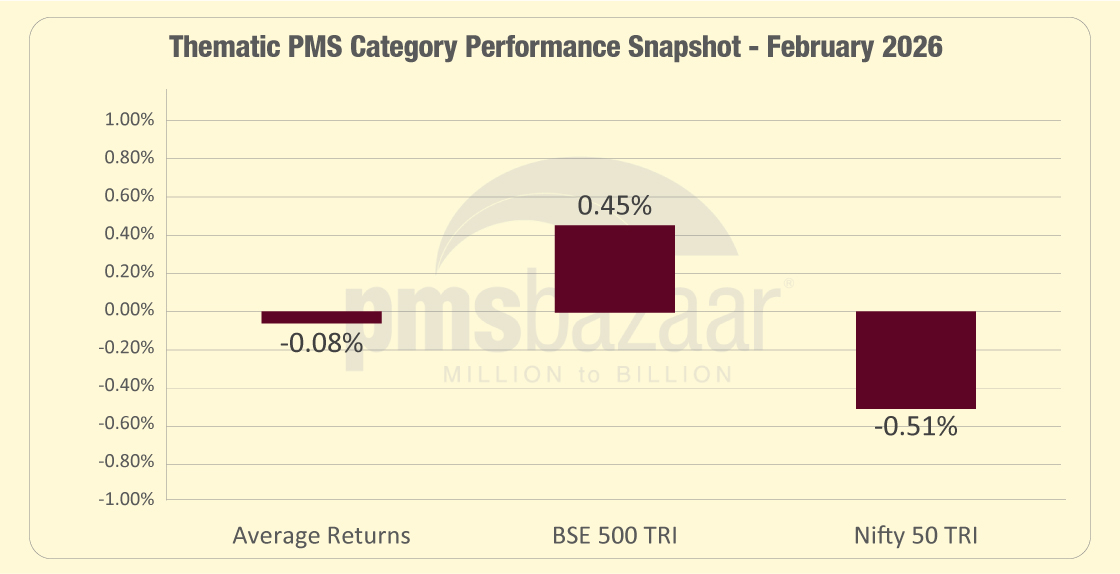
Thematic PMSes were the only category to slip into negative territory on average in February 2026, with 21 schemes posting a mean return of minus 0.08 per cent. That left the segment behind the S&P BSE 500 TRI’s 0.45 per cent gain, though still ahead of the Nifty 50 TRI’s 0.51 per cent decline. Outperformance breadth was mixed: 11 schemes beat the BSE 500 TRI, while 13 outperformed the Nifty 50 TRI. The numbers suggest that in a month marked by sharp sectoral rotation, concentrated thematic mandates were more exposed to being on the wrong side of market moves.
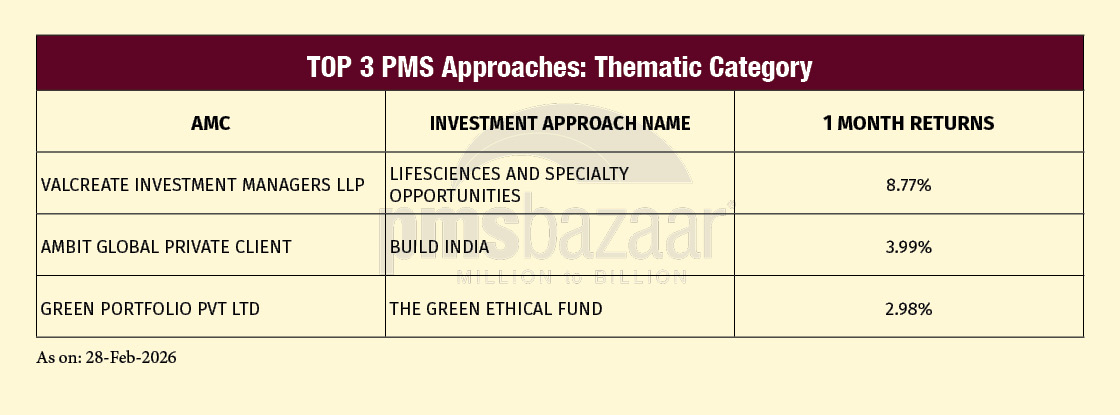
At the same time, the top end of the category remained strong. Valcreate Investment Managers’ Lifesciences and Specialty Opportunities was a clear standout with an 8.77 per cent return, far ahead of the rest of the field. Ambit Global Private Client’s Build India followed at 3.99 per cent, while Green Portfolio’s The Green Ethical Fund and Anand Rathi Advisors’ MNC PMS were close behind. That gap between the leader and the category average highlights just how dispersed outcomes were.
The broader takeaway is straightforward: thematic PMSes offered some of the sharpest upside opportunities in February, but also less room for error. Unlike broader diversified categories, this segment appears to have depended heavily on whether managers were positioned in the few sectors that worked during the month.
Outlook for March-2026
February 2026 once again highlighted an important reality for PMS investors: even when headline indices remain under pressure, active strategies can still uncover pockets of opportunity. The month was marked by volatility, uneven sectoral performance and lingering macro concerns, but a large share of equity PMSes still delivered positive returns and outperformed benchmarks. That is an encouraging sign for investors looking beyond short-term market noise.
The near-term environment, of course, is not without risks. Ongoing armed conflicts/wars, global growth concerns, policy uncertainty, AI disruption, liquidity shifts, earnings dispersion and sharp sector rotations can continue to keep markets choppy in the months ahead. Domestic flows also warrant monitoring, especially after the moderation in DII inflows, while global risk appetite could remain sensitive to interest-rate expectations and geopolitical developments. These factors may lead to further phases of correction or abrupt style reversals.
But for long-term investors, such periods often reinforce the case for disciplined allocation rather than caution-driven withdrawal. India’s structural growth drivers remain intact, corporate balance sheets are healthier than in many earlier cycles, and earnings opportunities continue to emerge across sectors and market-cap segments. In that backdrop, PMS strategies with clear investment frameworks, portfolio discipline and the flexibility to adapt across market conditions remain well placed. Volatility may persist, but for investors with patience and the right manager selection, it can also create the conditions for future alpha.
Happy Investing!
Recent Blogs

SEBI’s GARUDA Framework: A Big Boost for India’s AIF Industry and GIFT City Ecosystem

Winners & Losers: Sectors to Watch in the Current Global Crisis
PMS Bazaar recently organized a webinar titled “Winners & Losers: Sectors to Watch in the Current Global Crisis,” which featured Mr. Arpit Shah, Co-Founder and Director, Care Portfolio Managers. This blog covers the important points shared in this insightful webinar.

Why Market Corrections Are the Best Time to Build Your Core Equity Portfolio
PMS Bazaar recently organized a webinar titled “Why Market Corrections Are the Best Time to Build Your Core Equity Portfolio,” which featured Mr. Amit Nigam, Deputy CIO, ASK Investment Managers. The webinar blog covers insights from Mr. Nigam, which includes explanation how recent stock market volatility in India creates opportunities for long-term investors. It highlights shifting from a fixed deposit mindset to equities, his blog covers the important points shared in this insightful webinar.

Why ETF-Only Portfolios Are the Most Tax-Efficient Way to Invest
How deferred taxation and lower LTCG rates compound into significantly higher post-tax wealth for long-term investors
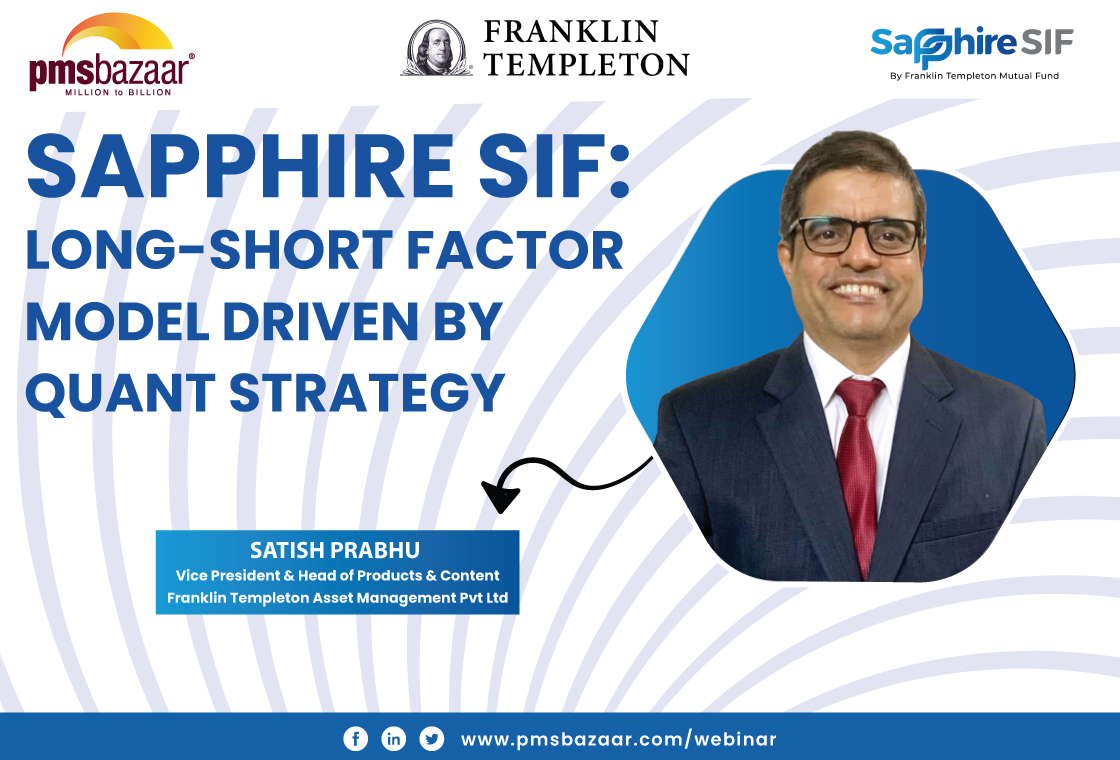
Sapphire SIF: Long-Short Factor Model Driven by Quant Strategy
PMS Bazaar recently organized a webinar titled “Sapphire SIF: Long-Short Factor Model Driven by Quant Strategy,” which featured Mr. Satish Prabhu, Vice President and Head of Products and Content, Franklin Templeton Asset Management Private Limited. This blog covers the important points shared in this insightful webinar.
6 out of 10 PMSes Beat Benchmarks In March Crash
Despite a fourth straight monthly sell-off, most PMSes fell less than benchmarks; a few even stayed in the green

Why Invest in Start-Ups for Wealth Creation?
PMS Bazaar recently organized a webinar titled “Why Invest in Start-Ups for Wealth Creation?” which featured Mr. Vinit Rai, MD& CIO, Managing Director, JM Financial Equity. This blog covers the important points shared in this insightful webinar.

Why Investors Are Turning to Semi-Liquid Credit Funds?
PMS Bazaar recently organized a webinar titled “Why Investors Are Turning to Semi-Liquid Credit Funds?” which featured Mr. Dipen Ruparelia, Chief Business and Product Officer, Vivriti Asset Management. This blog covers the important points shared in this insightful webinar.