

India’s Alternative Investment Fund (AIF) industry has evolved rapidly over the last few years. Investors today are increasingly moving beyond traditional investment products such as mutual funds and fixed deposits in search of differentiated opportunities across Private Equity, Venture Capital, Private Credit, Real Estate, infrastructure, and Category III long-short strategies.

As wealth creation in India expands and investor sophistication improves, alternative investments are steadily becoming an important part of modern portfolio allocation for HNIs, family offices, wealth managers, and institutional investors.
With the AIF industry growing at a strong pace with reaching over Rs 15 lakh core of commitments raised also with attractive 48.25% CAGR for last 10 years, but one challenge that fund managers have consistently faced is the time taken to launch new schemes.
Recognizing this need, the Securities and Exchange Board of India (SEBI) has proposed a new framework called GARUDA, which stands for “Green-Channel: AIF Rollout Upon Document Acknowledgement.” While the name may sound technical, the concept behind it is relatively simple. SEBI is looking to create a faster and smoother approval process for Alternative Investment Funds in India.
Currently, when an AIF manager wants to launch a new scheme, they are required to submit a Placement Memorandum (PPM) and other related documents to SEBI. Only after the regulatory processing is completed can the fund officially launch and begin raising capital from investors. Even though SEBI has already reduced processing timelines in recent months, the overall process can still take around 30 days or more in certain cases.
Under the proposed GARUDA framework, eligible AIF schemes could potentially receive acknowledgment-based clearance within approximately 10 working days. This effectively creates a “green channel” for fund launches, helping AIF managers raise capital and deploy investments much faster than before.
This could become a major positive for India’s private markets ecosystem. Consider a Private Credit Fund that identifies a high-yield lending opportunity backed by quality collateral. In the traditional process, the opportunity may already be closed before the fund completes approvals and raises capital. Under GARUDA, faster approvals could allow the fund manager to act quickly and capture such opportunities more efficiently. The same applies to Venture Capital and Private Equity funds investing in high-growth sectors where timing is often critical.
One of the most interesting aspects of the GARUDA proposal is the relaxation proposed for Accredited Investor-only schemes. Accredited Investors are financially sophisticated investors who meet certain income or net-worth criteria defined by SEBI. These investors are generally considered capable of understanding complex investment structures and evaluating risks independently.
Under the proposed framework, AIF schemes designed exclusively for Accredited Investors may receive additional operational flexibility. Certain merchant banker filing requirements could be relaxed, and some schemes may even be allowed to launch immediately after filing the required documents with SEBI. This could significantly improve efficiency for family offices, Ultra HNIs, institutional allocators, and sophisticated investors actively participating in alternative investments.
The GARUDA framework also carries significant importance for GIFT City and India’s ambition of becoming a global financial hub. Over the last few years, GIFT City has emerged as a growing center for offshore funds, international wealth management, cross-border investment structures, and global investing platforms. Faster AIF approvals and simplified operational processes could make GIFT City even more attractive for both domestic and international fund managers looking to structure India-focused or globally diversified investment vehicles.
In many ways, this move aligns India more closely with international financial centers such as Singapore, Dubai, and Luxembourg, where ease of fund launches and operational efficiency play a critical role in attracting global capital. Faster product launches may help strengthen India’s competitiveness in the global alternative investments space and support the long-term growth of GIFT City’s ecosystem.
Importantly, the GARUDA framework does not mean SEBI is reducing investor protection or weakening regulations. Instead, the regulator appears to be shifting from a “review first, launch later” model toward a “launch faster, monitor continuously” approach. SEBI is still expected to conduct post-facto reviews, risk-based inspections, and enforcement actions wherever necessary. Accountability on fund managers, sponsors, compliance officers, and merchant bankers will continue to remain extremely important.
In fact, as approval timelines become shorter, the responsibility on AIF managers to maintain high standards of governance, disclosures, compliance, and transparency may increase even further. Faster approvals will likely demand stronger internal systems and greater operational discipline from fund houses.
For investors, the GARUDA proposal could lead to broader access to innovative and differentiated investment opportunities across private markets. Faster launches may encourage fund managers to introduce more specialized strategies across sectors such as artificial intelligence, manufacturing, infrastructure, renewable energy, private credit, digital economy, and real assets. Investors could also gain quicker exposure to emerging opportunities that require timely capital deployment.
At the same time, investors should remember that faster approvals do not reduce investment risks. Proper due diligence, understanding of the investment strategy, manager evaluation, portfolio suitability, and risk assessment will continue to remain extremely important while investing in Alternative Investment Funds.
Overall, the GARUDA framework reflects SEBI’s evolving approach toward balancing ease of doing business with investor protection and long-term industry growth. India’s AIF industry is entering a new phase where speed, innovation, governance, and global competitiveness are becoming equally important. If implemented effectively, GARUDA could accelerate the growth of India’s alternative investment ecosystem, improve capital formation, strengthen GIFT City’s positioning as a global financial center, and support the long-term expansion of private markets in India.
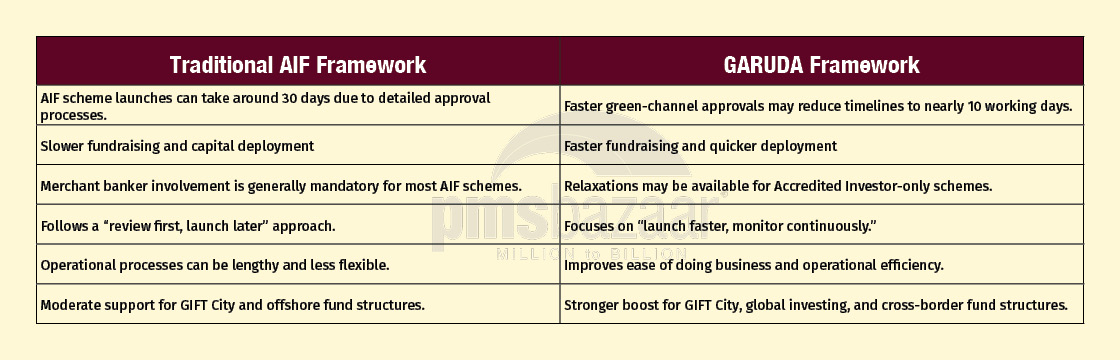
Source: SEBI Consultation Paper on GARUDA Framework
https://www.sebi.gov.in/reports-and-statistics/reports/may-2026/consultation-on-green-channel-aif-rollout-upon-document-acknowledgement-garuda-mechanism-for-processing-of-placement-memorandum-of-alternative-investment-funds-aifs-filed-with-sebi-_101340.html
Recent Blogs

PMS Performance: Over 94% of Tracked Strategies Beat Nifty 50 TRI
Global markets remained under pressure in August 2026 as geopolitical tensions, rising bond yields and elevated crude oil prices kept investors cautious.

The Next Alpha Cycle: How Should Investors Position ‘Alternatives’ in Their Portfolios?
PMS Bazaar recently organized a webinar titled “The Next Alpha Cycle: How Should Investors Position ‘Alternatives’ in Their Portfolios,” which featured Mr. Akhil Chaturvedi, ED & CBO, Motilal Oswal AMC. This blog covers the important points shared in this insightful webinar.

Performing Private Credit in India: Opportunity, Risk & the Investor’s Perspective
PMS Bazaar recently organised a webinar titled “Performing Private Credit in India: Opportunity, Risk & the Investor’s Perspective,” which featured Mr Saurabh Agrawal, Co-Fund Manager and Partner, Spark Asia Impact Alternative Asset Management.
GIFT City IFSC: India's Emerging Hub for Global Finance
PMS Bazaar recently organized a webinar titled “GIFT City IFSC: India's Emerging Hub for Global Finance,” which featured Mr. Bharath Shivappa, President & Chief of Markets, Gujarat International FinanceTec-City. This blog covers the important points shared in this insightful webinar.

PMS Performance: Who Outperformed in July 2026?
July 2026 was another month marked by uncertainty, with market performance shaped by evolving global cues and shifting investor sentiment. Despite the uncertain environment, equity PMS strategies continued to present opportunities, with several managers delivering returns ahead of the broader market benchmarks.

Arbitrage: Seeking Consistency Without Predicting Markets
Every investor grapples with the same challenge: uncertainty.

Structure Over Sentiment: India’s Private Credit Edge in a Volatile Global Market
The emergence of private credit over the past decade represents one of the most consequential developments in global finance.

What Seven Lakh Portfolio Reviews Reveal About How Indians Build Wealth
In March 2020, a friend asked me what he should do with his investments. He was a senior partner at a Big 4 firm who had spent two decades advising companies on their most consequential decisions. I asked him to send me his portfolio first.