

PMS Bazaar recently organized a webinar titled “Why Market Corrections Are the Best Time to Build Your Core Equity Portfolio,” which featured Mr. Amit Nigam, Deputy CIO, ASK Investment Managers. The webinar blog covers insights from Mr. Nigam, which includes explanation how recent stock market volatility in India creates opportunities for long-term investors. It highlights shifting from a fixed deposit mindset to equities, his blog covers the important points shared in this insightful webinar.
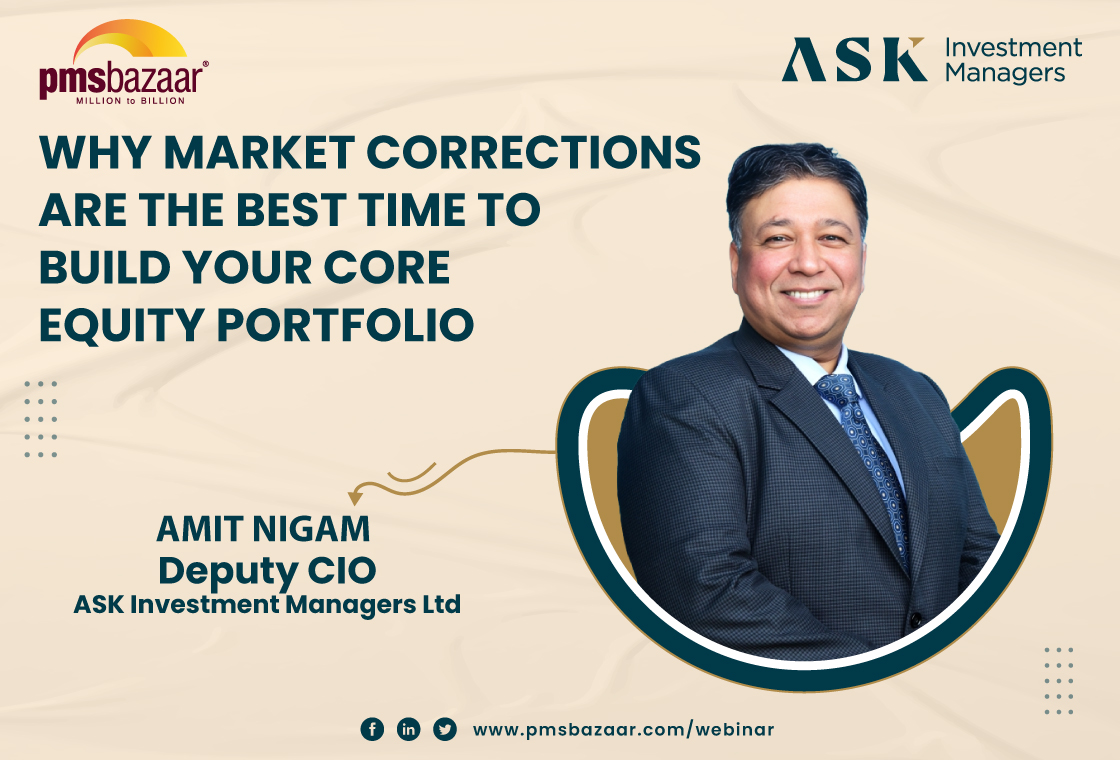
Understanding market corrections, and focusing on strong macroeconomic fundamentals. It also discusses valuations, earnings trends, and why disciplined investing during downturns can help build wealth over time.
Key aspects covered in this webinar blog are
- Overcoming the "fixed deposit" mindset
- Analyzing the breadth of market damage
- The pillars of India’s macroeconomic stability
- The resurgence of private capital expenditure
- Valuations and the earnings yield gap
- The "snake chart": tracking earnings expectations
- Dual drivers of returns
- The valuation premium in mid and small caps
- The shift from savings to investing
Summary: India’s recent market volatility—sharp corrections followed by quick recoveries—should be seen as an opportunity, not a threat, for long-term investors. Amit Nigam emphasizes shifting from a fixed-deposit mindset to embracing equities’ natural fluctuations. While broader indices show mild declines, micro-cap stocks have faced significant losses, driving investor anxiety. Despite this, India’s strong macro fundamentals, driven by consumption and rising private capex, remain intact. Valuations in large caps are attractive, unlike mid and small caps trading at premiums. Equity returns depend on both earnings growth and valuation re-rating, and disciplined investing during downturns can significantly enhance long-term wealth creation.
In recent months, the Indian financial landscape has undergone a period of significant fluctuation, characterized by sharp corrections followed by equally rapid recoveries. Mr. Amit Nigam shared his insights on why these moments of turbulence, while often sources of anxiety, are actually pivotal opportunities for long-term wealth creation. He noted that the recent market behavior where indices corrected by nearly 15% between February and March 2026 before bouncing back by 9% is exactly the kind of volatility that unnerves the average investor.
Overcoming the "Fixed Deposit" Mindset
Mr. Nigam observed that a large segment of the Indian population traditionally manages savings through conservative instruments like fixed deposits. For these individuals, the inherent "zig-zag" nature of the stock market can trigger an aversion to equities. However, he emphasized that for those who view the market through a long-term lens, these corrections are not threats but "opportune times" to increase equity allocations.
He argued that investing in equity is rarely a linear experience. While upward trends are naturally welcomed, the downward phases often drive up anxiety levels. He urged investors to shift their perspective, viewing these "downs" as a part and parcel of the journey rather than a reason for panic. Using historical context, he pointed out that major geopolitical events such as the Iraq War or the Kargil conflict which seemed catastrophic at the time, now appear as mere blips on a long-term growth chart.
Analyzing the Breadth of Market Damage
Providing a detailed breakdown of recent market performance, Mr. Nigam highlighted that while broad averages for large and mid-cap stocks showed only marginal declines, the "micro-cap" segment experienced significant pain. Referring to the AMFI definitions where the top 100 stocks are large-cap and subsequent tiers move down to micro-cap he noted a stark disparity in performance.
While a large-cap average return might sit at a modest 1%, this figure often masks individual stock declines of up to 29%. In the micro-cap space, the damage was even more pronounced, with some stocks plummeting by 65% to 67% over a six-month period. Statistics revealed that 86% of micro-cap companies delivered negative returns recently. Mr. Nigam explained that this widespread damage in broader markets is what has fueled current investor anxiety, necessitating a deeper discussion on whether these levels represent a "bottom" or a warning of further downsides.
The Pillars of India’s Macroeconomic Stability
Despite market volatility, Mr. Nigam remains staunchly optimistic about India’s fundamental growth story. He attributed this confidence to a stable "macroeconomic footing." India continues to be one of the fastest-growing large economies globally, even amidst international uncertainty.
He simplified the Indian GDP construct into three main pillars:
- Consumption (70%): This remains the primary engine of the economy, providing a massive cushion against global shocks.
- Investments (35%): A growing segment that fuels industrial capacity.
- Net Exports (-5%): Because India is a net importer, its direct linkages to global vagaries are relatively contained.
He further noted that the central bank’s "dovish" stance has been a pivotal factor. With the repo rate down by 125 basis points from late 2024 peaks and surplus liquidity in the market, the environment remains facilitative for corporate growth. While rising inflation (CPI) might worry consumers, Mr. Nigam explained that as an investor, a moderate rise within the 2% to 6% band is actually positive, as it grants corporates pricing power and drives profitability.
The Resurgence of Private Capital Expenditure
One of the most exciting developments highlighted by Mr. Nigam is the shift in Capital Expenditure (Capex). Over the previous decade, private sector spending was largely "anemic," growing at a CAGR of less than 1%. For years, the government (both State and Center) shouldered the burden of investment.
However, since FY22, there has been a dramatic shift. Private capex is now growing at more than 20%, more than doubling in the last few years. This "engine" is crucial because it leads to job creation. When jobs are created, incomes rise, which in turn feeds back into the 70% consumption engine, creating a "virtuous cycle" for the entire economy.
Valuations and the Earnings Yield Gap
Finally, Mr. Nigam addressed the technical side of the recent correction. He noted that Nifty valuations have corrected toward their 20-year averages. To provide a more sophisticated view, he introduced the concept of the Earnings Yield Gap comparing the yield of equity (the inverse of the PE ratio) against the 10-year bond yield (debt).
Historically, whenever this gap has reached current levels, the returns over the subsequent one to two years have been "handsome" and in line with equity market expectations. He lamented that markets only spend about 32% of their time in these "attractive zones," and unfortunately, these periods usually coincide with bad news cycles, be it geopolitical conflict or energy price pressures.
Mr. Nigam concluded by reminding investors that those who have entered the market in the last four years might lack the historical context of such volatility. His core message remained clear: the best long-term rewards are reserved for those who use these "tough times" to build their portfolios, leveraging temporary valuation dips to create lasting wealth.
The "Snake Chart": Tracking Earnings Expectations
To illustrate how the market prices in the future, Mr. Nigam presented what he colloquially termed "snake charts" visual representations of how Nifty earnings per share (EPS) estimates evolve over time. He explained that analysts typically begin forecasting earnings for a financial year nearly three years in advance.
For instance, in Financial Year 2023 (FY23), initial analyst estimates started at ₹735. However, the actual reported EPS ended at ₹800. This 11% "alpha" in earnings meant that even if market multiples remained stagnant, investors saw an 11% accretion to their wealth simply because companies performed better than expected. Conversely, FY26 (projected) tells a different story. Initial expectations of ₹1205 have been downgraded to approximately ₹1070 a 15% cut. Mr. Nigam identified these earnings downgrades as the primary "culprit" behind the market's recent relative weakness.
Dual Drivers of Returns
Mr. Nigam clarified that equity returns are powered by two distinct engines:
- Valuation Re-rating: When the price an investor is willing to pay for every rupee of profit increases.
- Earnings Growth: The organic increase in corporate profits.
He noted that when investments are made during undervalued periods, investors benefit from both drivers simultaneously. However, he issued a word of caution: while prices have corrected, valuations in certain sectors have not necessarily followed suit.
The Valuation Premium in Mid and Small Caps
A significant portion of the discussion focused on the "optimism" still baked into the mid-cap and small-cap segments.
- Mid-Caps: Currently trading at approximately 27-28 times one-year forward earnings, compared to 19 times for the Nifty 50. This represents a 40% premium over large caps.
- Small Caps: These continue to trade at a 20% premium to the Nifty, a sharp contrast to their 20-year historical average of trading at a 10% discount.
Mr. Nigam suggested that these segments have not yet fully factored in risks like cost inflation, shipping bottlenecks, and raw material availability. He remains skeptical that "bargains" are available en masse in these categories, suggesting that large caps currently offer a much more attractive risk-reward profile.
The Shift from Savings to Investing
Addressing the broader Indian economy, Mr. Nigam highlighted a structural pivot. Historically, Indians were "savers," favoring Gold and Fixed Deposits (FDs). However, with FD rates now hovering between 5.5% and 6.5%, they often fail to beat long-term inflation after taxes.
This has led to an accelerated shift toward equities. He dismissed the "cost of waiting" for a correction as a mental hurdle, advocating instead for disciplined SIPs (Systematic Investment Plans). He concluded that periods of market correction should be used to "enhance equity allocation," as a larger pool of capital compounding at higher rates is the only definitive path to becoming "richer."
Mr. Nigam covered all the topics mentioned above in-depth and answered questions from the audience toward the end of the session. For more such insights on this webinar, watch the recording of this insightful session through the appended link below.
Get access to rich data and analytics of PMS & AIF by subscribing to us. Join the 90000+ investors & experts: Subscribe NOW
Recent Blogs
PMS Performance : 401 Equity PMS Beat the Nifty 50 TRI
September 2026 saw global markets grapple with persistent macroeconomic uncertainty, as rising U.S. bond yields, crude oil prices above $90 per barrel and escalating Middle East tensions kept investors on edge. Concerns over renewed inflationary pressures and tighter financial conditions continued to shape market sentiment. The reported 25-basis-point Federal Reserve rate hike, bringing rates to 3.75–4.00 per cent, added another dimension to the evolving global outlook.
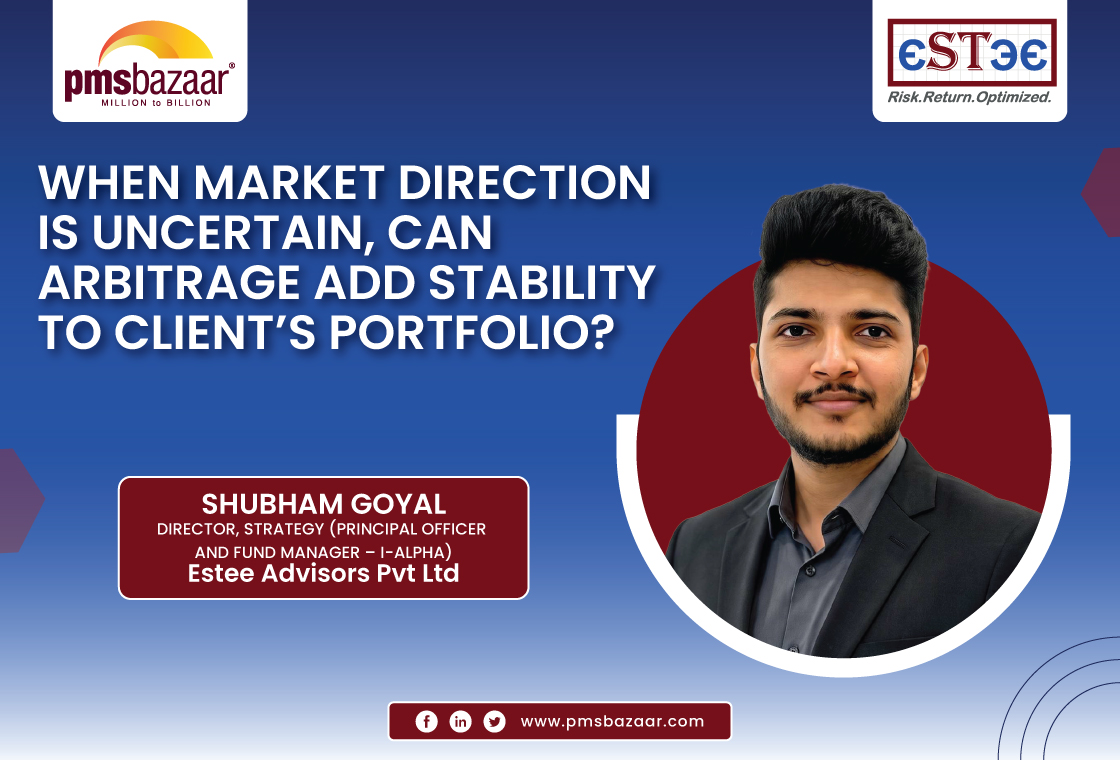
When Market Direction Is Uncertain, Can Arbitrage Add Stability to Client's Portfolio?
PMS Bazaar recently organised a webinar titled “When Market Direction Is Uncertain, Can Arbitrage Add Stability to Client's Portfolio?” which featured Mr. Sandeep Tyagi, Founder & Chairman, Estee Advisors and Mr. Shubham Goyal, Director, Strategy, (Principal Officer and Fund Manager - I-Alpha), Estee Advisors Pvt. Limited. This blog covers the important points shared in this insightful webinar.

MF-PMS: Is This the Next Big Wealth Management Opportunity
PMS Bazaar recently organised a webinar titled “MF-PMS: Is This the Next Big Wealth Management Opportunity,” which featured Mr. Sandeep Jethwani, Co-Founder, Dezerv & Vice Chairman, APMI.

PMS Performance: Over 94% of Tracked Strategies Beat Nifty 50 TRI
Global markets remained under pressure in August 2026 as geopolitical tensions, rising bond yields and elevated crude oil prices kept investors cautious.

The Next Alpha Cycle: How Should Investors Position ‘Alternatives’ in Their Portfolios?
PMS Bazaar recently organized a webinar titled “The Next Alpha Cycle: How Should Investors Position ‘Alternatives’ in Their Portfolios,” which featured Mr. Akhil Chaturvedi, ED & CBO, Motilal Oswal AMC. This blog covers the important points shared in this insightful webinar.

Performing Private Credit in India: Opportunity, Risk & the Investor’s Perspective
PMS Bazaar recently organised a webinar titled “Performing Private Credit in India: Opportunity, Risk & the Investor’s Perspective,” which featured Mr Saurabh Agrawal, Co-Fund Manager and Partner, Spark Asia Impact Alternative Asset Management.
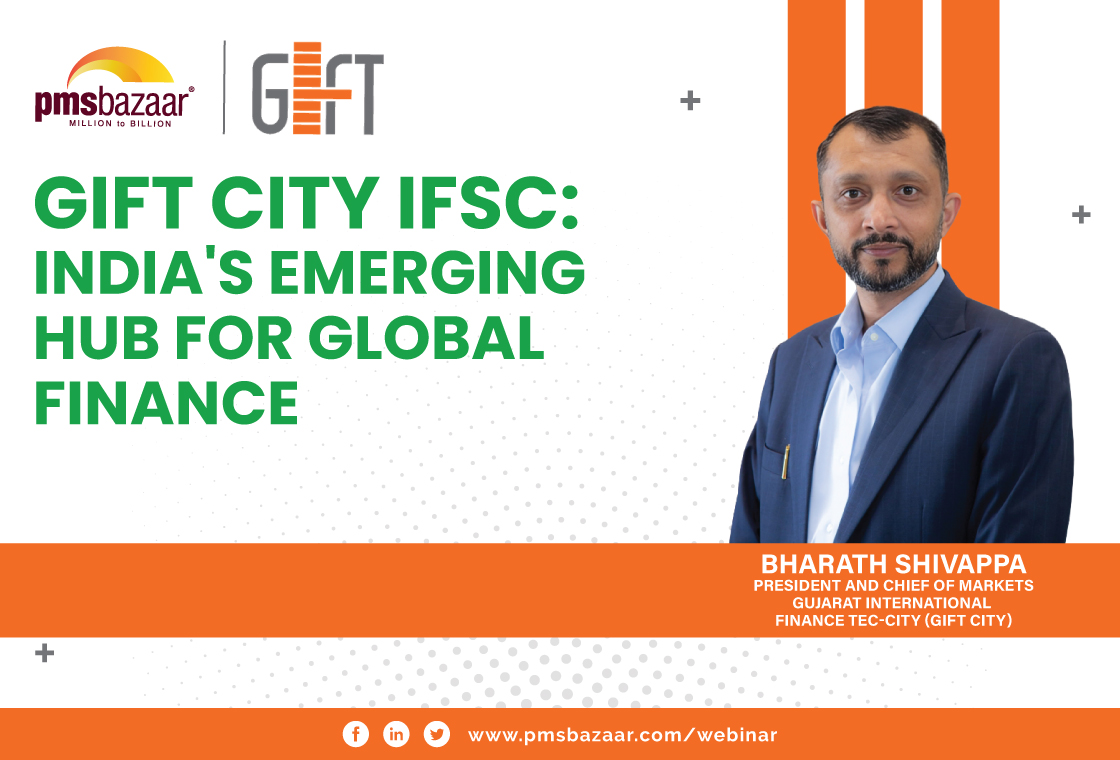
GIFT City IFSC: India's Emerging Hub for Global Finance
PMS Bazaar recently organized a webinar titled “GIFT City IFSC: India's Emerging Hub for Global Finance,” which featured Mr. Bharath Shivappa, President & Chief of Markets, Gujarat International FinanceTec-City. This blog covers the important points shared in this insightful webinar.

PMS Performance: Who Outperformed in July 2026?
July 2026 was another month marked by uncertainty, with market performance shaped by evolving global cues and shifting investor sentiment. Despite the uncertain environment, equity PMS strategies continued to present opportunities, with several managers delivering returns ahead of the broader market benchmarks.