

PMS Bazaar recently organized a webinar titled “Sapphire SIF: Long-Short Factor Model Driven by Quant Strategy,” which featured Mr. Satish Prabhu, Vice President and Head of Products and Content, Franklin Templeton Asset Management Private Limited. This blog covers the important points shared in this insightful webinar.
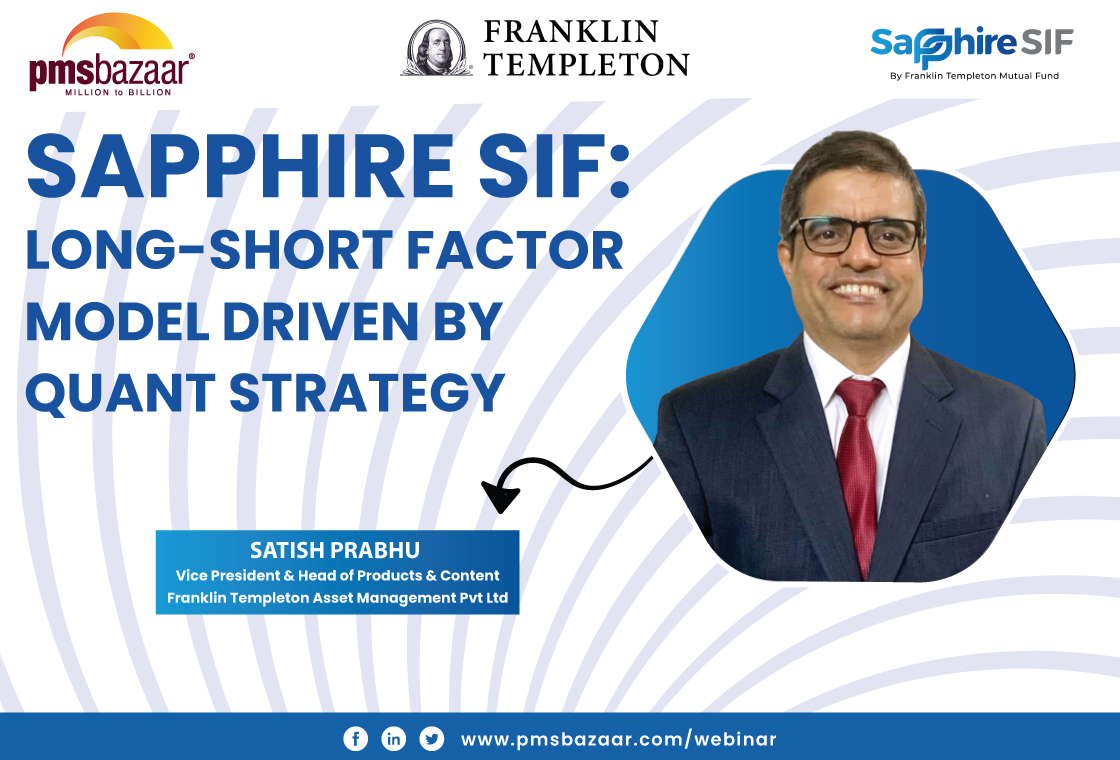
The webinar blog covers insights from Mr. Prabhu, which includes, explanation on Specialized Investment Funds (SIFs), a new SEBI-regulated category that blends mutual fund accessibility with advanced strategies like shorting. It highlights how Franklin Templeton’s Sapphire Longshot Equity SIF uses global expertise and quantitative models to generate returns in all market conditions, while offering investors a more accessible, diversified, and risk-managed approach to sophisticated investing.
Key aspects covered in this webinar blog are
- The regulatory context and investor access
- Key differentiators: SIFs vs. traditional mutual funds
- Franklin Templeton’s sapphire longshot equity sif
- A quantitative, factor-based approach
- Robust backtesting and future proofing
- The critical human element
- Validating performance through multi-factor models
- The mechanics of the timing model
- Indian market dynamics and alpha creation
- The emerging “middle-class” alternative
- Addressing “passive breaches” and risks
Summary: Mr. Satish Prabhu explained that Specialized Investment Funds (SIFs), introduced by SEBI, aim to provide regulated access to advanced strategies like derivatives while improving investor awareness. Unlike traditional mutual funds, SIFs can go both long and short, enabling returns in rising and falling markets. With a lower entry barrier of ₹10 lakhs, they democratize access to sophisticated investments. Franklin Templeton’s Sapphire Longshot Equity SIF leverages global expertise and a quantitative, factor-based model to drive performance. Combining disciplined data-driven strategies with human oversight, the fund seeks consistent alpha generation, downside protection, and long-term growth across varying market conditions.
In a recent industry address, Mr. Satish Prabhu outlined the regulatory landscape and market rationale behind the introduction of Specialized Investment Funds (SIFs), specifically focusing on Franklin Templeton’s new offering, the Sapphire Longshot Equity SIF. His presentation aimed to demystify SIFs, highlighting their unique position in the Indian market, their differentiation from traditional mutual funds, and the advanced quantitative strategies powering Franklin Templeton’s approach.
Mr. Prabhu began by extending his gratitude to the audience for participating on short notice. He introduced SIFs as the newest product category mandated by the market regulator, SEBI (Securities and Exchange Board of India). Before detailing Franklin Templeton's specific launch—the Sapphire Longshot Equity SIF—he emphasized the critical context and reasoning behind the regulator's decision to introduce this product category to Indian investors.
The Regulatory Context and Investor Access
A key driver for SIFs, as Mr. Prabhu explained, was SEBI's observation that while investor participation in derivatives has grown significantly, understanding of these complex instruments remains limited. Recognizing this gap, SEBI sought to create a regulated framework that allows investors to access derivatives through professionally managed structures. By introducing derivative-focused products within the mutual fund ecosystem, the regulator aims to improve investor awareness while enabling the use of derivatives as part of long-term investment strategies.
Mr. Prabhu noted that SIFs also serve to bring more sophisticated or “exotic” strategies to a broader investor base. While such strategies already exist within Portfolio Management Services (PMS) and Alternative Investment Funds (AIFs), their high entry thresholds typically ₹50 lakhs for PMS and ₹1 crore for AIFs limit accessibility. In contrast, SIFs require a minimum investment of ₹10 lakhs, significantly lowering the barrier to entry. This shift effectively democratizes access to advanced investment approaches that were previously available only to high-net-worth individuals.
Key Differentiators: SIFs vs. Traditional Mutual Funds
Mr. Prabhu then shifted focus to the core distinction between SIFs and conventional mutual funds. Using a simple illustration, he highlighted that the defining difference lies in the ability to “go short.”
Traditional mutual funds are long-only products. In a long strategy, portfolio managers invest in stocks they expect to rise in value and generate returns when markets move upward. When faced with potential underperformance in a stock or sector, their only options are to reduce exposure or exit the position. During market downturns, long-only funds adopt defensive strategies, such as increasing cash levels to reduce risk, but they cannot actively profit from falling markets.
In contrast, SIFs allow managers to use derivatives to take short positions. Shorting enables a manager to profit when stock prices decline. Mr. Prabhu explained this with a simple example: a stock sold at ₹150 and repurchased at ₹100 generates a profit of ₹50. This capability fundamentally changes how returns can be generated, allowing SIFs to potentially perform in both rising and falling markets.
This dual capability, he argued, is a major advantage over traditional mutual funds. However, he also emphasized that shorting through derivatives is complex and involves higher risk. As a result, SIFs are intended for relatively informed investors.
To manage risk, SEBI has introduced strict safeguards. The minimum investment is set at ₹10 lakhs, and short exposure is capped at 25% of the portfolio, while long exposure ranges between 75% and 100%. This ensures that SIFs remain less aggressive than many AIF strategies, positioning them as a balanced product combining accessibility with controlled sophistication.
Franklin Templeton’s Sapphire Longshot Equity SIF
Turning to Franklin Templeton’s offering, Mr. Prabhu noted that SEBI has defined seven SIF categories across equity, fixed income, and hybrid strategies. Each SIF must have a distinct identity, and Franklin Templeton chose the name “Sapphire” to reflect resilience and strength qualities the firm aims to deliver.
He highlighted that SIFs retain several operational similarities with mutual funds. Features such as systematic investment plans (SIPs) and systematic transfer plans (STPs) are permitted, provided the minimum investment requirement is maintained. This familiarity helps investors transition more easily into the new product category.
A key strength of the Sapphire Longshot Equity SIF lies in Franklin Templeton’s global expertise. Mr. Prabhu stated that the firm manages approximately $1.7 trillion in assets globally, underscoring its scale and experience. The Investment Solutions team already manages multiple global mandates, including long-short strategies. This ensures that the Indian SIF is backed by a proven framework rather than a new or experimental approach.
A Quantitative, Factor-Based Approach
Mr. Prabhu explained that the SIF will be driven by a quantitative strategy managed by a global team with decades of experience. The team currently manages around 70 such mandates worldwide, indicating strong operational depth.
The investment process is based on a multi-factor model that evaluates over 40 parameters across categories such as quality, value, and momentum. Stocks are scored based on these factors, and only those with the highest cumulative scores are included in the long portfolio. He likened these stocks to “all-rounders” in cricket—strong across multiple dimensions and valuable in any market condition. The long portfolio typically consists of 80 to 90 such stocks drawn from the Nifty 500 universe.
On the other hand, the short portfolio targets weak-performing stocks with poor fundamentals or governance issues. The fund usually maintains 10 to 15 short positions. The allocation between long and short exposure is determined dynamically within the regulatory limits by a proprietary timing model.
This model incorporates various macroeconomic and market indicators, including GDP trends, inflation, bond yields, and market sentiment. Based on these inputs, it adjusts the portfolio stance leaning more bullish or defensive depending on market conditions.
Robust Backtesting and Future Proofing
To demonstrate the model’s effectiveness, Mr. Prabhu presented 25-year backtesting results. The long-short strategy delivered annualized returns of approximately 19%, compared to 17% for a long-only version. This 2% alpha, he emphasized, is meaningful over long investment horizons.
He also highlighted performance across different market phases. During the post-COVID recovery (2020–2024), the strategy outperformed the Nifty 500. In flat markets, it still generated positive returns by leveraging short opportunities. During major downturns such as the dot-com bust and the global financial crisis, the model limited losses and captured strong recoveries, resulting in significant alpha over full cycles.
Mr. Prabhu stressed that the model is not purely theoretical. It is a live global strategy refined over 15–20 years. The integration of technologies like artificial intelligence further enhances its ability to process large data sets and adapt to evolving market conditions.
The Critical Human Element
Despite the quantitative foundation, Mr. Prabhu clarified that the fund is not fully automated. A portfolio manager, Arihant Jain, will oversee the strategy. While the model runs continuously, major rebalancing typically occurs at month-end.
Human oversight remains essential for responding to real-time developments such as geopolitical events or company-specific news. The portfolio manager ensures that such factors are incorporated into decision-making, complementing the model’s outputs.
In summary, Mr. Prabhu outlined three key reasons to consider the Sapphire Longshot Equity SIF:
- Unique capability to generate returns in both rising and falling markets.
- Backing of Franklin Templeton’s global experience.
- A disciplined, data-driven investment process designed for consistent outperformance.
In a follow-up Q&A session, Mr. Satish Prabhu addressed investor queries regarding performance, shorting strategies, and market positioning.
Validating Performance Through Multi-Factor Models
Responding to concerns about short-term performance, he emphasized that equity investments should be evaluated over longer periods. He noted that Franklin Templeton’s existing multi-factor fund, using the same model, has already generated positive alpha since launch. Given the SIF’s additional ability to short, it has greater potential to outperform, particularly during market corrections.
The Mechanics of the Timing Model
Mr. Prabhu explained that shorting decisions are entirely model-driven. The timing model determines both the level of short exposure (0–25%) and the selection of stocks. Typically, it identifies the weakest-performing stocks from a derivatives universe of around 200 and recommends 10 to 15 short positions, along with defined holding periods.
Unlike traditional funds that move to cash during uncertainty, the SIF actively uses shorting to generate returns, making capital deployment more efficient.
Indian Market Dynamics and Alpha Creation
Providing historical context, Mr. Prabhu noted that Indian markets have been positive in most years over the past 25 years. As a result, the majority of returns in the SIF are expected to come from long positions. However, the shorting component plays a crucial role in mitigating risks and generating alpha during downturns.
The Emerging "Middle-Class" Alternative
He emphasized that SIFs are particularly suited for India’s growing middle class. By offering lower entry thresholds and mutual fund-like tax benefits, they provide an accessible alternative to PMS and AIFs. Long-term capital gains taxation at 12.5% further enhances their appeal.
Addressing "Passive Breaches" and Risks
Mr. Prabhu concluded by clarifying operational rules. A decline in investment value below ₹10 lakhs due to market movements is considered a passive breach and does not require additional investment. However, active withdrawals that reduce the balance below the threshold must be topped up.
He reiterated that SIF performance should be evaluated based on alpha rather than absolute returns, as the objective is to provide downside protection while delivering long-term growth.
Mr. Prabhu covered all the topics mentioned above in-depth and answered questions from the audience toward the end of the session. For more such insights on this webinar, watch the recording of this insightful session through the appended link below.
Get access to rich data and analytics of PMS & AIF by subscribing to us. Join the 90000+ investors & experts: Subscribe NOW
Recent Blogs

PMS Performance : 401 Equity PMS Beat the Nifty 50 TRI
September 2026 saw global markets grapple with persistent macroeconomic uncertainty, as rising U.S. bond yields, crude oil prices above $90 per barrel and escalating Middle East tensions kept investors on edge. Concerns over renewed inflationary pressures and tighter financial conditions continued to shape market sentiment. The reported 25-basis-point Federal Reserve rate hike, bringing rates to 3.75–4.00 per cent, added another dimension to the evolving global outlook.

When Market Direction Is Uncertain, Can Arbitrage Add Stability to Client's Portfolio?
PMS Bazaar recently organised a webinar titled “When Market Direction Is Uncertain, Can Arbitrage Add Stability to Client's Portfolio?” which featured Mr. Sandeep Tyagi, Founder & Chairman, Estee Advisors and Mr. Shubham Goyal, Director, Strategy, (Principal Officer and Fund Manager - I-Alpha), Estee Advisors Pvt. Limited. This blog covers the important points shared in this insightful webinar.

MF-PMS: Is This the Next Big Wealth Management Opportunity
PMS Bazaar recently organised a webinar titled “MF-PMS: Is This the Next Big Wealth Management Opportunity,” which featured Mr. Sandeep Jethwani, Co-Founder, Dezerv & Vice Chairman, APMI.

PMS Performance: Over 94% of Tracked Strategies Beat Nifty 50 TRI
Global markets remained under pressure in August 2026 as geopolitical tensions, rising bond yields and elevated crude oil prices kept investors cautious.

The Next Alpha Cycle: How Should Investors Position ‘Alternatives’ in Their Portfolios?
PMS Bazaar recently organized a webinar titled “The Next Alpha Cycle: How Should Investors Position ‘Alternatives’ in Their Portfolios,” which featured Mr. Akhil Chaturvedi, ED & CBO, Motilal Oswal AMC. This blog covers the important points shared in this insightful webinar.

Performing Private Credit in India: Opportunity, Risk & the Investor’s Perspective
PMS Bazaar recently organised a webinar titled “Performing Private Credit in India: Opportunity, Risk & the Investor’s Perspective,” which featured Mr Saurabh Agrawal, Co-Fund Manager and Partner, Spark Asia Impact Alternative Asset Management.

GIFT City IFSC: India's Emerging Hub for Global Finance
PMS Bazaar recently organized a webinar titled “GIFT City IFSC: India's Emerging Hub for Global Finance,” which featured Mr. Bharath Shivappa, President & Chief of Markets, Gujarat International FinanceTec-City. This blog covers the important points shared in this insightful webinar.

PMS Performance: Who Outperformed in July 2026?
July 2026 was another month marked by uncertainty, with market performance shaped by evolving global cues and shifting investor sentiment. Despite the uncertain environment, equity PMS strategies continued to present opportunities, with several managers delivering returns ahead of the broader market benchmarks.