

PMS Bazaar recently organized a webinar titled “GIFT City IFSC: India's Emerging Hub for Global Finance,” which featured Mr. Bharath Shivappa, President & Chief of Markets, Gujarat International FinanceTec-City. This blog covers the important points shared in this insightful webinar.
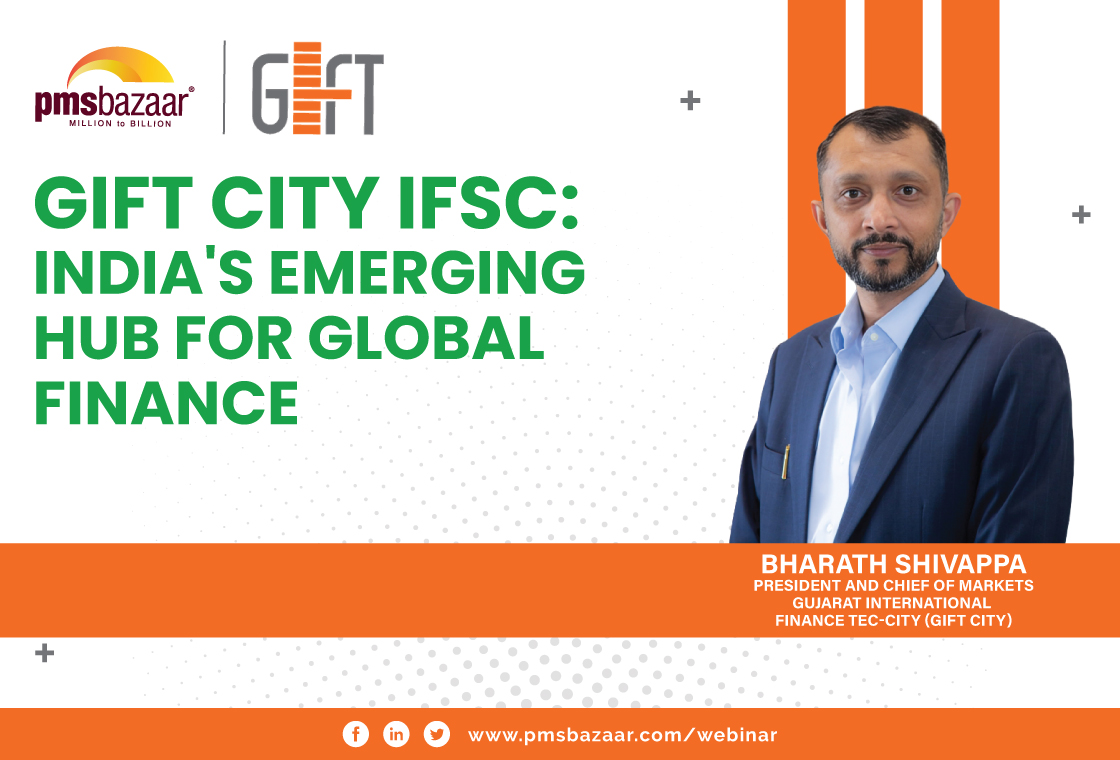
The webinar blog covers insights from Mr. Shivappa, which includes GIFT City’s evolution as India’s premier international financial hub and its role in connecting global institutions with India’s growing economy. It covers GIFT City’s infrastructure, regulatory and tax advantages, financial ecosystem, fund management opportunities, global connectivity and sectoral growth. The blog also examines how GIFT City is positioning itself as a competitive alternative to established offshore financial centres.
Key aspects covered in this webinar blog are
- The India opportunity and access to a growing market
- Bridging global and domestic business
- An integrated ecosystem: IFSC and DTA
- World-class infrastructure from scratch
- Social infrastructure and connectivity
- Diverse sectors and rapid growth
- Strategic advantages and future outlook
- Bridging the global-domestic gap and the path to 2047
- The fund ecosystem: opportunities in credit, wealth, and hedge funds
- Onshoring the offshore: why global institutions choose GIFT City
- Market proximity and an integrated cluster approach
Summary: Mr. Bharath Shivappa presented GIFT City as a global financial hub offering direct access to India’s rapidly growing economy and consumer market. He highlighted its integrated IFSC and domestic ecosystem, world-class infrastructure, tax advantages, multi-currency operations, and strong regulatory framework. With over 1,300 entities across banking, funds, insurance, aviation, fintech and capital markets, GIFT City is emerging as a competitive alternative to offshore centres such as Singapore, Dubai and London. Its integrated cluster model, access to talent and proximity to India’s domestic market position it as a key financial engine supporting India’s growth and the Viksit Bharat vision by 2047.
Mr. Bharath Shivappa started the session by giving a comprehensive overview of GIFT City, highlighting its position as a premier global financial and business hub. Addressing an audience familiar with the region—and welcoming those already operating there—he aimed to outline the distinct value proposition that GIFT City offers to the international community.
The India Opportunity and Access to a Growing Market
Mr. Shivappa began by emphasizing the broader context of the Indian economy, noting that it stands as one of the largest and highest-growing global economies, boasting a four-trillion-dollar GDP and an annual growth rate of six to seven percent. A critical demographic factor highlighted was that sixty-five percent of India's working population is below the age of thirty-five. Because consumption serves as a fundamental driver of economic strength, this vast population unlocks a major value proposition: direct access to one of the largest markets of today and tomorrow.
Bridging Global and Domestic Business
Explaining the core rationale behind GIFT City, Mr. Shivappa pointed out that access to India remains a critical aspiration for mature economies, global investors, and international bankers. GIFT City acts as a two-way bridge. On one hand, it allows global entities to conduct business in India, with India, and from India. On the other hand, it functions as an offshore gateway for Indian businesses to operate globally without needing to relocate their physical centers outside the country. Domestic companies can effectively hold and manage their international operations directly from an offshore center based in GIFT City.
An Integrated Ecosystem: IFSC and DTA
Detailing the structural design, Mr. Shivappa explained that an International Financial Services Centre (IFSC) is a regulated financial space hosting banks, fund managers, capital markets, and ancillary services. However, GIFT City distinguishes itself by integrating both the IFSC zone—part of a Special Economic Zone (SEZ)—and Domestic Tariff Areas (DTAs).
He stressed that a financial ecosystem remains incomplete without non-financial support. Essential components like technology capability services, research and development, innovations, and mid-to-back offices form the backbone of any industrial cluster. By providing solutions for both financial and non-financial entities to coexist, GIFT City has established a fully functional, integrated ecosystem.
World-Class Infrastructure from Scratch
Spanning approximately one thousand acres, GIFT City represents a greenfield project developed with best-in-class infrastructure. Mr. Shivappa noted that being built from scratch allowed them to implement pioneering infrastructural solutions, such as India's first underground utility tunnel. This seven-by-seven-meter tunnel manages water, power, data, and chilled water supply, ensuring a digging-free city environment complemented by a fully equipped city command and control center.
Furthermore, GIFT City features India's first city-level district cooling system. By utilizing the utility tunnel, the city delivers air conditioning with thirty to thirty-three percent greater efficiency, significantly lowering cooling costs compared to traditional sources. The infrastructure also incorporates automated waste management systems, water management, and power sourcing that is fifty-seven percent green.
Social Infrastructure and Connectivity
Recognizing the need for holistic living spaces, Mr. Shivappa discussed ongoing developments in social infrastructure, including healthcare, recreation, education, and sports. Planned additions include five-star hotels, international schools, and an expanded metro network connecting to the South Gate. Anticipating the upcoming high-speed bullet train between Mumbai and Ahmedabad, transit times between Bandra Kurla Complex (BKC) and GIFT City are projected to drop significantly to just two hours and twenty minutes.
Additionally, urban planners are developing a five-kilometer riverfront featuring a world-class recreational walking bridge, an entertainment district, and sports arenas designed to support major regional events like the upcoming Commonwealth Games in Ahmedabad. Future enhancements also include a central park with a golf range, expansive food and beverage zones, and landscapes designed in partnership with world-renowned urban designers.
Diverse Sectors and Rapid Growth
Mr. Shivappa reported robust growth across multiple sectors, with active entities growing past thirteen hundred. The financial landscape includes world-leading banks, global capability centers (GCCs), investment funds, fintech firms, insurance and reinsurance companies, and capital markets. Banking assets have comfortably surpassed one hundred twenty billion dollars, while funds target over seventy-seven billion dollars.
The aviation asset sector is also experiencing accelerated momentum following the introduction of the Tax-Free Special Purpose Vehicle structure, which allows airline companies to manage aircraft outside their balance sheets and attract global patient capital. Similarly, the fund management sector features hundreds of active structures, including private equity, ESG funds, and sovereign wealth funds.
Capital markets benefit immensely from India's strong professional and retail investor liquidity, hosting multiple stock exchanges and numerous broker-traders. Meanwhile, the insurance sector—particularly reinsurance—continues to see strong inflows from Europe, the Middle East, the US, and Singapore.
Strategic Advantages and Future Outlook
Concluding his presentation, Mr. Shivappa highlighted the unique jurisdictional benefits of operating within GIFT City. Situated outside FEMA regulations as an offshore non-resident space within Indian jurisdiction, entities enjoy a twenty-year corporate tax holiday with zero corporate income tax, followed by fifteen percent thereafter. As an SEZ, indirect and withholding taxes are eliminated, and transactions are conducted across fifteen global currencies alongside non-INR options.
Supported by robust academic partnerships with institutions like IIM, IIT Gandhinagar, and foreign universities, GIFT City ensures a steady stream of curated talent in finance and technology. To facilitate a seamless transition for new arrivals, Mr. Shivappa noted that dedicated relationship management teams are in place to handhold businesses through every stage of their setup journey—from regulatory approvals and licensing to workspace acquisition.
Bridging the Global-Domestic Gap and the Path to 2047
Mr. Shivappa explained that while foreign entities have long done business in and with India, conducting business from India like an offshore center in Singapore or Dubai remained challenging due to complex multi-regulatory frameworks and taxation. GIFT City was designed to solve this exact problem, functioning as an accessible offshore hub within Indian jurisdiction.
Looking forward, he linked the growth of GIFT City directly to India's centenary of freedom in 2047 and the vision of Viksit Bharat. With a projected thirty-trillion-dollar economy, domestic organic growth alone will not suffice, necessitating an accelerated financial engine. In just four years since receiving its full regulatory framework in 2019 and navigating the pandemic, GIFT City has scaled to over thirteen hundred financial entities with combined banking assets and fund AUMs comfortably exceeding one hundred billion dollars, positioning itself as a critical nerve center for future capital requirements.
The Fund Ecosystem: Opportunities in Credit, Wealth, and Hedge Funds
When addressing the diverse fund ecosystem—spanning private equity, private credit, hedge funds, and exchange-traded funds—Mr. Shivappa outlined his personal ranking of growth potential. He identified private credit as a major low-hanging fruit, driven by clear tax advantages and robust domestic consumption. Wealth management follows closely, bolstered by recent product innovations and tax-efficient structures.
Hedge funds represent another high-potential sector, as top-tier talent and premier portfolio managers can operate from anywhere. He noted that major global funds already employ a significant percentage of top-tier talent from institutions like the IITs and IIMs. Following these, private equity continues to expand, benefiting from a streamlined, hazard-free regulatory scrutiny that makes investing in India significantly smoother compared to other foreign jurisdictions.
Onshoring the Offshore: Why Global Institutions Choose GIFT City
Discussing why Indian asset managers and global institutions should establish a presence in GIFT City rather than traditional foreign hubs like London, Singapore, Dubai, or Mauritius, Mr. Shivappa emphasized cost competitiveness and regulatory clarity. While foreign jurisdictions often involve prohibitive setup costs ranging from half a million to a million dollars, GIFT City offers a globally competitive fee structure alongside a unified regulatory ecosystem.
Furthermore, he highlighted how GIFT City is effectively "onshoring the offshore." It provides the same bilateral benefits, multi-currency operations across fifteen global currencies, and tax-free environments that asset managers previously sought abroad, while keeping them directly connected to one of the world's fastest-growing markets. Over fifty percent of the banks currently operating in GIFT City are prominent international institutions, proving the undeniable momentum of global participation.
Market Proximity and an Integrated Cluster Approach
Comparing GIFT City to peer International Financial Services Centres across the Middle East and Asia, Mr. Shivappa underscored that many regional hubs lack a strong domestic market. GIFT City's greatest unique selling proposition is its direct access to India's massive consumer and capital markets, allowing lenders and investors to remain in close proximity to the assets they finance.
When asked which specific segment—ranging from banking and insurance to aircraft leasing, ship financing, fintech, and global capability centers (GCCs)—would serve as the primary growth engine, Mr. Shivappa stressed that the ecosystem operates as an integrated cluster rather than isolated sectors. Growth in one area naturally pulls the others along; for instance, the expansion of aviation and ship leasing structures directly fuels the banking and fund lending ecosystems. Ultimately, this interconnected framework ensures that GIFT City remains a comprehensive, self-sustaining financial powerhouse for the global economy.
Mr. Shivappa covered all the topics mentioned above in-depth and answered questions from the audience toward the end of the session. For more such insights on this webinar, watch the recording of this insightful session through the appended link below.
Get access to rich data and analytics of PMS & AIF by subscribing to us. Join the 100000+ investors & experts: Subscribe NOW
Recent Blogs
PMS Performance : 401 Equity PMS Beat the Nifty 50 TRI
September 2026 saw global markets grapple with persistent macroeconomic uncertainty, as rising U.S. bond yields, crude oil prices above $90 per barrel and escalating Middle East tensions kept investors on edge. Concerns over renewed inflationary pressures and tighter financial conditions continued to shape market sentiment. The reported 25-basis-point Federal Reserve rate hike, bringing rates to 3.75–4.00 per cent, added another dimension to the evolving global outlook.

When Market Direction Is Uncertain, Can Arbitrage Add Stability to Client's Portfolio?
PMS Bazaar recently organised a webinar titled “When Market Direction Is Uncertain, Can Arbitrage Add Stability to Client's Portfolio?” which featured Mr. Sandeep Tyagi, Founder & Chairman, Estee Advisors and Mr. Shubham Goyal, Director, Strategy, (Principal Officer and Fund Manager - I-Alpha), Estee Advisors Pvt. Limited. This blog covers the important points shared in this insightful webinar.
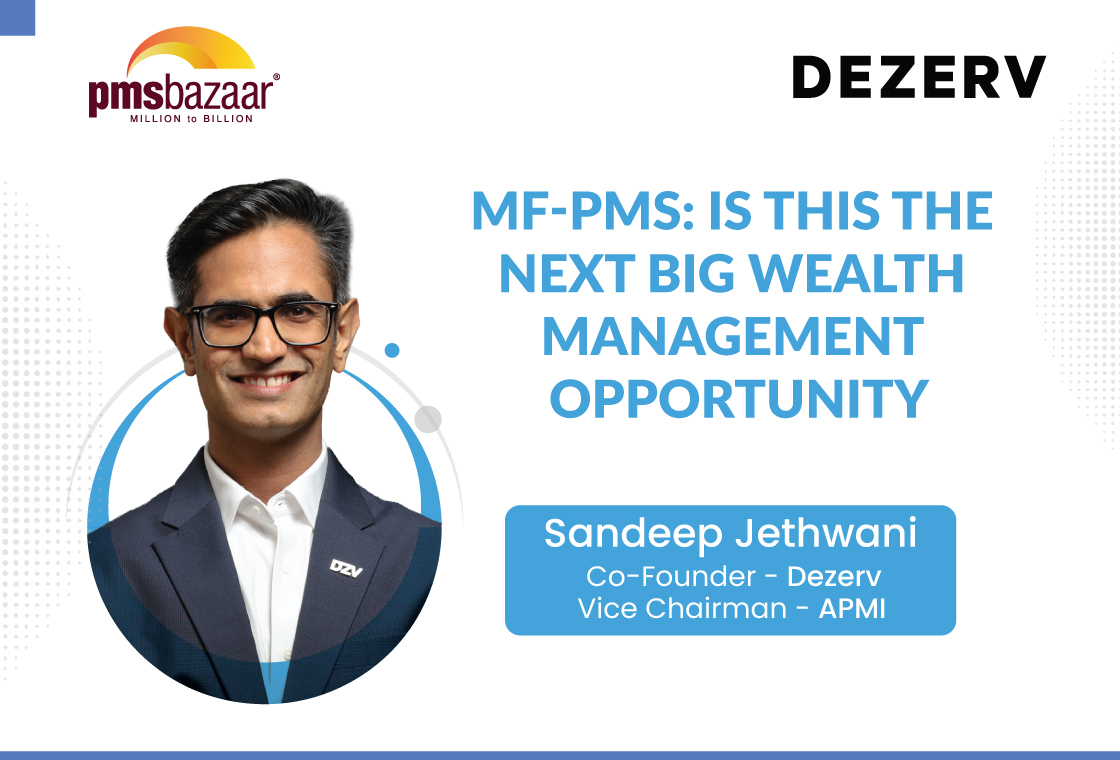
MF-PMS: Is This the Next Big Wealth Management Opportunity
PMS Bazaar recently organised a webinar titled “MF-PMS: Is This the Next Big Wealth Management Opportunity,” which featured Mr. Sandeep Jethwani, Co-Founder, Dezerv & Vice Chairman, APMI.

PMS Performance: Over 94% of Tracked Strategies Beat Nifty 50 TRI
Global markets remained under pressure in August 2026 as geopolitical tensions, rising bond yields and elevated crude oil prices kept investors cautious.

The Next Alpha Cycle: How Should Investors Position ‘Alternatives’ in Their Portfolios?
PMS Bazaar recently organized a webinar titled “The Next Alpha Cycle: How Should Investors Position ‘Alternatives’ in Their Portfolios,” which featured Mr. Akhil Chaturvedi, ED & CBO, Motilal Oswal AMC. This blog covers the important points shared in this insightful webinar.
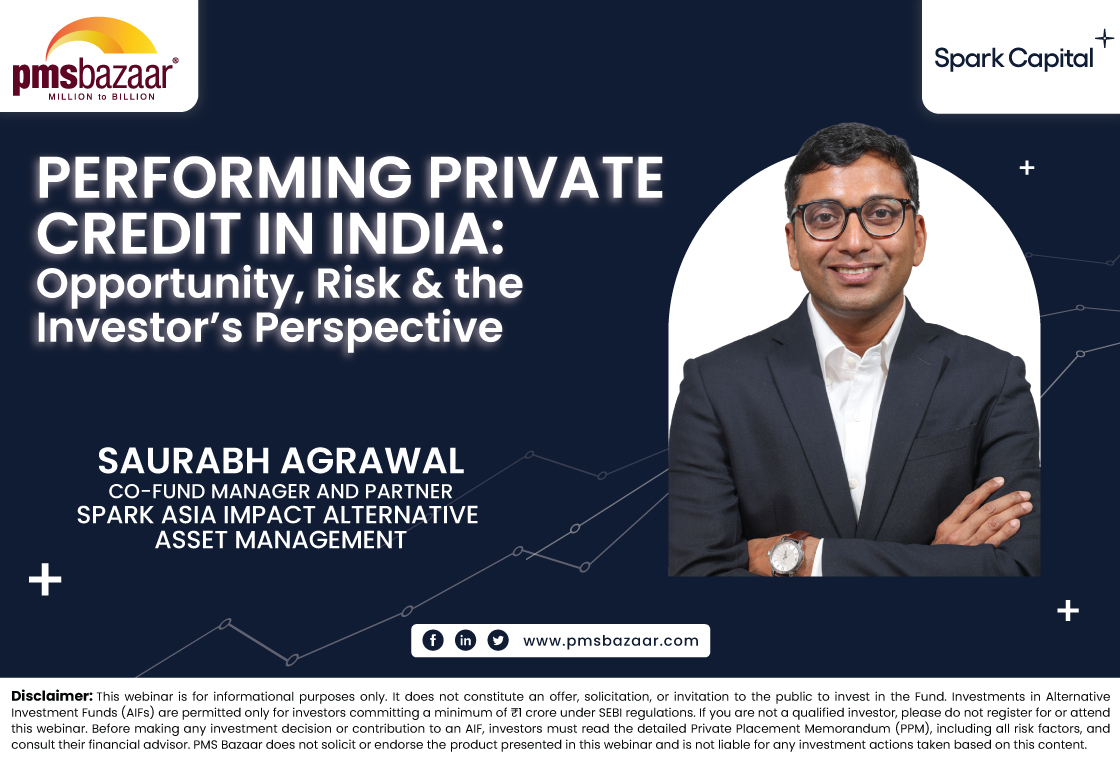
Performing Private Credit in India: Opportunity, Risk & the Investor’s Perspective
PMS Bazaar recently organised a webinar titled “Performing Private Credit in India: Opportunity, Risk & the Investor’s Perspective,” which featured Mr Saurabh Agrawal, Co-Fund Manager and Partner, Spark Asia Impact Alternative Asset Management.

PMS Performance: Who Outperformed in July 2026?
July 2026 was another month marked by uncertainty, with market performance shaped by evolving global cues and shifting investor sentiment. Despite the uncertain environment, equity PMS strategies continued to present opportunities, with several managers delivering returns ahead of the broader market benchmarks.

Arbitrage: Seeking Consistency Without Predicting Markets
Every investor grapples with the same challenge: uncertainty.