

PMS Bazaar recently organised a webinar titled “When Market Direction Is Uncertain, Can Arbitrage Add Stability to Client's Portfolio?” which featured Mr. Sandeep Tyagi, Founder & Chairman, Estee Advisors and Mr. Shubham Goyal, Director, Strategy, (Principal Officer and Fund Manager - I-Alpha), Estee Advisors Pvt. Limited. This blog covers the important points shared in this insightful webinar.
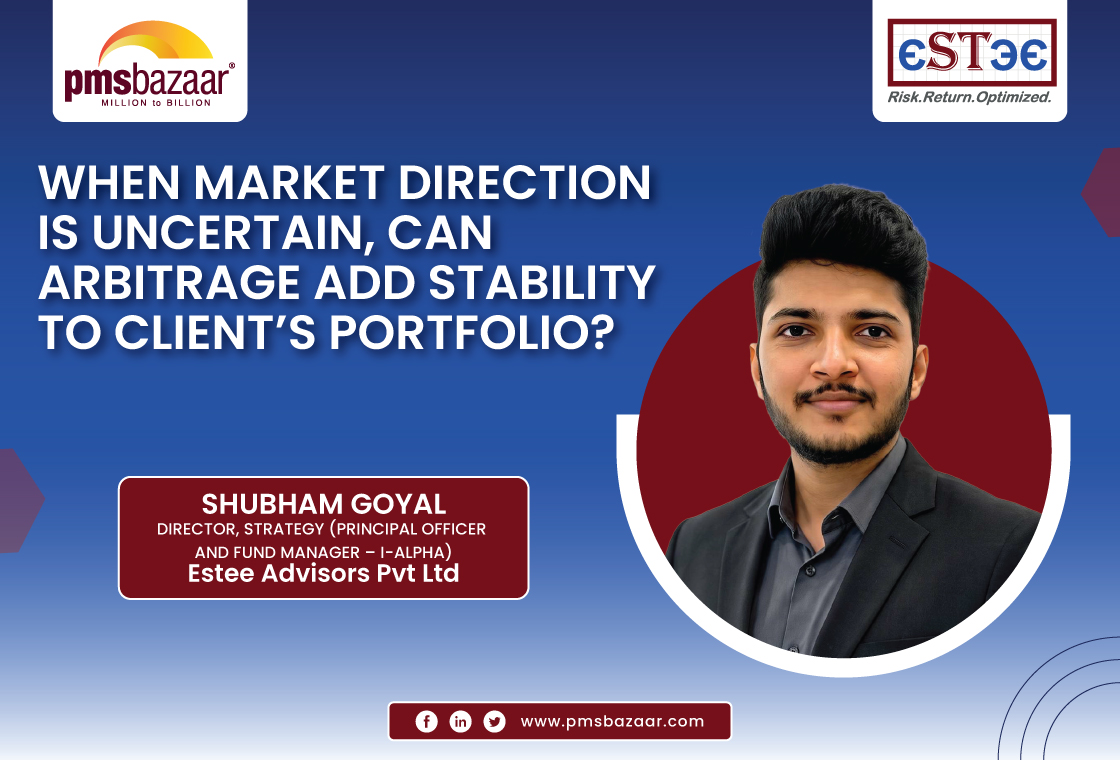
The webinar blog covers insights from Mr. Tyagi and Mr. Goyal, which include market-neutral investing and how arbitrage strategies can help navigate volatile or uncertain markets. It explained different types of arbitrage, the role of quantitative and high-frequency trading, and associated risks. The blog also examined the I-Alpha strategy, including its return components, risk-management framework, liquidity, taxation and how investors can consider such strategies within their portfolios..
Key aspects covered in this webinar blog are
- Understanding market-neutral investing
- Mechanics and evolution of arbitrage
- Managing risks and company capabilities
- Applying arbitrage: The I-Alpha strategy
- Return components and risk framework
- Taxation, convergence, and product selection
Summary: Sandeep Tyagi explained how market-neutral arbitrage strategies can help investors navigate uncertain and volatile markets without relying on market direction. He outlined venue, index, put-call parity and cash-future arbitrage, highlighting the role of technology and high-frequency trading in identifying pricing gaps. Shubham Goyal then presented I-Alpha, a market-neutral strategy combining fixed-deposit interest income with arbitrage trading. The discussion also covered risk controls, liquidity, taxation, spread convergence and portfolio allocation based on investors’ risk tolerance, financial goals and investment timelines.
Mr. Sandeep Tyagi started the session by posing a fundamental question about market direction over the upcoming quarter. He noted that while those who professed certainty required no assistance, the reality for most investors had been far more challenging. Given that markets had experienced roughly six consecutive quarters of downward and volatile movements, he highlighted that finding stability was crucial.
When market trajectories remain uncertain, Mr. Tyagi explained, arbitrage strategies can effectively stabilize client portfolios by acting as a fixed-income-plus approach that generates performance irrespective of market direction.
Understanding Market-Neutral Investing
Mr. Tyagi contrasted directional investing with market-neutral strategies to clarify how modern portfolios can insulate themselves from shocks. He explained that directional investing relies entirely on market movement; going long yields profits if markets rise, whereas going short succeeds when markets fall, but both carry substantial downside risks if predictions fail. In contrast, market-neutral investing is engineered to produce returns completely independent of market direction by identifying alternative sources of value. Comparing it to a traditional bank fixed deposit that delivers steady returns regardless of broader macroeconomic fluctuations, Mr. Tyagi stated that their strategies strive to achieve a closely aligned outcome.
To illustrate how arbitrage works in practice, he described it as purchasing an asset cheaply in one location and selling it higher elsewhere due to structural discrepancies. Citing a practical example, he noted that a specific stock might trade at slightly different prices on the National Stock Exchange and the Bombay Stock Exchange due to varying local supply and demand dynamics. Because settlements are netted across exchanges, investors can capture the price difference as net profit without dealing with physical delivery, entirely independent of daily stock price fluctuations.
Mechanics and Evolution of Arbitrage
Mr. Tyagi outlined four primary types of arbitrage opportunities that modern practitioners utilize:
- Venue Arbitrage: Exploiting price discrepancies for the exact same asset across different exchanges like the NSE and BSE.
- Index Arbitrage: Capitalizing on pricing gaps between a composite index like the Nifty and its underlying component stocks.
- Put-Call Parity: Utilizing structured mathematical relationships among futures, call options, and put options to lock in value.
- Cash-Future Arbitrage: Exploiting temporary pricing differences between cash instruments and their corresponding futures contracts before final convergence at expiry.
He explained that executing these strategies involves detecting price gaps, which persist even in efficient markets due to varying buy-sell pressures and independent information flows, and executing both legs efficiently to lock in risk-free profits. Furthermore, Mr. Tyagi traced the evolution of speed in the trading industry, noting how electronic trading removed traditional friction, algorithmic trading introduced continuous software monitoring, and high-frequency trading enabled microsecond-level execution that far outpaced human capabilities. He remarked that human reaction times cannot compete with HFT algorithms operating in microseconds.
Managing Risks and Company Capabilities
While arbitrage offers structural advantages, Mr. Tyagi cautioned that various strategies carry distinct risks, such as merger arbitrage failing if a corporate acquisition falls through or statistical correlations breaking down. Transitioning to an overview of his firm, he highlighted its quantitative and analytics-driven foundation. Established in 2008 when SEBI first permitted direct computer connectivity to stock exchanges, the firm pioneered co-located servers and algorithmic trading in India.
Concluding his comprehensive address, Mr. Tyagi emphasized the firm's robust technological infrastructure, capable of executing millions of orders daily, alongside vast data repositories recording decades of tick-by-tick market activity. With global registrations and a multi-disciplinary team, the organization continues to design specialized products tailored to complex investor needs. Having established that foundational overview, he handed the discussion over to his colleague Shubham to detail the I-Alpha product.
Applying Arbitrage: The I-Alpha Strategy
Transitioning from theoretical concepts, Mr. Shubham Goyal took over the presentation to explain how arbitrage principles are practically applied in their flagship product, I-Alpha. He clarified that I-Alpha is a market-neutral, pure arbitrage strategy designed not to predict market directions, but rather to exploit temporary pricing relationships between related instruments—specifically index derivatives and a basket of single-stock derivatives weighted in exact proportion to the index.
Mr. Goyal emphasized that I-Alpha is not an equity allocation product and should not be expected to generate equity-like returns or drawdowns. Instead, it is best viewed as a treasury alternative or a substitute for fixed-income assets. The strategy targets net returns comparable to fixed deposits plus around two percent, backed by exceptionally low historical volatility and no negative quarters since its inception.
Return Components and Risk Framework
Mr. Goyal detailed that the strategy's overall returns originate from two core components:
- Interest Income: Approximately ninety-nine percent of the capital sits safely in fixed deposits, generating steady interest.
- Arbitrage Trading Income: A small remaining portion of capital acts as collateral to margin high-frequency arbitrage trades across exchanges.
To ensure capital protection, Mr. Goyal highlighted that the firm utilizes a robust risk management system. Real-time checks monitor daily and monthly profit and loss, maximum drawdowns, and gross exposures. If any parameter breaches pre-set limits, the automated system immediately halts trading to safeguard investor funds. Furthermore, practical operations offer monthly liquidity, with structured fee models tailored to investor preferences.
Following the presentation, an interactive question-and-answer session featured both Mr. Shubham Goyal and Mr. Sandeep Tyagi addressing critical investor inquiries regarding technology, market efficiency, and taxation.
Mr. Tyagi distinguished between quantitative analysis, algorithmic execution, and high-frequency trading. He explained that quantitative models evaluate hundreds of financial parameters regularly, algorithms automate the logic through code, and high-frequency trading operates at microsecond speeds to capture fleeting price gaps before human traders can react.
Addressing concerns about market efficiency and regime changes, Mr. Tyagi noted that structural mispricing persists because buyers and sellers in index markets operate independently from those trading individual stocks. Consequently, arbitrage remains effective regardless of whether markets are bullish, bearish, or transitioning between sectors.
Taxation, Convergence, and Product Selection
Mr. Tyagi and Mr. Goyal also clarified technical aspects regarding spread convergence and taxation. They explained that positions do not need to wait until complete expiry; instead, algorithmic execution exits trades once spreads narrow sufficiently, effectively avoiding the directional delivery risks associated with holding single stocks overnight. On the regulatory and tax front, trading gains are classified as business income, while earnings from underlying deposits follow conventional interest taxation structures.
Mr. Tyagi provided guidance on portfolio construction. He noted that investors should allocate between conservative options like I-Alpha and growth-oriented products like Long Alpha based strictly on their individual risk tolerance, financial timelines, and overall capacity to absorb market fluctuations.
Mr. Tyagi and Mr. Goyal covered all the topics mentioned above in-depth and answered questions from the audience toward the end of the session. For more such insights on this webinar, watch the recording of this insightful session through the appended link below.
Get access to rich data and analytics of PMS & AIF by subscribing to us. Join the 100000+ investors & experts: Subscribe NOW
Recent Blogs

MF-PMS: Is This the Next Big Wealth Management Opportunity
PMS Bazaar recently organised a webinar titled “MF-PMS: Is This the Next Big Wealth Management Opportunity,” which featured Mr. Sandeep Jethwani, Co-Founder, Dezerv & Vice Chairman, APMI.

PMS Performance: Over 94% of Tracked Strategies Beat Nifty 50 TRI
Global markets remained under pressure in August 2026 as geopolitical tensions, rising bond yields and elevated crude oil prices kept investors cautious.

The Next Alpha Cycle: How Should Investors Position ‘Alternatives’ in Their Portfolios?
PMS Bazaar recently organized a webinar titled “The Next Alpha Cycle: How Should Investors Position ‘Alternatives’ in Their Portfolios,” which featured Mr. Akhil Chaturvedi, ED & CBO, Motilal Oswal AMC. This blog covers the important points shared in this insightful webinar.
Performing Private Credit in India: Opportunity, Risk & the Investor’s Perspective
PMS Bazaar recently organised a webinar titled “Performing Private Credit in India: Opportunity, Risk & the Investor’s Perspective,” which featured Mr Saurabh Agrawal, Co-Fund Manager and Partner, Spark Asia Impact Alternative Asset Management.
GIFT City IFSC: India's Emerging Hub for Global Finance
PMS Bazaar recently organized a webinar titled “GIFT City IFSC: India's Emerging Hub for Global Finance,” which featured Mr. Bharath Shivappa, President & Chief of Markets, Gujarat International FinanceTec-City. This blog covers the important points shared in this insightful webinar.

PMS Performance: Who Outperformed in July 2026?
July 2026 was another month marked by uncertainty, with market performance shaped by evolving global cues and shifting investor sentiment. Despite the uncertain environment, equity PMS strategies continued to present opportunities, with several managers delivering returns ahead of the broader market benchmarks.

Arbitrage: Seeking Consistency Without Predicting Markets
Every investor grapples with the same challenge: uncertainty.
Structure Over Sentiment: India’s Private Credit Edge in a Volatile Global Market
The emergence of private credit over the past decade represents one of the most consequential developments in global finance.