

PMS Bazaar recently organized a webinar titled “Core and Satellite Approach to Equity Investing,” which featured Mr. Swapnil S Kulkarni, Co-Founder, PriceBridge. This blog covers the important points shared in this insightful webinar.
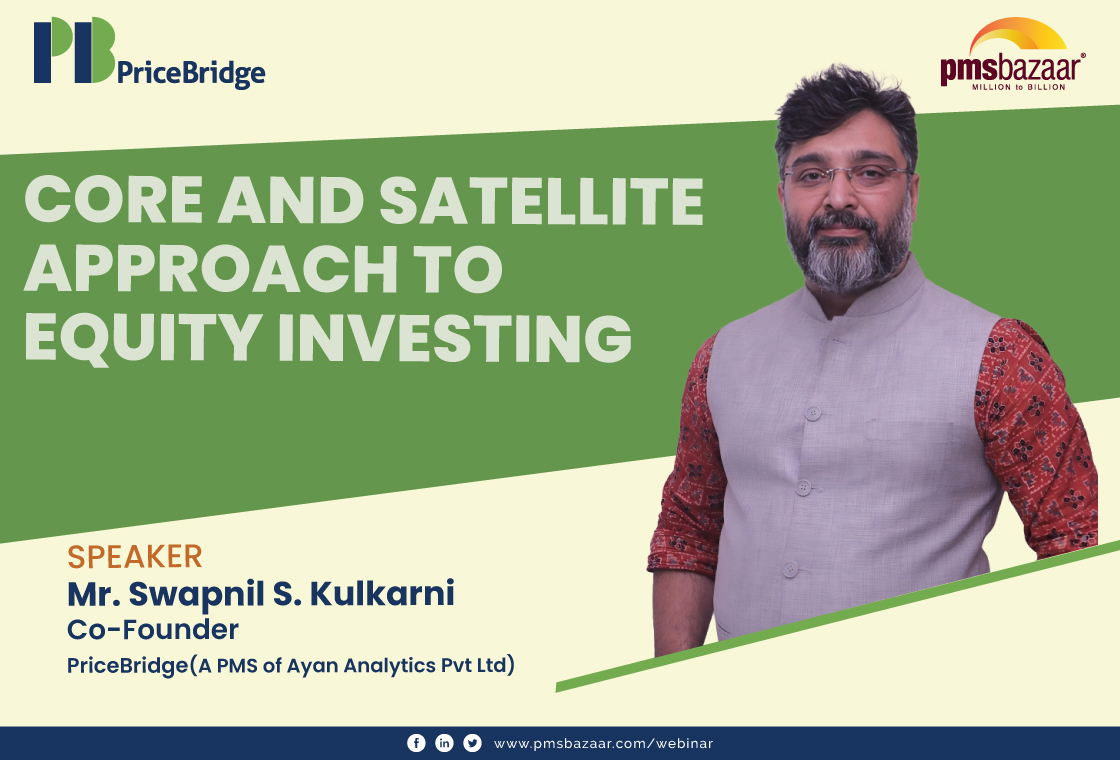
The webinar blog covers insights from Mr. Kulkarni, which includes his insights on PriceBridge’s disciplined approach to portfolio management, led by Swapnil Kulkarni. It stresses fixing the core portfolio with index ETFs since most active funds underperform. Their strategy combines a passively managed core with an actively managed satellite, using quantitative rules, sector rotation, and behavioral insights—buying during fear and selling during euphoria—to generate consistent alpha while controlling risk.
Key aspects covered in this webinar blog are
- Ayan Analytics’ Investment Philosophy
- The Diverse DNA of Ayan Analytics
- Fixing the Leak: The Case for Index Investing
- The “Passively Active” Honeycomb Strategy
- The Upswing Satellite Strategy
- Behavioral Investing Edge
- Managing Drawdowns and Market Risks
- Global Market Perspective
- Sector Outlook for 2026
- The Tax and Portfolio Churn Debate
Summary: Mr. Swapnil Kulkarni of PriceBridge emphasized disciplined, data-driven portfolio management built on the belief that “data is God.” He advised investors to first strengthen their core portfolio with low-cost index funds or ETFs, noting that about 85% of active funds underperform benchmarks long term. Ayan’s “passively active” Honeycomb strategy seeks 3–5% alpha through tactical market-cap allocation, sector rotation, and dynamic asset shifts. The Upswing strategy targets 14–22% returns using strict quantitative risk-reward rules. Kulkarni highlighted behavioral investing—buying during fear and selling during euphoria—and stressed consistency, risk control, and disciplined execution over chasing short-term multibaggers.
Mr. Swapnil Kulkarni started by sharing Ayan Analytics vision for modern portfolio management. Grounded in the philosophy that "Data is God," he articulated a sophisticated approach to investing that moves beyond simple performance chasing. Mr. Kulkarni emphasized that success in the markets is less about picking the next "multibagger" and more about structural discipline, risk management, and fixing the "leaky bucket" of underperforming core investments.
The Diverse DNA of Ayan Analytics
Mr. Kulkarni began by introducing the collective expertise at Ayan Analytics. He noted that the team is composed of seasoned professionals from various market segments, ranging from regulatory backgrounds and index creation to alternative research and classic mutual fund management. This multi-decadal, diverse experience forms the foundation of their semi-registered portfolio management services. According to Mr. Kulkarni, this variety of perspectives is what allows them to look at data through a different lens—one that prioritizes consistency over fleeting trends.
Fixing the Leak: The Case for Index Investing
A central theme of Mr. Kulkarni’s address was the critical need for investors to monitor their core holdings. He observed that most investors follow a predictable path: starting with fixed deposits, moving to mutual funds, and eventually seeking higher returns through Portfolio Management Services (PMS). However, in the pursuit of "alpha," many neglect the very foundation of their wealth.
Citing data from Standard & Poor’s (S&P) regarding the Indian market, Mr. Kulkarni pointed out a startling reality: roughly 85% of active funds underperform their benchmark index over the long run. Even those that do outperform often fail to remain at the top consistently. He noted that while investors often "behaviorally" assume they are matching market returns, the lack of regular portfolio reviews and the rarity of timely fund switches result in significant underperformance.
His advice to investors was direct: "Fix your core first." He argued that while fund managers may change, the market index is permanent. By utilizing index funds or ETFs, investors can "hug the index" and capture long-term market returns at a significantly lower cost.
The "Passively Active" Strategy: Price Bridge Honeycomb
Mr. Kulkarni then introduced a unique strategy for managing ETFs, which he termed "passively active." Under the Price Bridge Honeycomb strategy, the team manages passives with an active overlay. The primary objective is not to take incremental risks but to generate a consistent 3-5% alpha over the benchmark.
He explained that they achieve this through three primary levers:
- Tactical Market Cap Allocation: Shifting focus between large, mid, and small caps depending on which segment is poised for growth.
- Sector Rotation: Recognizing that sectors are cyclical, the team avoids entering sectors after they have already peaked.
- Dynamic Asset Allocation: Using risk maps and heat maps to move into defensive assets like gold or silver when equity markets show signs of extreme "heat."
Mr. Kulkarni highlighted that as of early 2026, their approach had delivered a 6.8% annualized alpha over the Nifty index over a three-year period, proving that one can outperform the market without aggressive risk-taking.
The Satellite Component: Price Bridge Upswing
While the core should be indexed, Mr. Kulkarni suggested that the "satellite" portion of a portfolio should focus on absolute returns. He introduced the Price Bridge Upswing strategy, a flexicap approach designed to deliver 14-22% absolute returns over a 3-4 year horizon.
This strategy is strictly quantitative. Mr. Kulkarni explained that they utilize an internal Order Management System (OMS) that prevents any fund manager—including the CIO—from executing a trade unless it meets a predefined 1:2.5 risk-reward ratio. This system-driven discipline is intended to remove human emotion, such as greed or fear, from the investment process.
The Federer Analogy: It’s About the Points, Not Just the Matches
To illustrate the importance of "hit ratios," Mr. Kulkarni drew an analogy from sports, referencing a viral speech by tennis legend Roger Federer. He noted that while Federer won 80% of his matches, he won only 54% of the total points played.
Applying this to investing, Mr. Kulkarni shared that PriceBridge doesn't need to be right 100% of the time. By maintaining a hit ratio of approximately 60-65% and ensuring that winning trades yield significantly more than losing trades (the 1:3 risk-reward framework), they can achieve superior CAGR. He showcased client data where different hit ratios and risk-reward balances consistently led to returns in the 14-18% range, regardless of whether the broader market was moving sideways.
Navigating the Behavioral Cycle
Mr. Kulkarni delved into the psychology of investing, mapping out emotions like greed, self-doubt, and euphoria. He observed that most "hot tips" reach investors during the "greed" phase, where the risk-reward ratio is often inverted (e.g., 1:0.43).
PriceBridge’ strategy is to wait for the "greed" to subside and for "self-doubt" to set in among the masses. By initiating positions in a staggered manner during these periods of market skepticism, they secure a much more favorable risk-reward entry point.
The Behavioral Edge: Buying Fear and Selling Euphoria
Mr. Kulkarni began by distinguishing the "behavioral quant" model from standard algorithmic trading. While many quantitative models are designed to follow trends—often entering the market during phases of high conviction or technical breakouts—his approach is decidedly contrarian. He explained that the Ayan Analytics model is built to identify and exploit the emotional extremes of the masses.
According to Mr. Kulkarni, typical quant models often fall victim to "crowding," where too many participants chase the same momentum. Price Bridge seeks to avoid this by acting as a "supplier" when the market is euphoric and a "buyer" when fear takes hold. He noted that while the model is automated to remove human bias, human intervention remains critical for establishing risk controls, particularly regarding stock weightage and position sizing. This ensures that the system doesn't just chase data but stays within a predefined safety framework.
Scaling Alpha: Why Size Isn't a Constraint
A common concern in the PMS industry is whether an increase in Assets Under Management (AUM) leads to a "shrinkage" of alpha. Mr. Kulkarni addressed this by highlighting the liquidity of their chosen universe. Because Ayan Analytics primarily dabbles in ETFs and heavy-weight index stocks, they operate in a space where liquidity is ample.
He provided a striking comparison: the largest PMS in India is still smaller than the average mutual fund scheme of the top five Asset Management Companies (AMCs). Since these large mutual funds successfully manage thousands of crores within the same index universe, Mr. Kulkarni expressed total confidence that PriceBridge could maintain its 3–5% alpha target without facing liquidity bottlenecks or "alpha decay" as they grow.
Managing Drawdowns in a Volatile World
Addressing the elephant in the room—market corrections—Mr. Kulkarni was candid about the limitations of risk management. He admitted that while market risk can be reduced, it can never be entirely eliminated, especially during "black swan" or geopolitical events that trigger market circuits.
Price Bridge Honeycomb (ETF Strategy)
- Performance Context: This strategy is designed to maintain performance in line with the benchmark index.
- Risk Profile: It intentionally mimics index volatility rather than trying to avoid it entirely.
- Core Objective: The primary focus is on alpha generation (targeting 3–5% over the benchmark) through tactical sector and market cap rotation while "hugging" the index.
Price Bridge Upswing (Stock Strategy)
- Performance Context: This strategy has shown strong resilience historically, outperforming the market in 3 out of 4 major downturns.
- Risk Profile: It operates as a concentrated, high-conviction portfolio of 25–40 stocks.
- Drawdown Experience: In the most recent market correction, it experienced a 23% drawdown, which was largely attributed to an exit by Foreign Institutional Investors (FIIs) in the low-volatility stocks where the fund had taken shelter.
He noted that during a recent market dip, the Upswing strategy fell slightly more than the Nifty—not due to high beta, but because they had sought shelter in "low volatility" stocks that were disproportionately affected by Foreign Institutional Investor (FII) exits. This served as a reminder that even defensive positioning carries unique risks when global liquidity shifts.
Global Perspectives: US vs. India ETFs
When asked about global allocations, particularly US active vs. passive ETFs, Mr. Kulkarni urged caution. He observed that the US markets have experienced a "crazy rise" over the last two decades and are currently hovering between phases of high conviction and euphoria.
At this juncture, he suggested that Asian markets might offer better value than the US. For investors adamant about US exposure, he recommended a stock-specific approach rather than broad index chasing. Furthermore, he addressed technical concerns regarding Indian ETFs, advising investors to always look at the Indicative Net Asset Value (iNAV) rather than just bid-ask spreads to ensure they are not overpaying during times of high market activity.
Tactical Shifts: Sector Outlook for 2026
Mr. Kulkarni shared a "peek under the hood" of their current portfolio, revealing a dynamic approach to sector rotation. While financial services have led the recent rally, Ayan Analytics has begun trimming exposure there due to heightened risk at current levels.
- Bullish Sectors: Energy, Public Sector Enterprises (excluding PSU banks), and Defense.
- Value Pockets: Consumption and FMCG, which he noted are currently at attractive valuations.
- Avoidance List: Information Technology, as he believes the sector will take more time to bottom out.
- Metals: A tactical play where they have been "selling on the rise" in silver to lock in profits from euphoric price spikes.
The Tax Question: Is Churn a Disadvantage?
Finally, Mr. Kulkarni addressed the "tax disadvantage" often associated with the high churn in PMS portfolios. He argued that any alpha generation above 2% easily justifies the tax liability of the churn. Interestingly, despite their active management, he revealed that 60–70% of their gains across both strategies remain Long-Term Capital Gains (LTCG), with only 30–35% classified as short-term.
His parting advice to new investors was to view the current market "fear" as an opportunity. In the behavioral cycle, fear is the signal for Ayan Analytics to be aggressive and fully deployed. By sealing the "leak" in the core portfolio through ETFs and adding a disciplined, quantitative satellite, investors can navigate even the most sideways markets with conviction.
Mr. Kulkarni covered all the topics mentioned above in-depth and answered questions from the audience toward the end of the session. For more such insights on this webinar, watch the recording of this insightful session through the appended link below.
Get access to rich data and analytics of PMS & AIF by subscribing to us. Join the 90000+ investors & experts: Subscribe NOW
Recent Blogs
PMS Performance : 401 Equity PMS Beat the Nifty 50 TRI
September 2026 saw global markets grapple with persistent macroeconomic uncertainty, as rising U.S. bond yields, crude oil prices above $90 per barrel and escalating Middle East tensions kept investors on edge. Concerns over renewed inflationary pressures and tighter financial conditions continued to shape market sentiment. The reported 25-basis-point Federal Reserve rate hike, bringing rates to 3.75–4.00 per cent, added another dimension to the evolving global outlook.
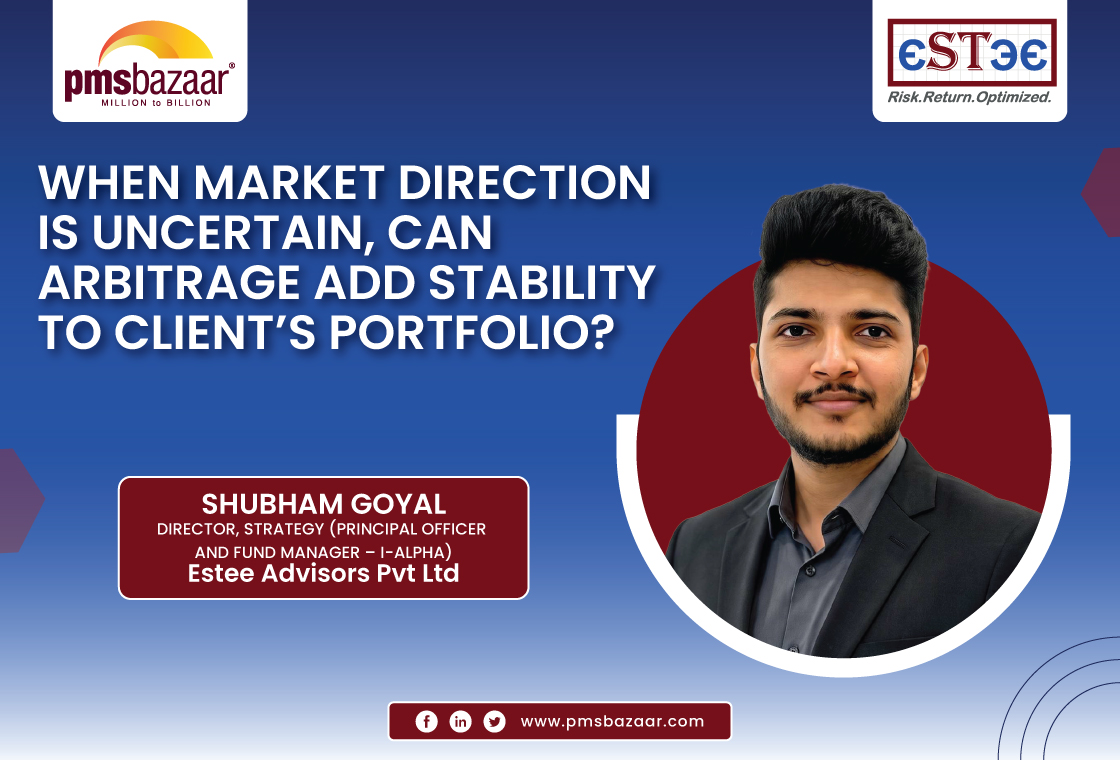
When Market Direction Is Uncertain, Can Arbitrage Add Stability to Client's Portfolio?
PMS Bazaar recently organised a webinar titled “When Market Direction Is Uncertain, Can Arbitrage Add Stability to Client's Portfolio?” which featured Mr. Sandeep Tyagi, Founder & Chairman, Estee Advisors and Mr. Shubham Goyal, Director, Strategy, (Principal Officer and Fund Manager - I-Alpha), Estee Advisors Pvt. Limited. This blog covers the important points shared in this insightful webinar.

MF-PMS: Is This the Next Big Wealth Management Opportunity
PMS Bazaar recently organised a webinar titled “MF-PMS: Is This the Next Big Wealth Management Opportunity,” which featured Mr. Sandeep Jethwani, Co-Founder, Dezerv & Vice Chairman, APMI.

PMS Performance: Over 94% of Tracked Strategies Beat Nifty 50 TRI
Global markets remained under pressure in August 2026 as geopolitical tensions, rising bond yields and elevated crude oil prices kept investors cautious.

The Next Alpha Cycle: How Should Investors Position ‘Alternatives’ in Their Portfolios?
PMS Bazaar recently organized a webinar titled “The Next Alpha Cycle: How Should Investors Position ‘Alternatives’ in Their Portfolios,” which featured Mr. Akhil Chaturvedi, ED & CBO, Motilal Oswal AMC. This blog covers the important points shared in this insightful webinar.

Performing Private Credit in India: Opportunity, Risk & the Investor’s Perspective
PMS Bazaar recently organised a webinar titled “Performing Private Credit in India: Opportunity, Risk & the Investor’s Perspective,” which featured Mr Saurabh Agrawal, Co-Fund Manager and Partner, Spark Asia Impact Alternative Asset Management.

GIFT City IFSC: India's Emerging Hub for Global Finance
PMS Bazaar recently organized a webinar titled “GIFT City IFSC: India's Emerging Hub for Global Finance,” which featured Mr. Bharath Shivappa, President & Chief of Markets, Gujarat International FinanceTec-City. This blog covers the important points shared in this insightful webinar.

PMS Performance: Who Outperformed in July 2026?
July 2026 was another month marked by uncertainty, with market performance shaped by evolving global cues and shifting investor sentiment. Despite the uncertain environment, equity PMS strategies continued to present opportunities, with several managers delivering returns ahead of the broader market benchmarks.