


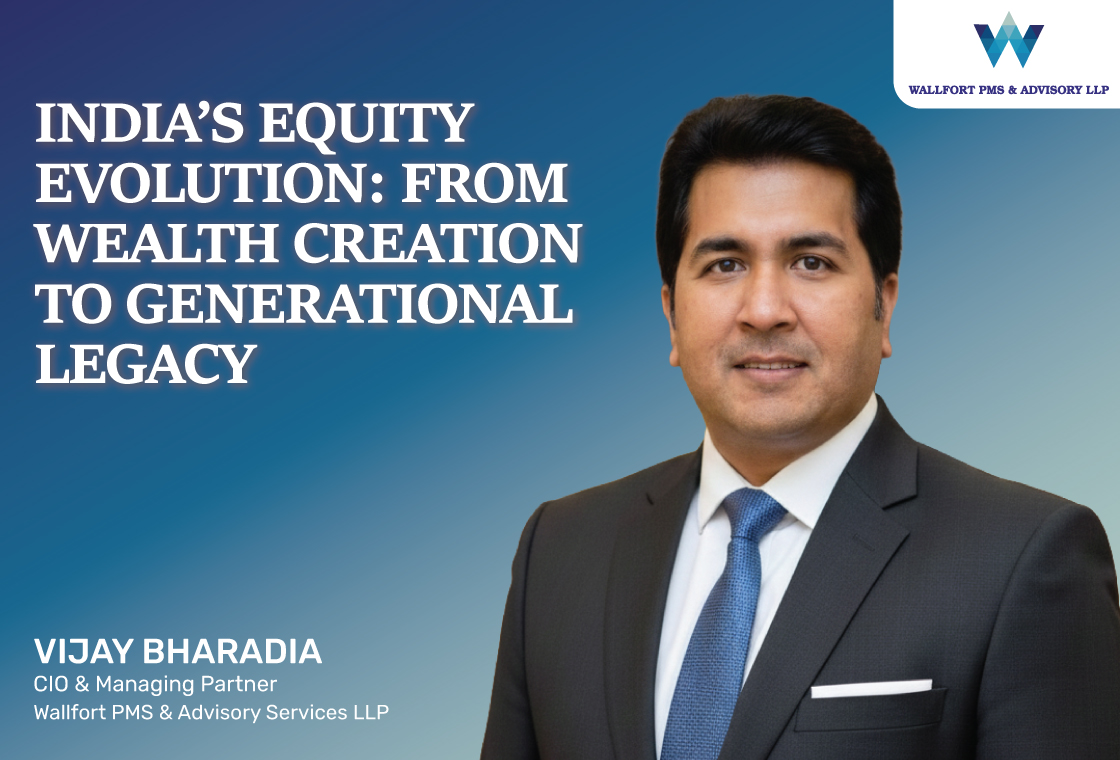
Author - Vijay Bharadia CIO & Managing Partner, Wallfort PMS & Advisory Services LLP. He has over 28 years of experience in Indian equity markets with deep expertise in mid and small-cap investing. As CIO & Managing Partner of Wallfort PMS, he has delivered over 45% CAGR in the last five years, through disciplined stock selection and on-ground research. His investment approach focuses on understanding promoters, business cycles and buying quality businesses without overpaying. Having navigated multiple market cycles, he believes wealth creation is driven by process, patience and the courage to stay invested when others hesitate.
The Long Game: Equity as a Test Match
Investing in equities is very much like playing a Test match. You respect the conditions, avoid reckless shots, and trust that time at the crease will eventually reward you. Markets behave the same way. Short bursts of excitement fade, but steady accumulation builds innings that last generations. Equity investing is not a sprint driven by adrenaline; it is a carefully paced marathon where temperament matters more than brilliance. The greatest fortunes in markets have never been made in a season; they have been made over decades.; it is a carefully paced journey where temperament matters more than timing.
A Personal Fascination with Market History
My relationship with markets has been shaped more by history than headlines. I have always been intrigued by how families like the Rothschilds dominated markets through superior information and how institutions such as Goldman Sachs survived for over 150 years across wars and recessions. The lesson is simple: ownership of good businesses outlives every other form of wealth. Empires have disappeared, currencies have been replaced, but equity has adapted and compounded. That resilience is what convinced me early in my career that this asset class is permanent.
Patience Pays, Impatience Costs
Markets reward behaviour more than brilliance. Over the last 3 decades Indian equities have delivered strong double-digit returns despite crises such as the Asian contagion, the global financial meltdown, the taper tantrum and the pandemic. If one observes carefully, almost 75% of the time markets are either flat or rising, and only about 25% is truly painful. Yet that painful phase is fierce enough to shake confidence. Those who exited during Covid remember the regret; those who stayed invested created significant wealth. The truth remains markets transfer wealth from the impatient to the patient.
Why Equity is the Most Flexible Asset
Land brings issues of title and liquidity. Gold brings storage and safety concerns. Fixed income protects but rarely compounds meaningfully. Equity is digital, divisible and dynamic. Businesses can reinvent, expand and improve margins without the investor lifting a finger. This adaptability makes equities the most efficient vehicle for long‑term compounding and participation in India’s entrepreneurial energy.
India at a Historic Inflection Point
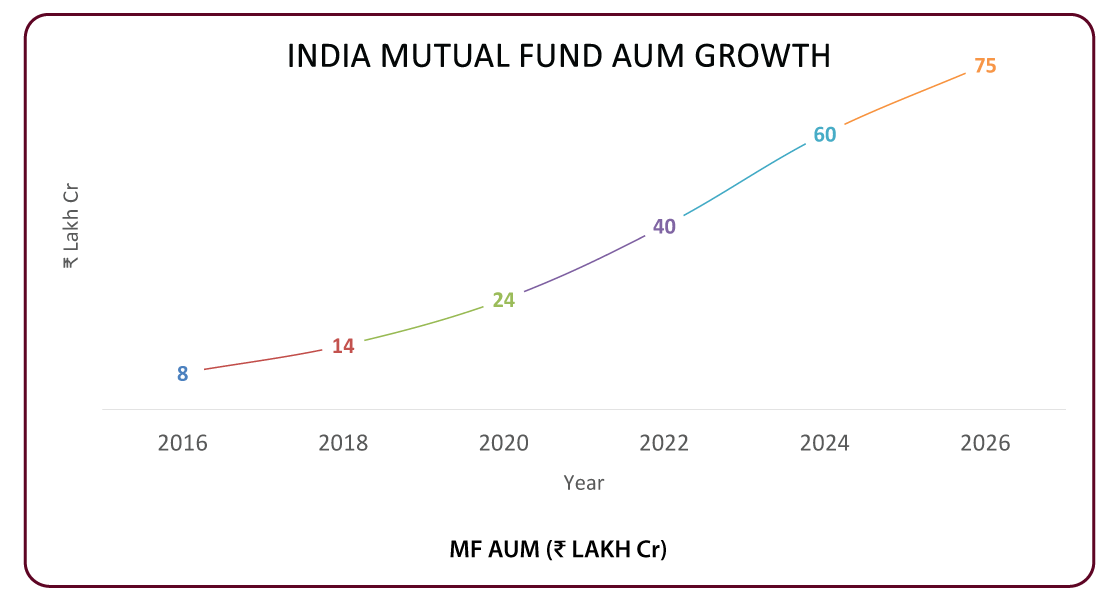
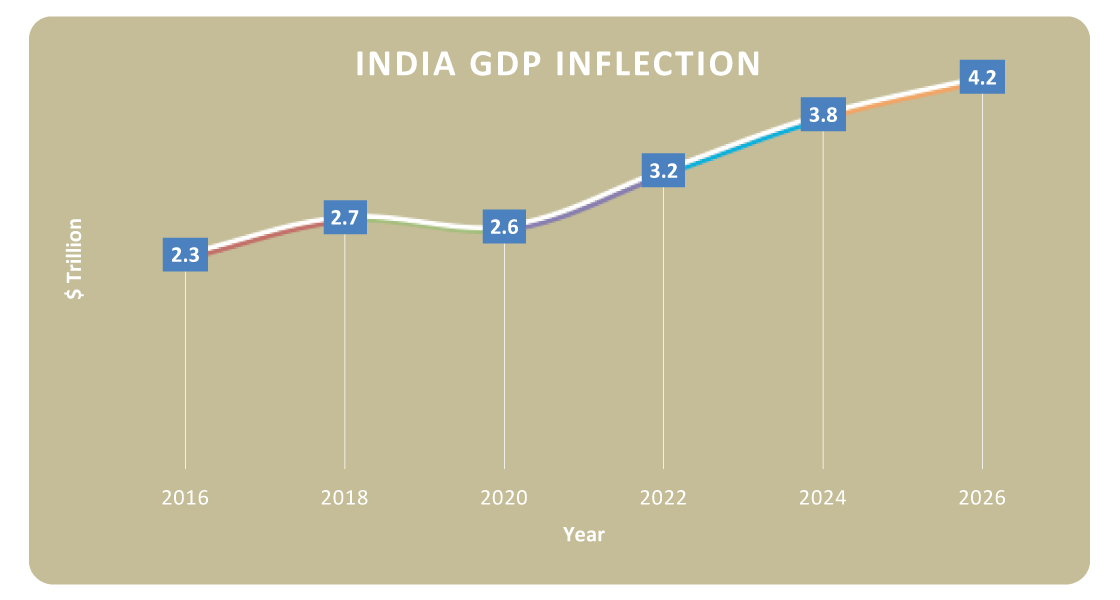
India stands at the threshold of a four-trillion-dollar economy. Historically, nations that cross this mark double faster thereafter. What makes India’s journey unique is its population story. For decades our 1.4 billion people were viewed as a burden, low per-capita income combined with a large base was seen as a drag on resources. Today the same population has become our greatest strength. With per-capita income nearing USD 2,800, a vast section of society has moved beyond survival to aspiration. A large population with low income is a challenge; a large population with rising income is a massive market. This shift is creating a powerful premium consumer class and an unprecedented opportunity for businesses. The India of today is more formal, digital and aspirational than ever before.
From a Saving Nation to an Investing Nation
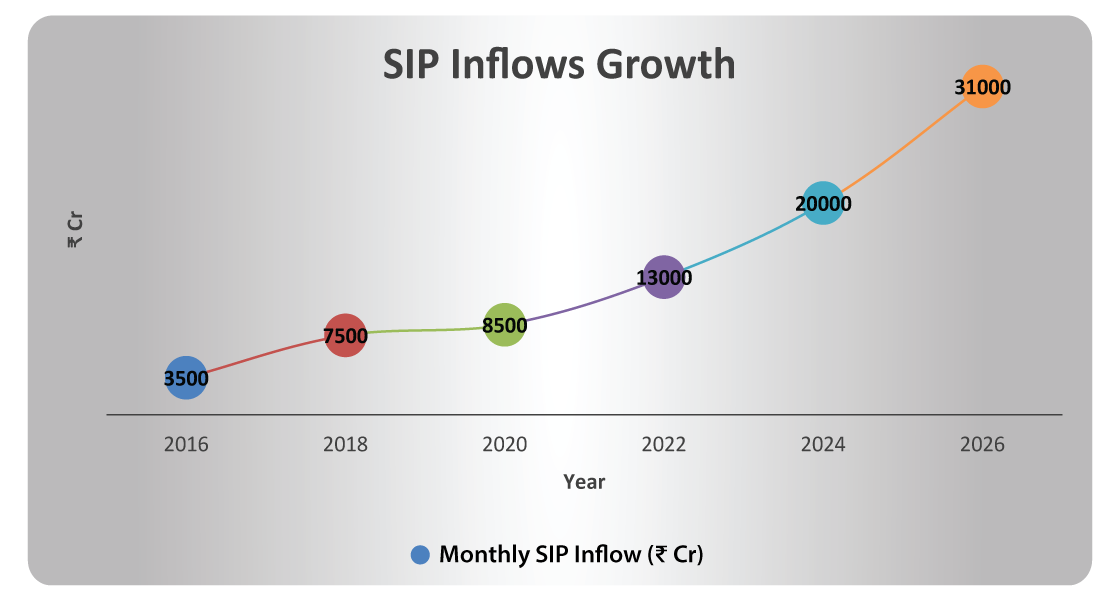
Perhaps the most powerful change is behavioral. India has moved from being a nation that saved in gold and real estate to one that invests in businesses. Mutual fund assets have multiplied many times over the last decade and systematic investment plans have brought discipline to households. Capital markets are now accessed through a phone, not through privilege. Veteran investor, Late Shri Rakesh Jhunjhunwala predicted a tsunami of retail money would hit markets; That prophecy is unfolding in front of us.
 The Rise of Professional Management
The next phase of this journey will be led by portfolio management services and alternative investment structures. As families grow wealthier, they seek customized, research-driven solutions rather than generic products. This is similar to what the United States witnessed between 1990 and 2008 when investors gradually shifted from mutual funds to professionally managed accounts. I believe India is entering a comparable cycle where PMS will play a central role in channelizing sophisticated capital.
Policy Support Creating a Virtuous Cycle
Recent government actions have further strengthened the foundation. Reduction in CRR and repo rates, rationalisation of GST and income-tax slabs, and focused efforts to revive consumption are improving liquidity in the system. Corporate balance sheets are healthier than ever, banks are well capitalised and formalisation is expanding the organised sector’s share. These steps may appear incremental, but together they create a powerful earnings tailwind for the coming years.
 Equity as a Generational Asset
 For me equity is a bridge between generations. In my own family it has funded education, entrepreneurship and security. The next generation thinks digitally and is comfortable owning businesses on a screen. Managed through a PMS framework, equities bring governance and discipline.
Looking Ahead with Optimism
We are living through what could be the finest period in centuries to be an Indian. Stable institutions, a young population, expanding infrastructure and confident entrepreneurs are combining in rare harmony. The world is looking at India not as a market of hope but as a market of delivery. For investors who can think beyond quarterly noise, this decade offers an extraordinary canvas.
Closing Thoughts
Equity investing ultimately is an act of faith in human progress. It is believing that businesses will innovate, consumers will aspire and India will continue to rise. If we remain patient, diversified and disciplined, equities will do far more than create wealth. They will build enduring legacies that our children will inherit with pride.
Recent Blogs

April rebound lifts PMS strategies, but small-cap tilt drives leaders
A broad market recovery helped managers beat large-cap indices, though alpha against wider benchmarks remained more selective and category-dependent

SEBI’s GARUDA Framework: A Big Boost for India’s AIF Industry and GIFT City Ecosystem
India’s Alternative Investment Fund (AIF) industry has evolved rapidly over the last few years. Investors today are increasingly moving beyond traditional investment products such as mutual funds and fixed deposits in search of differentiated opportunities across Private Equity, Venture Capital, Private Credit, Real Estate, infrastructure, and Category III long-short strategies.

Winners & Losers: Sectors to Watch in the Current Global Crisis
PMS Bazaar recently organized a webinar titled “Winners & Losers: Sectors to Watch in the Current Global Crisis,” which featured Mr. Arpit Shah, Co-Founder and Director, Care Portfolio Managers. This blog covers the important points shared in this insightful webinar.
Why ETF-Only Portfolios Are the Most Tax-Efficient Way to Invest
How deferred taxation and lower LTCG rates compound into significantly higher post-tax wealth for long-term investors
Why Market Corrections Are the Best Time to Build Your Core Equity Portfolio
PMS Bazaar recently organized a webinar titled “Why Market Corrections Are the Best Time to Build Your Core Equity Portfolio,” which featured Mr. Amit Nigam, Deputy CIO, ASK Investment Managers. The webinar blog covers insights from Mr. Nigam, which includes explanation how recent stock market volatility in India creates opportunities for long-term investors. It highlights shifting from a fixed deposit mindset to equities, his blog covers the important points shared in this insightful webinar.

6 out of 10 PMSes Beat Benchmarks In March Crash
Despite a fourth straight monthly sell-off, most PMSes fell less than benchmarks; a few even stayed in the green
Sapphire SIF: Long-Short Factor Model Driven by Quant Strategy
PMS Bazaar recently organized a webinar titled “Sapphire SIF: Long-Short Factor Model Driven by Quant Strategy,” which featured Mr. Satish Prabhu, Vice President and Head of Products and Content, Franklin Templeton Asset Management Private Limited. This blog covers the important points shared in this insightful webinar.
Why Invest in Start-Ups for Wealth Creation?
PMS Bazaar recently organized a webinar titled “Why Invest in Start-Ups for Wealth Creation?” which featured Mr. Vinit Rai, MD& CIO, Managing Director, JM Financial Equity. This blog covers the important points shared in this insightful webinar.