


This Article is Authored by Rishi Agarwal Co-Founder & Fund Manager, Aarth Growth Fund

For decades, Indian entrepreneurial wealth followed a simple rule: build the operating business and park surplus capital in real estate. Land was tangible, familiar and perceived as safe.
But a quiet shift is now underway inside the boardrooms of India’s emerging family offices. As wealth transitions to the second and third generations, capital allocation is gradually moving away from opportunistic asset ownership toward institutional portfolio construction.
Alternative Investment Funds (AIFs) are increasingly becoming the bridge between promoter capital and professional investing.
The Rise of the Indian Family Office
India’s wealth landscape is undergoing a structural transformation. Entrepreneurial success across manufacturing, services, pharmaceuticals, technology and infrastructure has created a new class of promoter families managing substantial pools of capital.
As wealth grows and ownership transitions across generations, many families are establishing dedicated family offices to manage investments more professionally.
Growth of Indian Family Offices
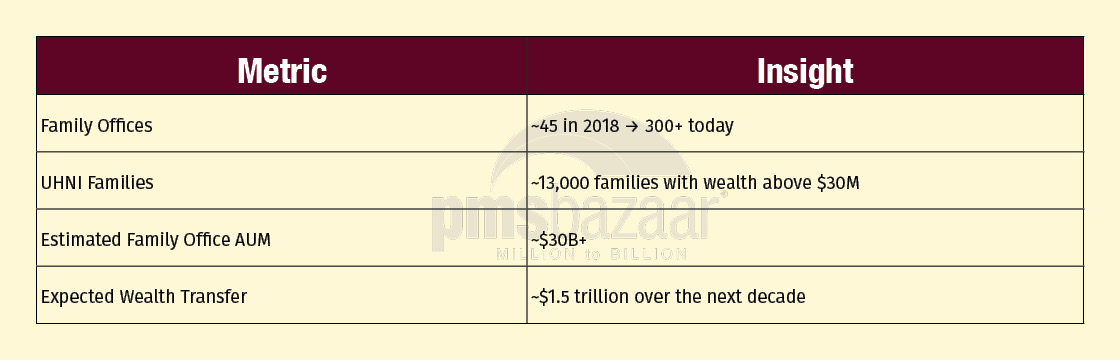
This transition reflects a deeper shift. Family offices are evolving from extended accounting departments into structured investment organisations.
Yet the institutionalisation of wealth management is still incomplete.
The Missing Piece: An Investment Policy Statement
Despite the rise of family offices, many portfolios remain individual-driven rather than policy-driven.
Capital allocation decisions often move between real estate, equities, private deals, commodities, international investments and derivatives depending on market sentiment or deal flow. Without a structured framework, portfolios become reactive rather than strategic.
In many cases, families have not answered the most fundamental questions that define long-term investment success.
Questions Every Family Office Must Answer
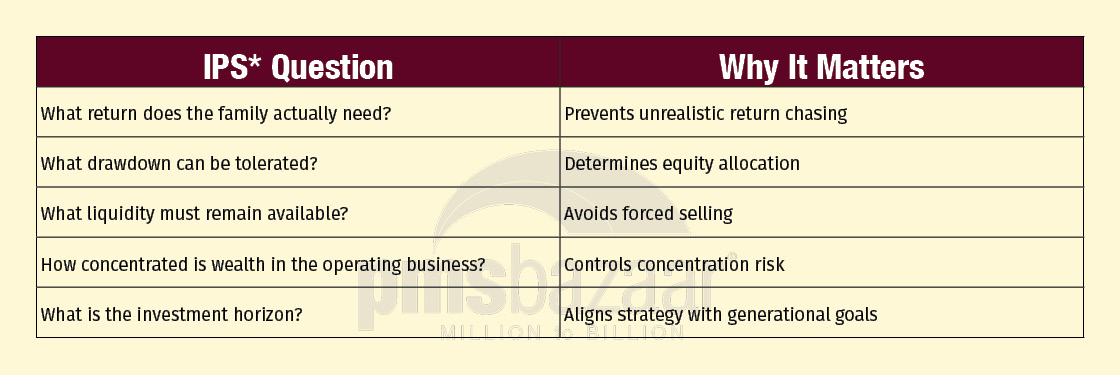
Unless these questions are addressed through a formal Investment Policy Statement* (IPS), even well-intentioned investment strategies tend to collapse during market cycles.
Family offices must also recognise that the operating business itself forms a large part of the investment portfolio. Ignoring this concentration risk can distort overall asset allocation decisions.
Why Real Estate Became the Default Asset?
Historically, real estate dominated Indian wealth portfolios for several reasons. It offered tangibility, perceived safety and informational advantage through local networks. It also allowed families to deploy large pools of capital quickly while serving as a hedge against inflation.
However, modern wealth portfolios increasingly require diversification and capital efficiency.
Real Estate vs AIF Structures
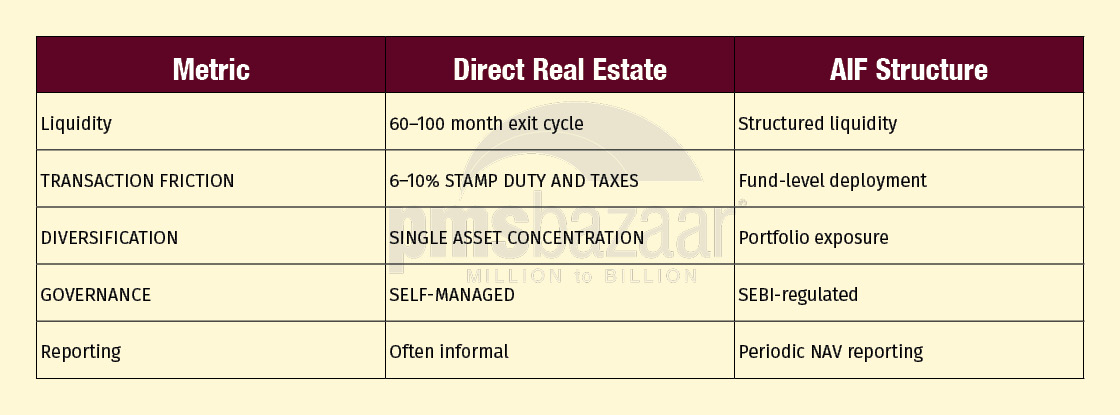
While real estate continues to serve as a store of value, it is gradually becoming one component of a diversified portfolio rather than the dominant allocation.
Three Structural Shifts in Indian Family Offices
Beyond the visible migration toward financial assets, three deeper structural changes are reshaping how Indian family offices deploy capital.
1. From Opportunistic Investing to Policy-Driven Allocation
Historically, investment decisions within promoter families were driven by opportunity rather than allocation discipline. Capital moved between asset classes based on prevailing narratives.
As family offices mature, many are institutionalising decisions through Investment Policy Statements and defined asset allocation ranges. Long-term wealth preservation depends less on individual investment outcomes and more on portfolio construction discipline.
2. From Asset Ownership to Capital Efficiency
Earlier generations of wealth creation focused on accumulating physical assets. The emerging generation is increasingly focused on capital efficiency.
Investments are now evaluated based on:
- Liquidity
- Governance
- Scalability of returns
- Diversification benefits
This shift is pushing family office capital toward professionally managed investment structures such as Alternative Investment Funds.
3. From Informal Networks to Institutional Research
Investment decisions historically relied heavily on personal networks and relationship-driven deal flow. Modern capital markets increasingly require institutional research capabilities, particularly in complex segments such as SME and microcap investing.
As a result, many family offices are complementing direct investments with allocations to specialised fund managers with dedicated research teams. Taken together, these shifts reflect a broader transformation in how Indian entrepreneurial wealth is managed.
The IPO Trap: When Narratives Replace Valuation
One recurring pattern observed across family offices is the tendency to chase highly marketed IPO opportunities.
These transactions often arrive accompanied by detailed pitch decks, extensive research reports and strong word-of-mouth momentum. By the time such opportunities reach broader investor circles, however, much of the upside may already be embedded in valuations.
In market terms, a priced story can resemble a squeezed lemon.
The most powerful source of equity alpha historically has been discovery premium — identifying businesses before narratives are widely built around them. Disciplined investors therefore spend more time analysing downside risk and earnings potential than chasing the latest market story.
Microcaps: The Misunderstood Opportunity
Many family offices attempt direct investments in microcap companies in search of multi-bagger returns.
The reality of this segment is far more complex.
Microcap Misconceptions
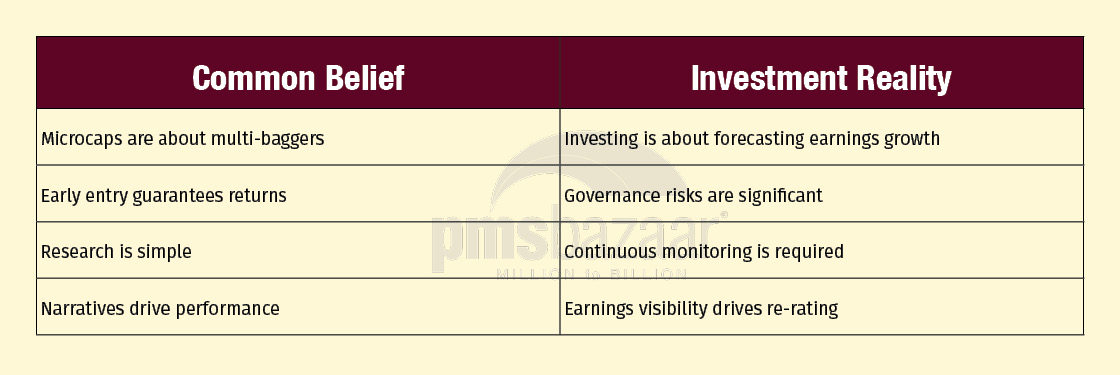
Successful microcap investing typically requires evaluating three to five years of earnings growth supported by industry expansion. As companies scale and enter the investment universe of institutional investors such as mutual funds, valuation multiples can expand significantly.
For many family offices, managing this research process independently can become operationally intensive. Over time, several have found it more effective to allocate capital to specialised fund managers with dedicated research capabilities.
Case Study: A Third-Generation Portfolio Reset
A third-generation manufacturing family historically deployed surplus capital across real estate projects and opportunistic equity investments.
Over time, the family realised their portfolio suffered from three structural issues:
- no defined asset allocation
- limited portfolio performance tracking
- excessive exposure to illiquid assets
The introduction of an Investment Policy Statement and defined allocations toward public markets and alternative strategies brought greater clarity and discipline to the portfolio.
Periodic reviews and diversified exposure significantly improved the family’s ability to manage risk while maintaining long-term growth objectives.
The Indian Family Office Portfolio Pyramid
A useful way to visualise modern family office portfolios is through a layered allocation framework.
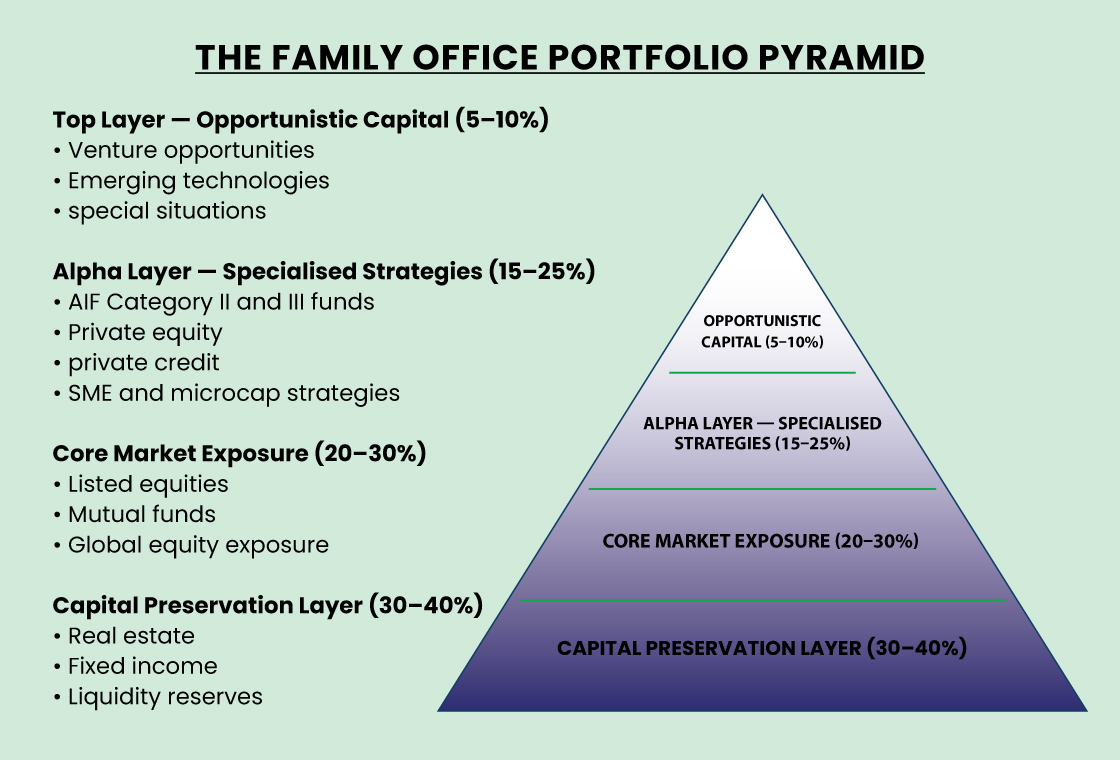
Within this framework, real estate remains a capital preservation asset, while AIFs increasingly occupy the alpha generation layer.
From Asset Ownership to Portfolio Construction
Indian family offices are gradually transitioning from a mindset of owning assets to managing portfolios.
This shift requires disciplined frameworks, diversified asset allocation and periodic portfolio reviews. It also requires recognising when specialised strategies are better executed through professional fund managers.
Alternative Investment Funds are emerging as a key component of this transition.
The families that succeed in preserving and compounding wealth across generations will not necessarily be those who own the most assets. They will be those who allocate capital with the greatest discipline.
Thus a conclusion, as India’s family office landscape is gradually evolving from a traditional model of asset ownership to a more disciplined approach centred on strategic portfolio construction. While real estate will continue to play a role as a capital preservation asset, the increasing need for diversification, governance, and professional oversight is encouraging families to adopt more structured investment frameworks. In this changing environment, Alternative Investment Funds (AIFs) are emerging as an important bridge between promoter capital and institutional investing.
As India’s entrepreneurial wealth expands and generational wealth transfer accelerates, the long-term success of family offices will depend less on the volume of assets accumulated and more on the discipline with which capital is allocated and managed.
Learn more here: https://pmsbazaar.com/Strategy/Aarth_Growth_Fund/Aarth-AIF
Disclaimer: The content shared in this blog is for informational and educational purposes only and should not be construed as an offer, solicitation, or recommendation to invest in any Alternative Investment Fund (AIF). As per SEBI regulations, AIF investments are allowed only for investors with a minimum commitment of ₹1 crore. Prospective investors are strongly advised to carefully review the Private Placement Memorandum (PPM), including all associated risk factors, and seek independent financial advice before making any investment decision. PMS Bazaar neither endorses nor recommends any specific fund or product mentioned herein and is not responsible for any investment decisions made based on this content.
Recent Blogs

SEBI’s Accredited Investor Certificate: Exclusive Access to AIFs, PMS, SIFs & Private Markets
PMS Bazaar recently organized a webinar titled “SEBI’s Accredited Investor Certificate: Exclusive Access to AIFs, PMS, SIFs & Private Markets,” which featured Mr. Rajesh Kumar S, Head of Business, NSDL Database Management Limited. This blog covers the important points shared in this insightful webinar.

April rebound lifts PMS strategies, but small-cap tilt drives leaders
A broad market recovery helped managers beat large-cap indices, though alpha against wider benchmarks remained more selective and category-dependent

SEBI’s GARUDA Framework: A Big Boost for India’s AIF Industry and GIFT City Ecosystem
India’s Alternative Investment Fund (AIF) industry has evolved rapidly over the last few years. Investors today are increasingly moving beyond traditional investment products such as mutual funds and fixed deposits in search of differentiated opportunities across Private Equity, Venture Capital, Private Credit, Real Estate, infrastructure, and Category III long-short strategies.

Winners & Losers: Sectors to Watch in the Current Global Crisis
PMS Bazaar recently organized a webinar titled “Winners & Losers: Sectors to Watch in the Current Global Crisis,” which featured Mr. Arpit Shah, Co-Founder and Director, Care Portfolio Managers. This blog covers the important points shared in this insightful webinar.
Why Market Corrections Are the Best Time to Build Your Core Equity Portfolio
PMS Bazaar recently organized a webinar titled “Why Market Corrections Are the Best Time to Build Your Core Equity Portfolio,” which featured Mr. Amit Nigam, Deputy CIO, ASK Investment Managers. The webinar blog covers insights from Mr. Nigam, which includes explanation how recent stock market volatility in India creates opportunities for long-term investors. It highlights shifting from a fixed deposit mindset to equities, his blog covers the important points shared in this insightful webinar.

Why ETF-Only Portfolios Are the Most Tax-Efficient Way to Invest
How deferred taxation and lower LTCG rates compound into significantly higher post-tax wealth for long-term investors

6 out of 10 PMSes Beat Benchmarks In March Crash
Despite a fourth straight monthly sell-off, most PMSes fell less than benchmarks; a few even stayed in the green
Sapphire SIF: Long-Short Factor Model Driven by Quant Strategy
PMS Bazaar recently organized a webinar titled “Sapphire SIF: Long-Short Factor Model Driven by Quant Strategy,” which featured Mr. Satish Prabhu, Vice President and Head of Products and Content, Franklin Templeton Asset Management Private Limited. This blog covers the important points shared in this insightful webinar.