

PMS Bazaar recently organized a webinar titled “How to Navigate Micro and Small Cap Sector,” which featured Mr. Hemant Gadodia, Founder and Managing Director Invicta Capserv Private Limited. This blog covers the important points shared in this insightful webinar.
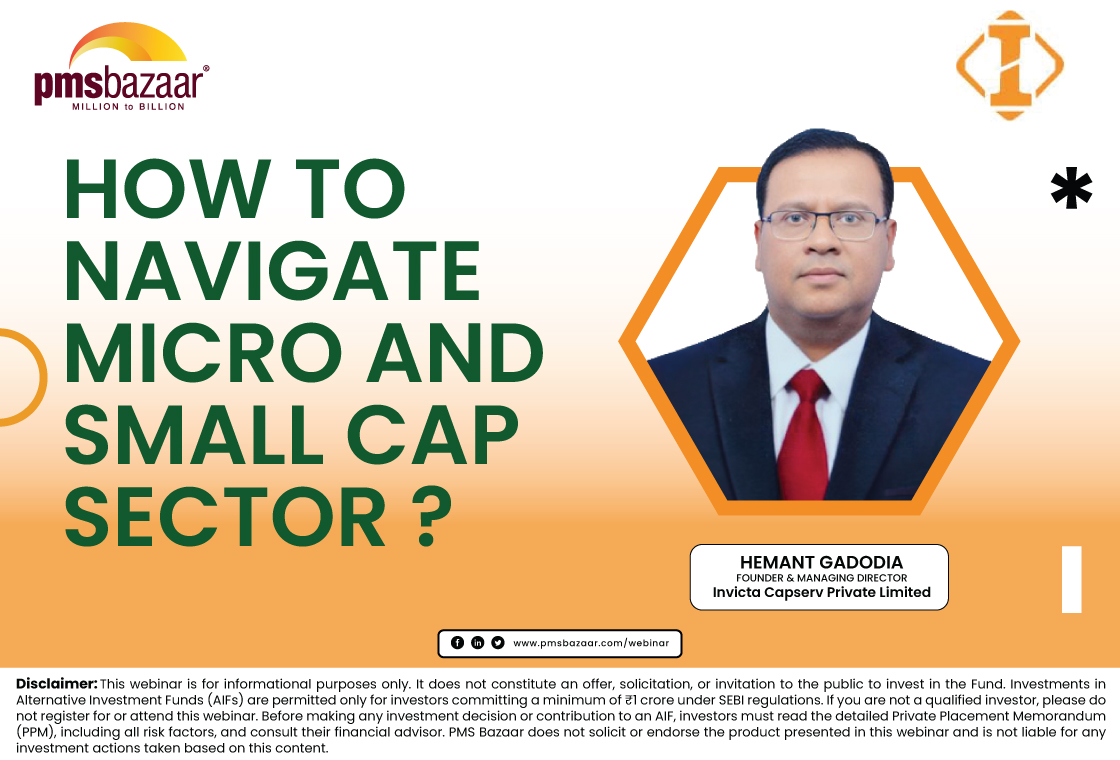
The webinar blog covers insights from Mr. Hemant, which includes his investment philosophy for identifying high-potential opportunities in India’s micro, small-cap, and pre-IPO markets. It explains his framework for evaluating businesses through qualitative and quantitative factors, managing risks, navigating market volatility, and constructing concentrated portfolios. The discussion also outlines his disciplined, valuation-driven approach to achieving sustainable long-term investment returns.
Key aspects covered in this webinar blog are
- Introduction to India's micro and small-cap investment landscape
- The dynamics of micro and small-cap investing
- A framework for value identification
- Qualitative assessment of businesses
- The importance of avoiding excessive leverage
- Opportunities and risks in pre-IPO investments
- Liquidity challenges in the pre-IPO market
- Patience and discipline in investing
- Position sizing and portfolio concentration
- Dynamic portfolio rebalancing
- Risk management and portfolio construction
- Balancing listed and pre-IPO investments
- Managing sector and company exposure
Summary: Mr. Hemant Gadodia outlined a disciplined approach to investing in India’s micro and small-cap segments, emphasizing that long-term success depends on identifying high-quality businesses rather than chasing market trends. He stressed evaluating management quality, scalable market opportunities, attractive valuations, strong profitability, efficient capital allocation, and low leverage while avoiding highly indebted companies. For pre-IPO investments, he highlighted liquidity and information risks, advocating thorough due diligence and late-stage opportunities with clear IPO timelines. His fund follows active portfolio management, concentrated diversification, valuation discipline, and regular rebalancing, targeting 25–30% IRR through a research-driven, risk-conscious investment strategy.
Mr. Hemant Gadodia started by providing an analysis of the Indian investment landscape, specifically focusing on the micro and small-cap sectors. With a backdrop of significant market expansion—where India’s total market capitalization has reached an impressive $5 trillion—Mr. Hemant highlighted the critical nuances of identifying value in a segment that constitutes the vast majority of the country's listed entities. His insights offered a roadmap for investors seeking to capture growth while cautiously managing the inherent risks of the smaller end of the market.
The Dynamics of Micro and Small-Cap Investing
Mr. Hemant noted that while the small-cap segment has historically outperformed large-cap indices like the Nifty 50 over rolling five-to-seven-year periods, this performance is consistently accompanied by significant volatility. He observed that as the Indian market continues to mature, the definition of these segments is shifting; companies that were once considered mid-caps now fall into the small-cap category due to the sheer growth in overall market capitalization.
He emphasized that while small and micro-caps account for roughly 80% to 90% of listed entities on the NSE and BSE, the vast majority of these firms struggle to create long-term shareholder value. Consequently, investors face a fundamental paradox: while the segment is a fertile ground for identifying future "diamonds," it also harbors significant risks that can erode capital if not approached with extreme rigor. He noted that although there is a sense of optimism regarding the potential for high returns, it is tempered by a pervasive fear among investors who are not fully attuned to the unique mechanics of this sector.
A Framework for Value Identification
To filter potential winners from value-destroying entities, Mr. Hemant outlined a robust, two-pronged approach. He suggested that by following this structured thought process, investors could avoid most of the names likely to destroy value.
- The Qualitative Assessment: Mr. Hemant identified the quality of management as the single most important differentiator. He argued that many investors overlook this subjective but critical aspect, leading to suboptimal outcomes. Furthermore, he stressed the importance of identifying companies with a large addressable market. The industry in which the firm operates must be large enough—and growing at high double-digit rates—to allow the company to grow faster than the market and eventually scale significantly over a three-to-five-year period. Additionally, he emphasized that entry valuation is paramount; most money is made at the point of entry, and a built-in margin of safety is essential to minimize the risk of capital loss.
- Quantitative Rigor: Beyond qualitative factors, Mr. Hemant firm utilizes strict filtering criteria regarding operating efficiency and capital allocation. He suggested that companies should ideally maintain operating margins of at least 13-14% and net margins of 7-8%. This baseline ensures the company exhibits minimum operating efficiency in its day-to-day business. Furthermore, he prioritized capital efficiency, setting a benchmark of at least 15-16% for Return on Capital Employed (ROCE) and 20% for Return on Equity (ROE). These metrics serve as indicators of the company’s ability to deploy capital efficiently over the medium to long term.
Perhaps most importantly, Mr. Hemant expressed a strong aversion to leverage. Drawing on his background in corporate and commercial banking, he warned that companies carrying high debt-to-equity ratios rarely create value and often end up in distress, litigation, or even insolvency. He stated that his team avoids companies with a debt-to-EBITDA ratio exceeding 2.5, preferring to take risks on improving operational efficiency rather than on corporate turnarounds involving debt reduction.
The Risks and Realities of Pre-IPO Investments
The discussion also delved into the increasingly popular pre-IPO space. While acknowledging that these opportunities allow investors to secure positions at lower valuations before a public debut, Mr. Hemant cautioned against the significant liquidity risks involved.
He pointed out that a substantial number of companies that raised pre-IPO capital in the last three years may fail to go public entirely. Unlike the secondary markets for listed entities, there is often no easy exit mechanism for unlisted shares. In the micro and small-cap sectors, if a liquidity event like an IPO or a rare M&A transaction does not occur, the investor is essentially locked in. Furthermore, he noted a recurring issue with information asymmetry. He observed that information dissemination in the pre-IPO space is often negligible; very few companies are responsible enough to share regular performance updates with their investors post-fundraise. Mr. Hemant concluded that navigating this space successfully usually requires the institutional resources necessary to perform deep due diligence and maintain rigorous follow-ups with the intermediaries responsible for taking these companies public.
Navigating Market Volatility
Reflecting on the performance of the Indian market over the past two years, Mr.Hemant acknowledged a period where broader indices remained flat or even experienced negative returns due to valuation de-rating, despite underlying business growth. He framed this as the "nature of the beast" in equity investing, where markets tend to swing from one extreme to another, moving away from and eventually reverting to their mean long-term averages.
To thrive in such an environment, he advised that investors must adopt a professional approach:
- Patience and Discipline: He observed that the primary reason institutions often outperform individual investors is their ability to remain disciplined and ignore emotional impulses like fear and greed. Staying invested during volatile periods is easier said than done, yet it is essential for long-term success.
- Optimal Position Sizing: He argued that excessive diversification often leads to mediocre returns at the portfolio level. Instead, investors should size their positions based on the strength of their conviction, which must be rooted in deep research and an intimate understanding of the underlying business and its market.
- Dynamic Rebalancing: Mr. Hemant cautioned against "blind" buy-and-hold strategies. He recommended that investors review their portfolios at least every six months—scrutinizing quarterly results and re-evaluating the investment thesis to decide whether to add, hold, or weed out specific positions. He insisted that these are not times to simply hold for five years without oversight, but rather times to maintain a constant tab on the outlook of every company within one's portfolio.
Ultimately, Mr. Hemant's presentation underscored that while the micro and small-cap segments offer immense potential, success is not a passive endeavor. It requires a disciplined, research-heavy, and risk-conscious approach to separate sustainable, high-growth businesses from the inherent volatility of the market.
Building upon the previous discussion on market volatility, Mr. Hemant Gadodia further elaborated on the operational philosophy of his fund, emphasizing that while volatility is an inherent and unavoidable feature of the investment landscape, it can be navigated through rigorous discipline and active management.
Adapting to Market Swings
Mr. Hemant noted that the market recently moved through a phase of intense euphoria in 2023 and early 2024, followed by a necessary, albeit painful, correction. During such periods, his team’s approach remains grounded in proximity to the underlying assets. He highlighted that his firm has increased its focus on "ground-level" due diligence—conducting frequent plant visits, engaging directly with management teams, and maintaining constant communication with the intermediaries who manage the path to public listing. By staying close to the companies, the firm is able to adjust its conviction, trimming positions in underperforming entities while aggressively increasing exposure to those where the medium-term earnings thesis remains intact.
The Investment Philosophy: Valuation as a Moat
For Mr. Hemant, valuation is paramount. He asserted that investment success is determined at the point of entry, not at the time of exit. Consequently, the firm operates as a highly selective, "rejection-based" entity. While the fund is sector-agnostic, it adheres to strict filters: zero tolerance for leverage, a preference for companies with significant market share, and a mandate for robust operating cash flows.
The fund generally targets late-stage pre-IPO opportunities, aiming for minority stakes of 1% to 5% with an expected listing timeline of 6 to 18 months. To ensure a sufficient margin of safety, the firm targets entries at single-digit EBITDA multiples or low double-digit earnings multiples. By maintaining this valuation discipline, Mr. Gadodia believes the fund can generate the "alpha" required to outperform passive index strategies.
Risk Management and Portfolio Construction
The fund typically structures its portfolio with a split: 51% to 55% in pre-IPO names and 45% to 47% in listed equities. This balance allows for both deep value creation from unlisted opportunities and the liquidity of the public markets.
To manage concentration risk, the fund caps exposure to any single sector at 25% and refuses to commit more than 10% of the total fund to any single company. The portfolio is intentionally concentrated, with 22 to 25 core names contributing to 90% of the Assets Under Management (AUM). This structure is designed to avoid the mediocrity often associated with over-diversification.
A Long-Term View on Liquidity
Addressing the primary concern of pre-IPO liquidity, Mr. Hemant acknowledged that the exit remains the greatest challenge. However, he emphasized that by partnering with companies that have a clear 18-month path to IPO, the fund creates its own liquidity events. Even when companies go public, the firm often chooses to hold its positions if the business thesis strengthens—such as through unexpected M&A activity or accelerated growth—demonstrating that their strategy is rooted in fundamental business performance rather than mere short-term trading. Ultimately, Mr. Hemant concluded that for his specific fund, investors should look for a target IRR in the range of 25% to 30%.
Mr. Hemant covered all the topics mentioned above in-depth and answered questions from the audience toward the end of the session. For more such insights on this webinar, watch the recording of this insightful session through the appended link below.
Get access to rich data and analytics of PMS & AIF by subscribing to us. Join the 100000+ investors & experts: Subscribe NOW
Disclaimer: The content shared in this blog is for informational and educational purposes only and should not be construed as an offer, solicitation, or recommendation to invest in any Alternative Investment Fund (AIF). As per SEBI regulations, AIF investments are allowed only for investors with a minimum commitment of ₹1 crore. Prospective investors are strongly advised to carefully review the Private Placement Memorandum (PPM), including all associated risk factors, and seek independent financial advice before making any investment decision. PMS Bazaar neither endorses nor recommends any specific fund or product mentioned herein and is not responsible for any investment decisions made based on this content.
Recent Blogs
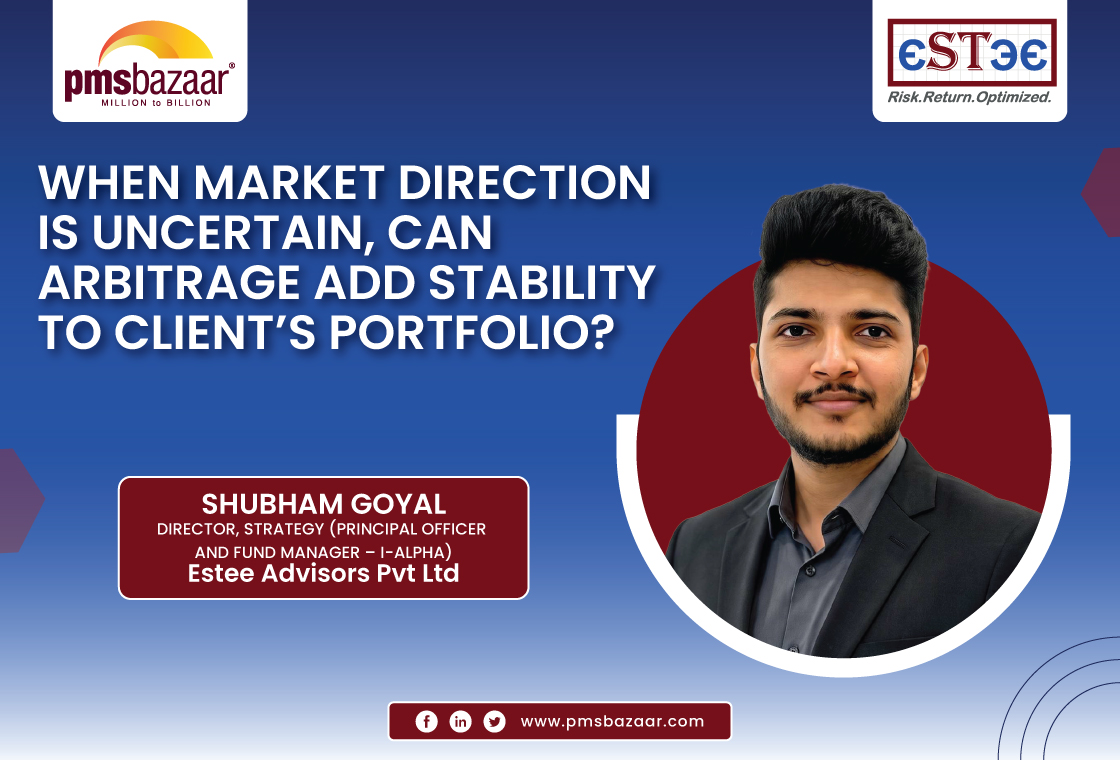
When Market Direction Is Uncertain, Can Arbitrage Add Stability to Client's Portfolio?
PMS Bazaar recently organised a webinar titled “When Market Direction Is Uncertain, Can Arbitrage Add Stability to Client's Portfolio?” which featured Mr. Sandeep Tyagi, Founder & Chairman, Estee Advisors and Mr. Shubham Goyal, Director, Strategy, (Principal Officer and Fund Manager - I-Alpha), Estee Advisors Pvt. Limited. This blog covers the important points shared in this insightful webinar.

MF-PMS: Is This the Next Big Wealth Management Opportunity
PMS Bazaar recently organised a webinar titled “MF-PMS: Is This the Next Big Wealth Management Opportunity,” which featured Mr. Sandeep Jethwani, Co-Founder, Dezerv & Vice Chairman, APMI.

PMS Performance: Over 94% of Tracked Strategies Beat Nifty 50 TRI
Global markets remained under pressure in August 2026 as geopolitical tensions, rising bond yields and elevated crude oil prices kept investors cautious.

The Next Alpha Cycle: How Should Investors Position ‘Alternatives’ in Their Portfolios?
PMS Bazaar recently organized a webinar titled “The Next Alpha Cycle: How Should Investors Position ‘Alternatives’ in Their Portfolios,” which featured Mr. Akhil Chaturvedi, ED & CBO, Motilal Oswal AMC. This blog covers the important points shared in this insightful webinar.

Performing Private Credit in India: Opportunity, Risk & the Investor’s Perspective
PMS Bazaar recently organised a webinar titled “Performing Private Credit in India: Opportunity, Risk & the Investor’s Perspective,” which featured Mr Saurabh Agrawal, Co-Fund Manager and Partner, Spark Asia Impact Alternative Asset Management.
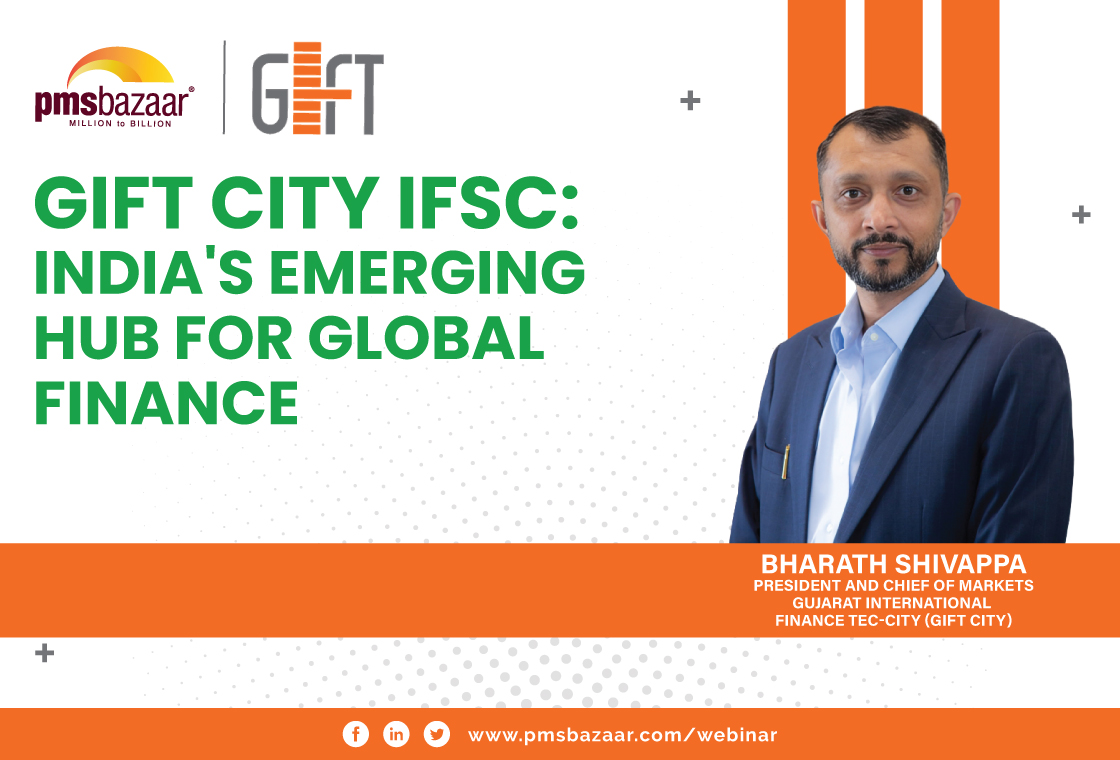
GIFT City IFSC: India's Emerging Hub for Global Finance
PMS Bazaar recently organized a webinar titled “GIFT City IFSC: India's Emerging Hub for Global Finance,” which featured Mr. Bharath Shivappa, President & Chief of Markets, Gujarat International FinanceTec-City. This blog covers the important points shared in this insightful webinar.

PMS Performance: Who Outperformed in July 2026?
July 2026 was another month marked by uncertainty, with market performance shaped by evolving global cues and shifting investor sentiment. Despite the uncertain environment, equity PMS strategies continued to present opportunities, with several managers delivering returns ahead of the broader market benchmarks.

Arbitrage: Seeking Consistency Without Predicting Markets
Every investor grapples with the same challenge: uncertainty.