

PMS Bazaar recently organized a webinar titled “Understand Why Quant Does Not Replace Fundamental Investing - It Strengthens It,” which featured Mr. Dinesh Giridhar, Co Founder, MD & CEO, Asset Management and Private Wealth, Dolat Capital. This blog covers the important points shared in this insightful webinar.
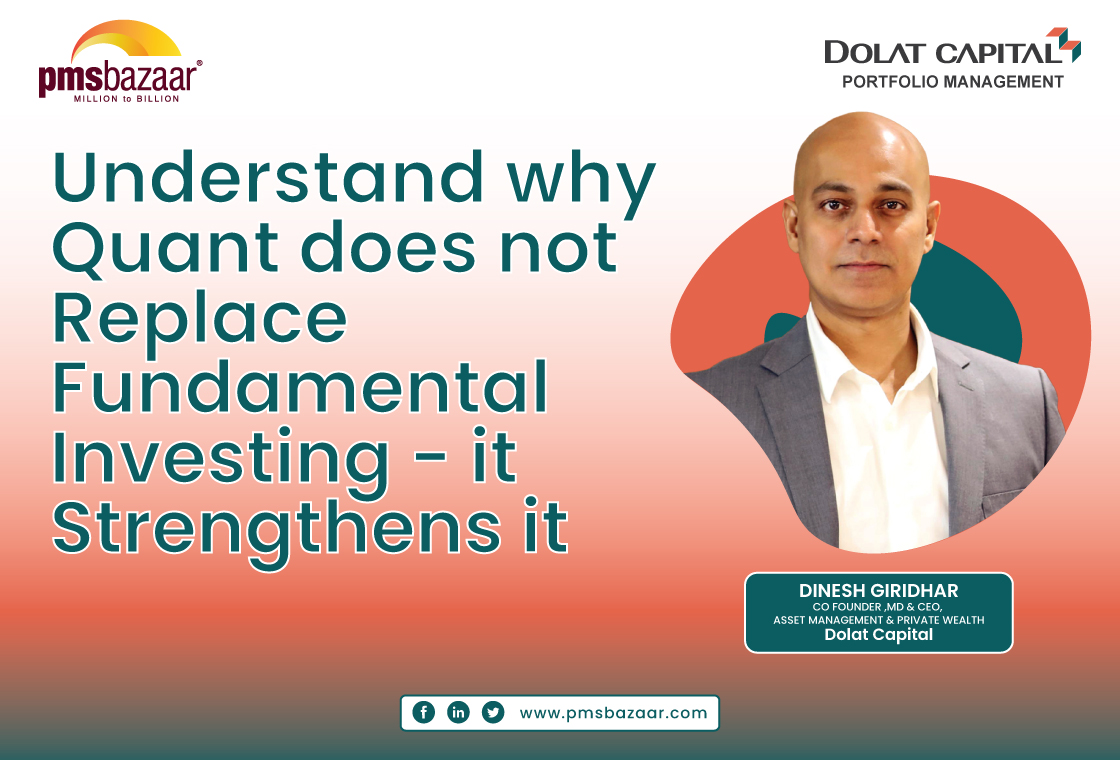
The webinar blog covers insights from Mr. Dinesh Giridhar, which includes his insights into Dolat Capital’s quant-first investment philosophy and the growing role of quantitative investing in India. It explored how advanced technology, large-scale data analysis, and model-driven decision-making can complement traditional investing, highlighted the firm’s flagship Dolat Quantum Leap strategy, and explained how systematic investing aims to deliver long-term wealth creation through disciplined, bias-free portfolio management.
Key aspects covered in this webinar blog are
- The strategic shift to quantitative architecture
- Why quantitative and traditional investing complement each other
- India’s quantitative investing adoption gap
- The infrastructure behind true quantitative investing
- Building a data- and technology-driven investment platform
- The multi-asset potential of quant strategies
- How the Dolat Quantum Leap strategy works
- Understanding the active nature of long-term investing
- Moving beyond factor-based investing
- The role of pattern recognition and market microstructure
- Backtesting versus curve-fitting: Building reliable quant models
- Using the DQL simulator to evaluate historical performance
- Managing portfolio churn and taxation
- Wealth creation through disciplined, model-driven investing
Summary: Mr. Dinesh Giridhar explained Dolat Capital’s transition to a quant-first asset management approach, leveraging its long-standing technological infrastructure and research expertise. He emphasised that quantitative and traditional investing are complementary, with quant models using data-driven analysis to capture broader market opportunities while minimising human bias. Highlighting India’s low adoption of quantitative strategies, he expressed confidence in significant future growth. He showcased Dolat’s technology-backed, multi-asset capabilities, powered by extensive historical data and advanced computing. The flagship Dolat Quantum Leap strategy employs model-driven stock selection, monthly rebalancing, and dynamic cash allocation, aiming to deliver long-term wealth creation through disciplined, evidence-based investing.
Mr. Dinesh Giridhar started the session by shedding light on this evolving sector, explaining why his firm has pivoted to a "quant-first" asset management philosophy despite the persistent dominance of traditional methodologies.
The Strategic Shift to Quantitative Architecture
Mr. Dinesh explained that for the Dolat group, the move toward a quant-first platform was not a sudden departure but rather the logical evolution of their existing operating capabilities. Having spent the better part of two decades as a front-runner in integrating technology into trading strategies, the group had already invested heavily in a robust technological infrastructure and assembled a team of sophisticated technologists.
Parallel to these technological advancements, Dolat Capital had established a strong reputation for its fundamental research capabilities. When it came time to define the direction of their asset management business, the leadership sought to address a distinct gap in the market. Mr. Dinesh emphasized that the firm did not view the two styles of investing as mutually exclusive. On the contrary, he articulated a sincere belief that both traditional and quantitative approaches are paramount to building a holistic portfolio, as they function as complementary forces that bring unique, distinct strengths to the table.
Complementary Strengths: Quant versus Traditional
In discussing the differences between the two, Mr. Dinesh outlined how traditional investing relies heavily on human capabilities. In this model, fund managers and investment committees build portfolios based on conviction, concentration, and market bias. He noted that while the quantitative industry often characterizes bias as a negative element, traditional practitioners view it as a constructive tool that helps form the conviction necessary to make significant, profitable market calls.
Conversely, Mr. Dinesh highlighted that quantitative investing’s primary differentiator lies in its ability to capture the breadth of the market. While a traditional manager might focus on a concentrated pool of stocks, a quant model leverages its infrastructure to analyze the entire market, ensuring that no potential opportunity is left unexploited. By systematically processing vast datasets, quant strategies remain adaptable, navigating various market cycles—be they bear or bull—to seize returns from every corner of the market.
Addressing the Global Adoption Gap
A critical point of discussion was the disparity in the adoption of quantitative strategies between mature markets like the United States and the developing landscape in India. Mr. Dinesh provided a striking comparison: in the US, where the total equity AUM is approximately $40 trillion, roughly 35% is managed through quantitative strategies. In contrast, India’s $1 trillion equity AUM sees less than 1.5% allocated to quant-based approaches.
Mr. Dinesh argued that this gap is significant, especially given that India offers a comparable universe of data—roughly 5,000 listed companies—similar to the 6,000 available in the US. He suggested that the reluctance in India may stem from a lack of service providers equipped with the necessary technological infrastructure. However, he expressed confidence that as firms continue to develop the required tech stacks to handle such large datasets, this adoption gap will close significantly over the next five years.
Infrastructure: The Backbone of True Quant Investing
When asked what distinguishes a sophisticated quant platform from basic, rule-based strategies, Mr. Dinesh emphasized that a robust quant approach rests on two essential pillars: high-quality data infrastructure and superior technological infrastructure. He explained that many firms fall into the trap of using only the most easily accessible data, which can lead to flawed outcomes.
Dolat, he noted, has gone a step further by acquiring 25 years of Indian market data and 100 years of US market data. Mr. Dinesh explained that their "market-agnostic" engine does not distinguish between geographies; for the model, data is simply information to be processed through proprietary pattern recognition. By utilizing a 10,000-plus core CPU, the firm can conduct parallel, continuous computations that would be impossible on standard systems. He cautioned that while simple, rule-based systems might appear to work, they lack the scalability, reliability, and depth of a truly quantitative architecture.
Beyond Equities: The Multi-Asset Potential
Addressing a common misconception, Mr. Dinesh clarified that quantitative investing is not restricted solely to the equity market. He asserted that wherever reliable data exists, the same engine can be extended to fixed income, currency, and commodities. The fundamental requirement is the appropriate arrangement of infrastructure pillars.
Mr. Dinesh mentioned that while the firm began with equity, they are actively building multi-asset strategies. He stressed that these models must remain model-driven; if a quant strategy merely processes data only for a human committee to make the final fundamental decision, the entire purpose of the exercise is defeated. True quantitative management, he insisted, must involve the model itself taking the executable decision to avoid the replication of human biases.
The Dolat Quantum Leap Strategy
Concluding the discussion, Mr. Dinesh introduced the firm’s flagship offering, the Dolat Quantum Leap strategy. This portfolio operates on the Nifty 500 universe with a 20-stock concentration. A defining feature of this strategy is that it treats all 500 stocks with equal priority, allowing the model to identify the 20 strongest stocks without the interference of sectoral biases.
He explained that the strategy incorporates a monthly rebalancing mechanism and a "cash logic" feature, which allows the model to shift into cash—sometimes up to 100%—based on market signals. Having undergone 25 years of rigorous backtesting, this strategy serves as a practical application of the firm’s belief in a technology-first, model-driven approach to wealth creation. As Mr. Dinesh concluded, the aim is to leverage the repeatability of history and the power of computational intelligence to navigate the complexities of the modern market.
Understanding the Active Nature of Long-Term Investing
Mr. Dinesh Giridhar clarified that while long-term investing is typically associated with a passive "buy and hold" approach, it can also be executed actively. He explained that the Dolat Quantum Leap (DQL) strategy is not a short-term trading vehicle but rather a long-term investment destination, with an ideal horizon of three to five years. Rather than holding stocks indefinitely, the model proactively seizes market opportunities, resulting in an average monthly churn where approximately five stocks are replaced to capture optimal returns.
Beyond Factors: The Core of the Quant Engine
Mr. Dinesh emphasized that the platform transcends simple factor-based investing. Instead, it relies on complex pattern recognition, an analysis of broader market microstructure, trend quality, and probability mapping. When discussing performance, he highlighted the fund's live track record since its January 2026 launch alongside its historical backtesting data dating back to May 2001. He stressed that this backtesting is not based on "curve-fitting"—the practice of tailoring a model to suit specific past market scenarios—but rather represents a rigorous, fine-tuned application of the quant engine across diverse and volatile market cycles.
Utilizing the DQL Simulator
A key highlight of the presentation was the introduction of a unique simulator tool. This software allows investors to input specific date ranges to observe how the strategy would have performed historically. Mr. Dinesh demonstrated this by running simulations for various periods, including both bull and bear markets. He noted that while the strategy has historically outperformed its benchmark, it is not a "magic bullet" that succeeds under every condition. For instance, in a one-year simulation from 2018 to 2019, the model showed an underperformance compared to the benchmark, a reality Mr.Dinesh presented candidly to illustrate that the strategy is subject to inevitable market volatility.
Addressing Churn, Taxation, and Wealth Creation
Addressing common investor concerns regarding rebalancing and taxation, Mr. Dinesh explained that the monthly churn is governed by a "coefficient of efficiency." He clarified that the decision to rebalance is the cumulative result of continuous data processing rather than an isolated event triggered on a specific day. While he acknowledged that frequent rebalancing incurs tax implications, he maintained that the primary objective remains wealth creation. The model is designed to compound winners while cutting losers quickly, a process driven entirely by data without the interference of human emotion or bias. Ultimately, Mr. Dinesh asserted that investors should focus on the long-term compounding effect rather than short-term tax hits or minor fluctuations in a single year’s performance.
Mr. Dinesh covered all the topics mentioned above in-depth and answered questions from the audience toward the end of the session. For more such insights on this webinar, watch the recording of this insightful session through the appended link below.
Get access to rich data and analytics of PMS & AIF by subscribing to us. Join the 100000+ investors & experts: Subscribe NOW
Recent Blogs

When Market Direction Is Uncertain, Can Arbitrage Add Stability to Client's Portfolio?
PMS Bazaar recently organised a webinar titled “When Market Direction Is Uncertain, Can Arbitrage Add Stability to Client's Portfolio?” which featured Mr. Sandeep Tyagi, Founder & Chairman, Estee Advisors and Mr. Shubham Goyal, Director, Strategy, (Principal Officer and Fund Manager - I-Alpha), Estee Advisors Pvt. Limited. This blog covers the important points shared in this insightful webinar.

MF-PMS: Is This the Next Big Wealth Management Opportunity
PMS Bazaar recently organised a webinar titled “MF-PMS: Is This the Next Big Wealth Management Opportunity,” which featured Mr. Sandeep Jethwani, Co-Founder, Dezerv & Vice Chairman, APMI.

PMS Performance: Over 94% of Tracked Strategies Beat Nifty 50 TRI
Global markets remained under pressure in August 2026 as geopolitical tensions, rising bond yields and elevated crude oil prices kept investors cautious.

The Next Alpha Cycle: How Should Investors Position ‘Alternatives’ in Their Portfolios?
PMS Bazaar recently organized a webinar titled “The Next Alpha Cycle: How Should Investors Position ‘Alternatives’ in Their Portfolios,” which featured Mr. Akhil Chaturvedi, ED & CBO, Motilal Oswal AMC. This blog covers the important points shared in this insightful webinar.

Performing Private Credit in India: Opportunity, Risk & the Investor’s Perspective
PMS Bazaar recently organised a webinar titled “Performing Private Credit in India: Opportunity, Risk & the Investor’s Perspective,” which featured Mr Saurabh Agrawal, Co-Fund Manager and Partner, Spark Asia Impact Alternative Asset Management.

GIFT City IFSC: India's Emerging Hub for Global Finance
PMS Bazaar recently organized a webinar titled “GIFT City IFSC: India's Emerging Hub for Global Finance,” which featured Mr. Bharath Shivappa, President & Chief of Markets, Gujarat International FinanceTec-City. This blog covers the important points shared in this insightful webinar.

PMS Performance: Who Outperformed in July 2026?
July 2026 was another month marked by uncertainty, with market performance shaped by evolving global cues and shifting investor sentiment. Despite the uncertain environment, equity PMS strategies continued to present opportunities, with several managers delivering returns ahead of the broader market benchmarks.

Arbitrage: Seeking Consistency Without Predicting Markets
Every investor grapples with the same challenge: uncertainty.