

PMS Bazaar recently organized a webinar titled “Early-Stage Access to India's Manufacturing Growth Story,” which featured Mr. Vignesh Shankar, Founder & Managing Partner, a99 VC. This blog covers the important points shared in this insightful webinar.
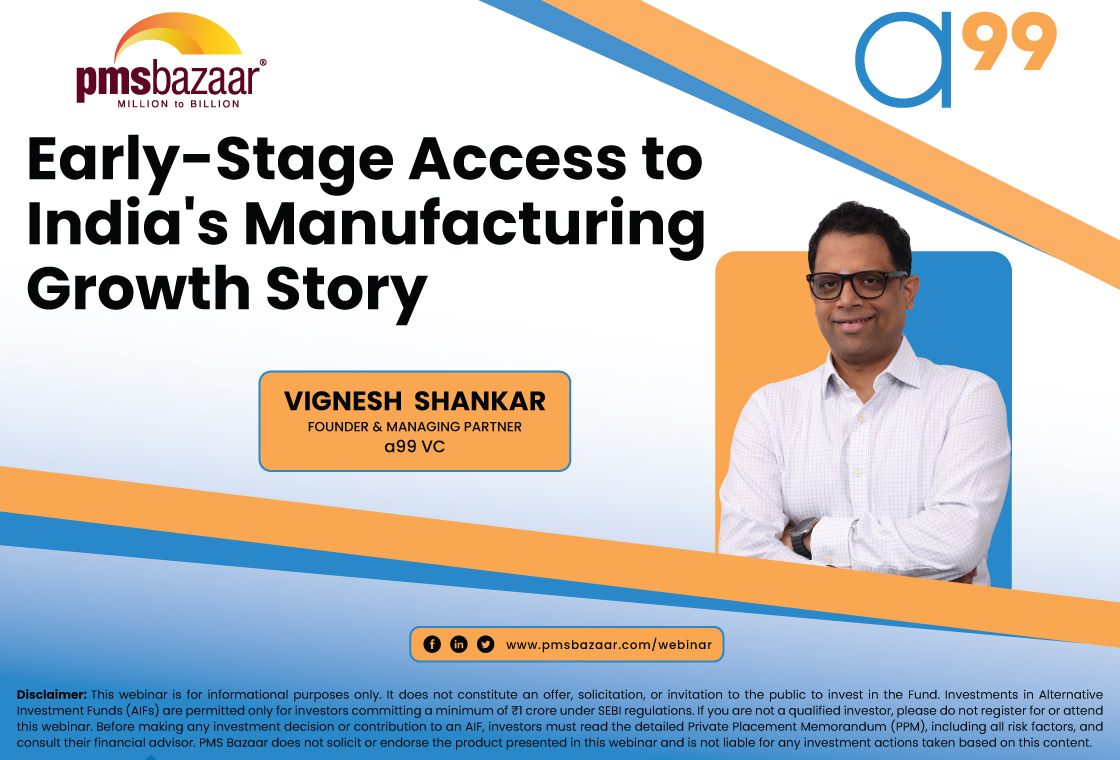
The webinar blog covers insights from Mr. Vignesh, which includes, his insights into India’s emerging manufacturing and infrastructure-led growth story and A99’s investment strategy. It explored why these sectors are becoming critical to India’s economic future, the funding gaps faced by manufacturing entrepreneurs, the role of AI’s physical infrastructure, and A99’s approach to identifying scalable, innovation-driven businesses positioned to benefit from India’s long-term industrial transformation.
Key aspects covered in this webinar blog are
- The strategic shift in India’s economic engine
- Historical context and current advantages
- The genesis of A99: A fund focused on tangible value
- Why manufacturing offers stability
- A99’s future thesis: The three pillars of growth
- IP and R&D-driven manufacturing
- The "shovel" strategy
- Digital disruption of shop floors
- The physical layer as a strategic necessity
- From macro vision to micro execution
- Scaling A99: Fundraising and portfolio management
- Diligence and the role of human expertise
- Addressing the "hockey stick" and long-term stability
- Investor conviction and portfolio allocation
- India’s industrial transformation: The road ahead
Summary: Mr. Vignesh Shankar highlighted India’s transition toward becoming a $35 trillion economy, emphasizing that manufacturing and infrastructure must drive future growth as the IT sector faces slower expansion due to AI disruption and limited R&D. He outlined India’s ambitions to significantly expand manufacturing and infrastructure output, supported by government initiatives and the China-plus-one strategy. Explaining A99’s focus, he noted a funding gap in manufacturing despite its stability and asset-backed nature. A99’s investment strategy centres on IP-driven manufacturing, enabling industries, Industry 4.0 technologies, and AI’s physical infrastructure layer. He stressed sustainable growth, rigorous diligence, and long-term opportunities in India’s industrial transformation.
Mr. Vignesh Shankar started the session by explaining the driving force behind A99 and shared his comprehensive perspective on the burgeoning opportunities within India's manufacturing and infrastructure sectors. He commenced the session by offering a candid reflection on the economic landscape, noting that while India’s growth to a nearly $4 trillion economy was largely propelled by the IT and ITES sectors, the future trajectory toward a target of $35 trillion necessitates a robust, multifaceted approach where manufacturing and infrastructure must play a foundational role.
The Strategic Shift in India’s Economic Engine
Mr. Vignesh emphasized that the IT and ITES sectors are undergoing a significant rediscovery phase, wherein the exponential growth experienced over the last two decades is unlikely to be replicated due to the disruptive influence of AI and a lack of sustained R&D. Consequently, he argued that for India to achieve its ambitious economic goals, it must rebalance its economic structure by aggressively strengthening the manufacturing and infrastructure segments. He highlighted that the current outlay from both the government and large private conglomerates into these sectors is substantial, underscoring a collective recognition of this necessity.
According to Mr. Vignesh, the data tells a compelling story. India currently aims to escalate its manufacturing output from approximately $532 billion to at least $8 trillion, and its infrastructure capacity from $200 billion to $2.5 trillion. He pointed out that January 2026 marked a record high for India’s Purchasing Managers' Index (PMI), signaling that not only is growth a necessity, but the green shoots of this transformation are already firmly visible in the public markets.
Historical Context and Current Advantages
Reflecting on history, Mr. Vignesh noted that India has traditionally been an agri-based economy that transitioned into a service-led one. While manufacturing has always existed, he described it as historically "boring" and largely a quiet performer compared to the glamour of the IT sector. However, he expressed strong conviction that this narrative is set to be disrupted. He outlined several key advantages that India possesses today—advantages that have not converged so strongly in the past. These include a sustained government focus with a 10-12% CAGR factored into budgets, the development of manufacturing clusters across previously untapped regions like Orissa and the Northeast, and the strategic "China plus one" initiative. Mr. Vignesh shared that he had personally been involved in facilitating $5 billion worth of manufacturing opportunities transitioning from China to India in his professional past.
The Genesis of A99: A Fund Focused on Tangible Value
Mr. Vignesh provided an engaging narrative regarding the inception of his fund, A99. Initially, the team intended to follow a conventional approach, exploring multiple sectors. However, they soon recognized a stark imbalance in the investment ecosystem. In the tech and SaaS sectors, they observed an abundance of venture capital chasing a limited number of high-valuation deals, often leading to overpayment and subsequent business struggles.
Conversely, when A99 surveyed the manufacturing landscape, they found that brilliant, experienced professionals—such as general managers at major industrial firms—faced a chronic lack of early-stage risk capital. Unlike the tech sector, where ideas on "paper napkins" could secure significant funding, those wishing to build hard-asset products in manufacturing were often forced to rely on personal savings or pledge family assets. Furthermore, data analysis revealed that over the decade leading up to 2024, only a minuscule fraction of total VC and PE capital flowed into core manufacturing and infrastructure, creating a massive funding vacuum between the seed and growth stages.
Why Manufacturing Offers Stability
Addressing why investors should consider this shift, Mr. Vignesh highlighted the inherent resilience of manufacturing businesses. He explained that when funding a manufacturing founder, capital is primarily deployed toward assets and machinery, which are essential for production and revenue generation. Should such a business encounter difficulties, there is a level of recoupability from those physical assets. This contrasts sharply with tech investments, which predominantly fund human capital and salaries—assets that cannot be recouped if a business fails. Furthermore, he noted that the market is beginning to recognize the value of hard-asset businesses, citing that Nifty Manufacturing and Nifty Infrastructure indices have consistently outperformed others, delivering superior returns even in challenging market conditions.
A99’s Future Thesis: The Three Pillars of Growth
Looking ahead, Mr. Vignesh detailed A99’s strategic evolution. Having successfully deployed their previous fund and achieving a 3.05X multiple on invested capital (MOIC), the firm is now launching a larger fund, with check sizes increased to between 30 and 100 crores. This, he explained, allows founders to focus on business growth rather than being forced to raise capital again in short intervals.
He outlined the firm's revised, three-pillar investment thesis:
- IP and R&D Driven Manufacturing: A99 is moving away from low-margin "build-to-print" models, which lack customer stickiness and are vulnerable to price competition. Instead, they are prioritizing businesses with 25-30% gross margins, built on a foundation of proprietary IP and significant R&D, ensuring long-term value.
- The "Shovel" Strategy: Recognizing that capital-intensive projects like Semicon fabs are beyond the scope of a single fund, A99 adopts a strategy of investing in the "multiple small wheels" that power these larger projects—such as ceramic suppliers for nuclear SMRs or purification technologies for semiconductors.
- Digital Disruption of Shop Floors: Mr. Vignesh emphasized that to remain globally competitive, India must digitally transform its manufacturing processes. Implementing Industry 4.0 and 5.0—including robotics, IoT, and analytics—is no longer optional but a critical necessity for achieving the cost efficiencies required to compete with global manufacturing giants.
Mr. Vignesh stated that while AI has become a common topic of inquiry for investors, A99 believes the greatest potential for AI lies in its application within the physical manufacturing layer. By staying focused on these tangible, high-growth strategies, A99 aims to continue its success in this exciting, multi-decadal growth story for India.
Mr. Vignesh posited that while the world often fixates on software capabilities, AI is fundamentally dependent on a tangible, physical layer. Without the support of data centers, robust power supplies, advanced compute power, and high-capacity hard drives, AI cannot function. He noted that even global titans like SpaceX are exploring ways to leverage space to meet the immense physical demands of AI data centers.
The Physical Layer as a Strategic Necessity
Mr. Vignesh stressed that in the Indian context, the primary challenge is establishing this physical foundation before AI can effectively compute at scale. While initiatives like Sarvam AI—India’s effort to develop its own Large Language Model—are commendable, he argued that their ultimate success is constrained by the underlying physical infrastructure. Consequently, A99 has adopted a clear investment thesis: if a company operates within the physical infrastructure layer of AI, it is a primary point of interest. Mr. Vignesh reaffirmed that since there is no AI without hardware, A99 remains committed to backing the producers of that hardware.
From Macro Vision to Micro Execution
Mr. Vignesh acknowledged that while discussing macro-level economic trends is straightforward, the true test lies in micro-level execution. He explained that A99 identifies growth segments within India's manufacturing sector—specifically those expanding at rates exceeding 8%—and applies its four-pillar thesis (IP-driven manufacturing, the "shovel" strategy, Industry 4.0, and the physical AI layer) to each. By analyzing data at a granular level, the team translates high-level visions into a specific, actionable deal pipeline. Currently, this pipeline includes opportunities in power electronics, data center infrastructure, nanotechnology membranes for green hydrogen, and defense data subsystems.
Scaling A99: Fundraising and Portfolio Management
Reflecting on the firm's recent fundraising success, Mr. Vignesh expressed pride in A99’s trajectory. With a goal of a 1,000-crore fully committed fund, the firm launched its fundraising efforts in March 2026. Within just 60 to 70 days, they successfully achieved a first close of 170 crores and set an ambitious target to reach 500 crores by the end of June 2026. Mr. Vignesh attributed this momentum to the immediate nature of the investment opportunity, emphasizing that they are moving quickly to ensure they do not miss "early triggers," a mistake he cited regarding past missed opportunities like Sedamac.
Diligence and the Role of Human Expertise
Addressing concerns regarding data limitations in venture investing, Mr. Vignesh explained that A99 employs a rigorous four-level diligence process—financial, commercial, legal, and forensic—before any deal is even presented to the Investment Committee. He highlighted the strength of his team, which comprises seasoned professionals with deep industrial experience, including alumni from the Murugappa Group and Stanley Black & Decker. Furthermore, the team is supported by a board of accomplished advisors, including former leaders from the CII and veterans of the banking and manufacturing sectors, who provide the critical market intelligence necessary to keep the firm grounded.
Addressing the "Hockey Stick" and Long-Term Stability
During the interactive session, a participant raised a common VC dilemma: the "hockey stick" growth profile of SaaS companies versus the more methodical, time-consuming scaling of manufacturing. Mr. Vignesh responded by reasserting his belief in the resilience of manufacturing. He argued that while SaaS scaling may offer explosive growth, it often involves a high degree of uncertainty. In contrast, manufacturing projects are built on clear customer needs and structured processes. He emphasized that he does not require a "hockey stick" to deliver returns; rather, he seeks sustainable, predictable growth.
Regarding the risk-reward profile, Mr. Vignesh clarified that he views investments not in rigid categories of "winners" or "losers," but as equal-opportunity players. He noted that performance can fluctuate rapidly, and a currently "flat" business may ultimately outperform others in the long run. When asked about his own conviction, Mr. Vignesh candidly revealed that 80-90% of his own liquid net worth is committed to his fund. He concluded by advising that for a balanced portfolio, investors should ideally allocate approximately 20% to risk capital, such as private equity and venture capital opportunities, to capture the upside of India’s industrial transformation.
Mr. Shankar covered all the topics mentioned above in-depth and answered questions from the audience toward the end of the session. For more such insights on this webinar, watch the recording of this insightful session through the appended link below.
Get access to rich data and analytics of PMS & AIF by subscribing to us. Join the 90000+ investors & experts: Subscribe NOW
Disclaimer: The content shared in this blog is for informational and educational purposes only and should not be construed as an offer, solicitation, or recommendation to invest in any Alternative Investment Fund (AIF). As per SEBI regulations, AIF investments are allowed only for investors with a minimum commitment of ₹1 crore. Prospective investors are strongly advised to carefully review the Private Placement Memorandum (PPM), including all associated risk factors, and seek independent financial advice before making any investment decision. PMS Bazaar neither endorses nor recommends any specific fund or product mentioned herein and is not responsible for any investment decisions made based on this content.
Recent Blogs
PMS Performance : 401 Equity PMS Beat the Nifty 50 TRI
September 2026 saw global markets grapple with persistent macroeconomic uncertainty, as rising U.S. bond yields, crude oil prices above $90 per barrel and escalating Middle East tensions kept investors on edge. Concerns over renewed inflationary pressures and tighter financial conditions continued to shape market sentiment. The reported 25-basis-point Federal Reserve rate hike, bringing rates to 3.75–4.00 per cent, added another dimension to the evolving global outlook.

When Market Direction Is Uncertain, Can Arbitrage Add Stability to Client's Portfolio?
PMS Bazaar recently organised a webinar titled “When Market Direction Is Uncertain, Can Arbitrage Add Stability to Client's Portfolio?” which featured Mr. Sandeep Tyagi, Founder & Chairman, Estee Advisors and Mr. Shubham Goyal, Director, Strategy, (Principal Officer and Fund Manager - I-Alpha), Estee Advisors Pvt. Limited. This blog covers the important points shared in this insightful webinar.
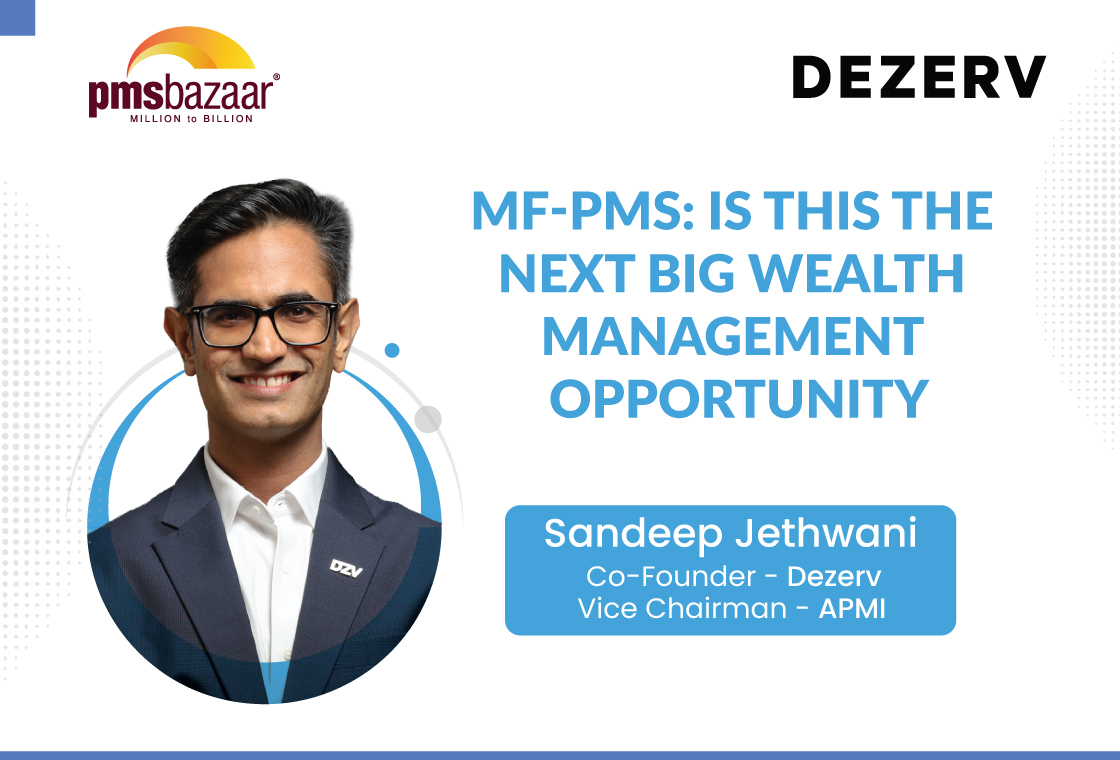
MF-PMS: Is This the Next Big Wealth Management Opportunity
PMS Bazaar recently organised a webinar titled “MF-PMS: Is This the Next Big Wealth Management Opportunity,” which featured Mr. Sandeep Jethwani, Co-Founder, Dezerv & Vice Chairman, APMI.

PMS Performance: Over 94% of Tracked Strategies Beat Nifty 50 TRI
Global markets remained under pressure in August 2026 as geopolitical tensions, rising bond yields and elevated crude oil prices kept investors cautious.

The Next Alpha Cycle: How Should Investors Position ‘Alternatives’ in Their Portfolios?
PMS Bazaar recently organized a webinar titled “The Next Alpha Cycle: How Should Investors Position ‘Alternatives’ in Their Portfolios,” which featured Mr. Akhil Chaturvedi, ED & CBO, Motilal Oswal AMC. This blog covers the important points shared in this insightful webinar.
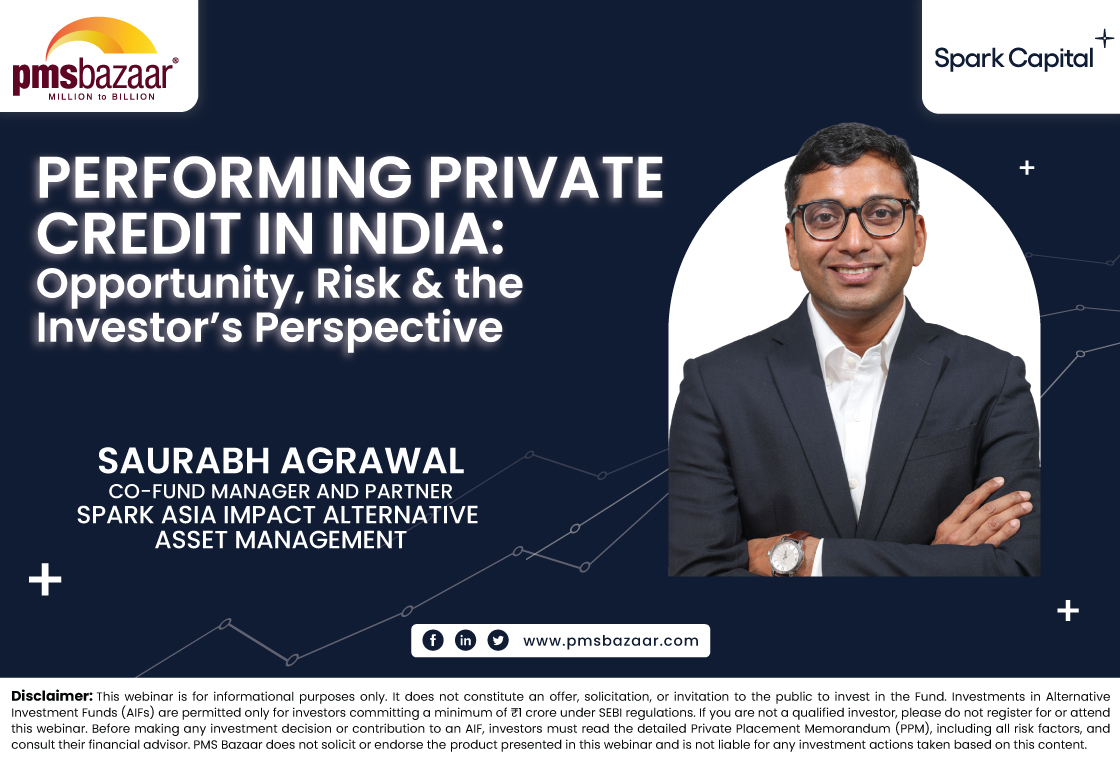
Performing Private Credit in India: Opportunity, Risk & the Investor’s Perspective
PMS Bazaar recently organised a webinar titled “Performing Private Credit in India: Opportunity, Risk & the Investor’s Perspective,” which featured Mr Saurabh Agrawal, Co-Fund Manager and Partner, Spark Asia Impact Alternative Asset Management.
GIFT City IFSC: India's Emerging Hub for Global Finance
PMS Bazaar recently organized a webinar titled “GIFT City IFSC: India's Emerging Hub for Global Finance,” which featured Mr. Bharath Shivappa, President & Chief of Markets, Gujarat International FinanceTec-City. This blog covers the important points shared in this insightful webinar.
PMS Performance: Who Outperformed in July 2026?
July 2026 was another month marked by uncertainty, with market performance shaped by evolving global cues and shifting investor sentiment. Despite the uncertain environment, equity PMS strategies continued to present opportunities, with several managers delivering returns ahead of the broader market benchmarks.